In Tokushima Prefecture, the word Awa-ai, or Awa indigo, has a precise meaning. Tokushima Prefecture explains that sukumo is a natural indigo dye made by fermenting the dried leaves of the indigo plant, and that the sukumo made in Tokushima is what is called Awa indigo. Cloth is not dyed with the leaves themselves but with a dye liquid prepared from sukumo.
In the Edo period this dye came to dominate the national market. This article follows it from the Yoshino River fields to distant dye houses, and on to its modern decline and preservation.
A crop shaped by the river
The Yoshino River flows from west to east across northern Tokushima. According to the prefecture, it had no embankments in the past, and in the typhoon season heavy rain made it flood almost every year.
Typhoons often came before the rice harvest, so rice farming carried a high risk of loss. Indigo, harvested before the typhoons arrived, suited the land better.
The floods were very dangerous for local people. Yet the prefecture notes that they also carried fertile soil into the fields after the harvest, making it possible to plant indigo on the same land year after year.
The Japan Heritage story for Awa indigo adds that the irrigation technology of the time could hardly draw water from this unruly river, so little rice was grown in the basin.
Early records
Interpretations differ
When indigo growing began in Awa is not certain, and accounts differ.
Interpretations differ
The prefecture states plainly that the origin is unclear. The Japan Heritage story says cultivation began at the end of the Heian period. Aizumi Town's museum says it is said to have begun in the Heian period, to dye cloth woven by the Awa Inbe clan in the mountains.
Firmer evidence comes from 1445. The prefecture points to a shipping entry for indigo in the Hyōgo Kitazeki port register of that year. From it, Awa indigo is thought to have been already produced and traded in the Muromachi period.
Aizumi Town describes the same year as one in which a large quantity of leaf indigo was shipped to the Kinai region around Kyoto. The Tokushima Prefectural Museum also says cultivation can be confirmed back to the Muromachi period.
According to Aizumi Town, demand rose in the Sengoku period because warriors wanted their under-armour clothing dyed with indigo. The town adds that the processing of indigo balls became full-scale at Shōzui, the castle town of the Miyoshi family. The Japan Heritage story is more cautious, saying that in the late Muromachi period indigo is said to have been processed into dye at Shōzui.
The domain and the national market
According to the Tokushima Prefectural Museum, Toyotomi Hideyoshi gave Awa to Hachisuka Iemasa in 1585, and the Hachisuka ruled Awa and Awaji until the Meiji Restoration. Aizumi Town says the domain encouraged indigo production from 1585 and built its finances on taxes collected from indigo makers and merchants.
The prefecture gives three reasons for Awa indigo's growth. Cotton came to be grown around Osaka, raising demand for indigo, which suits cotton.
The domain's protection led to better techniques and higher quality. Third, Tokushima's geography and climate suited the crop.
The prefecture says that by the 1700s Awa indigo had come to dominate the national market.
The Japan Heritage story credits a man named Inubushi Kyūsuke with improving the processing technique. Awa dye became known as hon-ai, "true indigo," and merchants with sales privileges brought the domain enormous profits.
The prefectural museum states that the domain's monopoly policy allowed Awa indigo to dominate the national market. The national cultural property record says that by the late Edo period it had surpassed other producing areas.
From leaf to sukumo
The museum divides the work into four stages: sowing, drying the leaves, making sukumo, and pounding it into indigo balls. Sowing took place around Setsubun in the first month of the lunar calendar. After the harvest in the sixth and seventh months, the chopped leaves were dried.
In the eighth month the leaves were piled up to ferment evenly. The finished sukumo was pounded in mortars into balls, and around the eleventh month it was shipped across Japan.
Fermentation takes place in a shed called a nedoko. The Japan Heritage story describes the piled leaves being watered and stirred repeatedly from autumn into winter, rising above 60°C and filling the shed with steam and a sharp smell.
Heat and smell show how the work is going, and by the first frost the leaves have become sukumo, like lumps of black earth. The prefecture puts the whole process at nearly a year, including about 100 days of fermentation under careful temperature control.
Because the pigment does not dissolve in water, dyers ferment sukumo for about a week with an alkali such as lime or wood-ash lye. When dipped cloth is exposed to air, the pigment reacts with oxygen and is fixed; rinsing then brings out the blue.
Merchants and their networks
Awa indigo reached the rest of Japan through its merchants. The prefectural museum notes that many powerful merchants handled everything from production to sale. Families holding sales rights for Kantō and Osaka, such as the Kujime, Miki, Nishino, Tanaka and Okumura, were known as great merchants, and a curator explains that such sales organizations existed in Edo, Osaka and elsewhere.
Their traces survive in stone. At the Kotohira Shrine in Seimichō, Tokushima City, a large lantern bears the words "domain-produced indigo balls, shipped to Osaka."
Its side is dated to an auspicious day in the third month of Tenpō 10 (1839), by the lunar calendar. Other offerings in the city name merchant groups trading toward today's Fukuoka and Ōita, and from Hyōgo to Kyoto.
The Tezuka family of Kokufu village had a branch in Edo and sold indigo across the Kantō region. Most of its 951 surviving documents are loan bonds from dyers who bought its indigo balls. In one, dated 1813, a dyer in Ashikaga borrowed 300 ryō, apparently because he was short of money to pay for indigo balls.
Another merchant, the Inoue family of Komatsushima, had branches in Suruga. Its sales ledger lists 171 trading partners, mainly in Suruga, many of them thought to be dyers.
The Japan Heritage story says merchants built grand residences and entertained visiting buyers lavishly to win their trust. It adds that they often invited puppet troupes, helping Awa puppet theatre flourish.
The prefectural museum also notes that the domain's farmers bore heavy annual taxes and were controlled under a strict status system.
Decline and preservation
The prefecture says the prosperity continued through the 1800s, and the area under indigo in Tokushima reached its peak of about 15,000 hectares in 1903. After that, imports of precipitated indigo from India and synthetic indigo from Europe grew, and production fell sharply. Aizumi Town links the decline to large imports of chemical dyes from Germany in the Meiji 30s (1897–1906).
The skill survived. On 9 May 1978 the state selected Awa indigo making as a Selected Conservation Technique. Its record notes that good sukumo had become hard to obtain and that indigo other than Awa indigo was almost impossible to find.
In 2019 nine municipalities in Tokushima, led by Aizumi Town, were recognized for the Japan Heritage story "Home of Indigo, Awa." The prefecture says indigo makers called aishi still produce Awa indigo, which makes up most of Japan's output.
Places to visit
Aizumi Town History Museum "Ai no Yakata."* The 13 buildings of the former Okumura residence, a major indigo merchant family, and about 130,000 family documents were given to the town in 1987; the museum opened in 1989. The nedoko shed displays tools used to grow and process indigo, and the museum holds 93 such tools designated by the state. Paper dolls show 24 scenes from sowing to shipping.
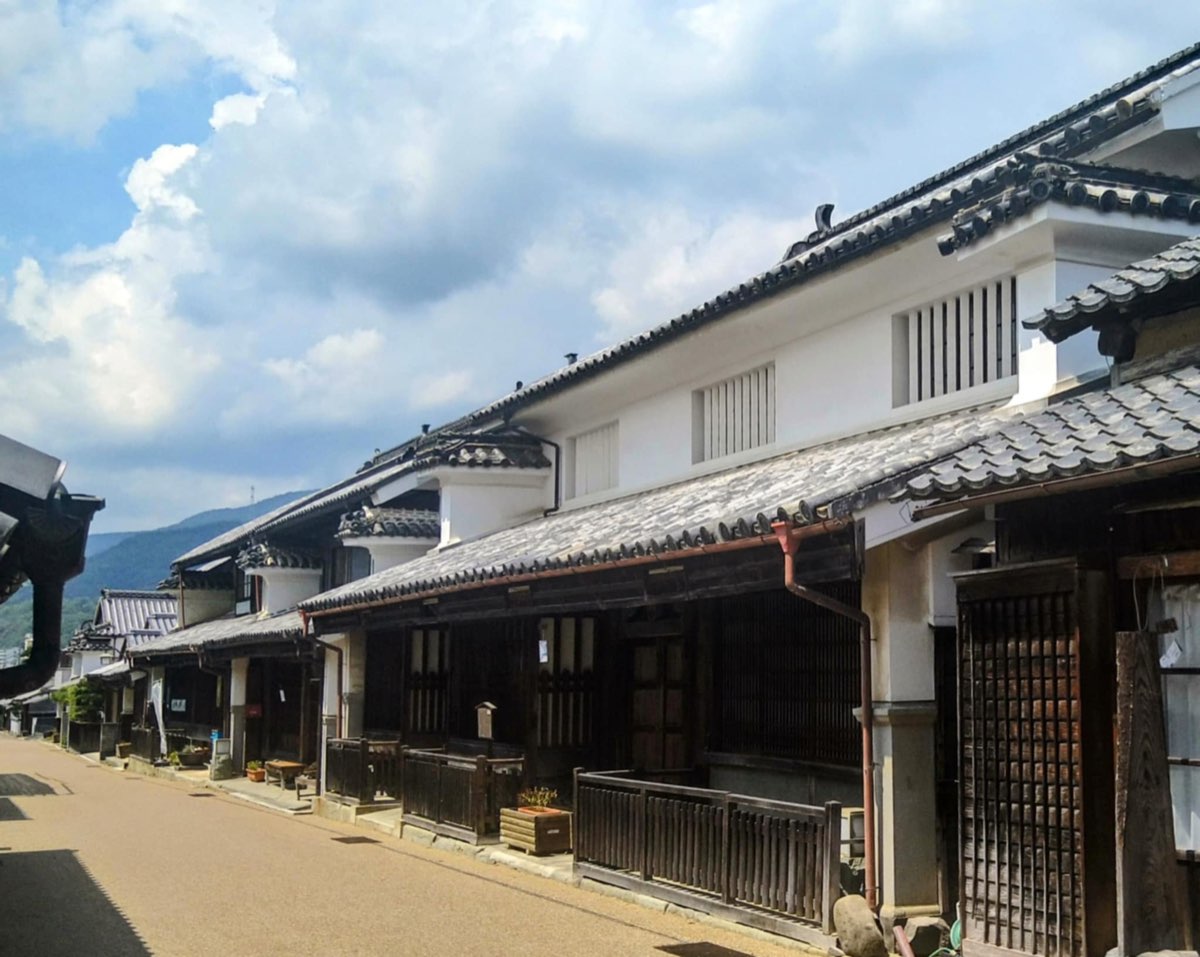
Wakimachi Minami-machi, Mima City.* On the north bank of the Yoshino River, this merchant town prospered from the Edo period as a collection point for Awa indigo. Townhouses from the early 18th century onward stand under heavy tiled roofs with decorative udatsu walls. It became an Important Preservation District for Groups of Traditional Buildings in 1988.
Check opening hours on each official website before visiting.
Sources
- 阿波藍Tokushima Prefecture
- 徳島県立博物館 常設展示 5 藩政のもとでTokushima Prefectural Museum
- 探してみよう!!藍商人活躍の足跡Tokushima Prefectural Museum
- 阿波藍商 手塚家資料Tokushima Prefectural Museum
- 「正雪紺屋」で使われた阿波藍-阿波と駿河を結ぶ藍-Tokushima Prefectural Museum
- 藍のふるさと 阿波~日本中を染め上げた至高の青を訪ねて~Japan Heritage Portal, Agency for Cultural Affairs
- 阿波藍製造Agency for Cultural Affairs, Government of Japan
- 令和元年度「日本遺産(Japan Heritage)」の認定結果の発表及び認定証の交付について(報道発表資料PDF)Agency for Cultural Affairs
- 藍の館Aizumi Town
- 建築美と歴史・展示室(藍の館)Aizumi Town
- 美馬市脇町南町(徳島県)重要伝統的建造物群保存地区の概要Mima City (published on the Agency for Cultural Affairs website)