Tokyo began as Edo, a small settlement below a castle. After Tokugawa Ieyasu arrived in 1590 it grew fast, and by the early eighteenth century estimates put its population at about one million.
This article follows Edo from Ōta Dōkan's castle to the shogun's capital, and then to the townspeople's world of books and prints. It relies on the Cabinet Office, the Agency for Cultural Affairs, the Tokyo Metropolitan Government, the National Diet Library, and the Tokyo National Museum.
Ōta Dōkan's castle
According to the Agency for Cultural Affairs, Edo Castle began in 1457, when Ōta Dōkan built a castle on the site of the Edo family's residence and called it Edo Castle. A Cabinet Office report describes Dōkan as the steward of the Ōgigayatsu branch of the Uesugi family.
The same report says the castle was well designed for war. Yet when Ieyasu arrived more than a century later, it had no stone walls, and only about ten thatched houses stood below it. The report adds, however, that recent research points out that Edo was already an important hub of trade in the Kantō.
Much of the land around it was low and marshy. When Ieyasu arrived, the report says, the castle had changed little since Dōkan's time and was not fit to be the seat of the most powerful lord under Hideyoshi.
The shogun's city
In 1590 the ruler Toyotomi Hideyoshi ordered Tokugawa Ieyasu to move from his lands in Mikawa, Suruga, and Tōtōmi to the Kantō. Ieyasu chose Edo as his base and entered it, by tradition, on the first day of the eighth month of the old calendar.
He had canals dug to drain the low ground and to carry goods by boat, and the first townspeople's quarters grew up along them. The Tokyo Metropolitan Government's chronology also records his entry into Edo Castle in 1590.
In 1603 Ieyasu became shogun and opened his government in Edo. From then on, Edo was no longer just the castle town of one lord: lords from all over Japan came to live there and built mansions, and the shogun's own retainers settled in Edo.
Merchants and craftsmen came to supply this huge warrior population, and the city grew quickly. In 1603, according to the Cabinet Office report, land was reclaimed from the sea for new streets, and the Nihonbashi bridge is said to have been built then; the Tokyo chronology also lists the first Nihonbashi under that year.
Castle building went on for decades, with lords across Japan obliged to contribute labor and materials. According to the Agency for Cultural Affairs, the main parts of the Honmaru and Nishinomaru, including the keep, were ready in 1607, the Ninomaru and Sannomaru in 1635, and the outer works, with their moats and stone walls, the following year.
The report describes the finished city as made up of three kinds of land: land for the warrior class, land for townspeople, and land for temples and shrines.
A city of about a million?
How large did Edo become? The figures are estimates. The Cabinet Office report gives them for the townspeople alone: about 150,000 in 1634, about 280,000 in 1657, about 350,000 in 1693, and about 500,000 in 1721.
Adding a warrior population of 500,000, the report reaches a total of about one million. By this estimate, it says, Edo was an exceptionally large city, even compared with the cities of Europe at the time.
Interpretations differ
The Tokyo Metropolitan Government's chronology gives a different figure. In its entry for a 1721 order to survey farmland and population across the provinces, it puts Edo's population at roughly 1.3 million. The "city of a million," then, is an estimate, and different sources give different totals.
Books for the townspeople
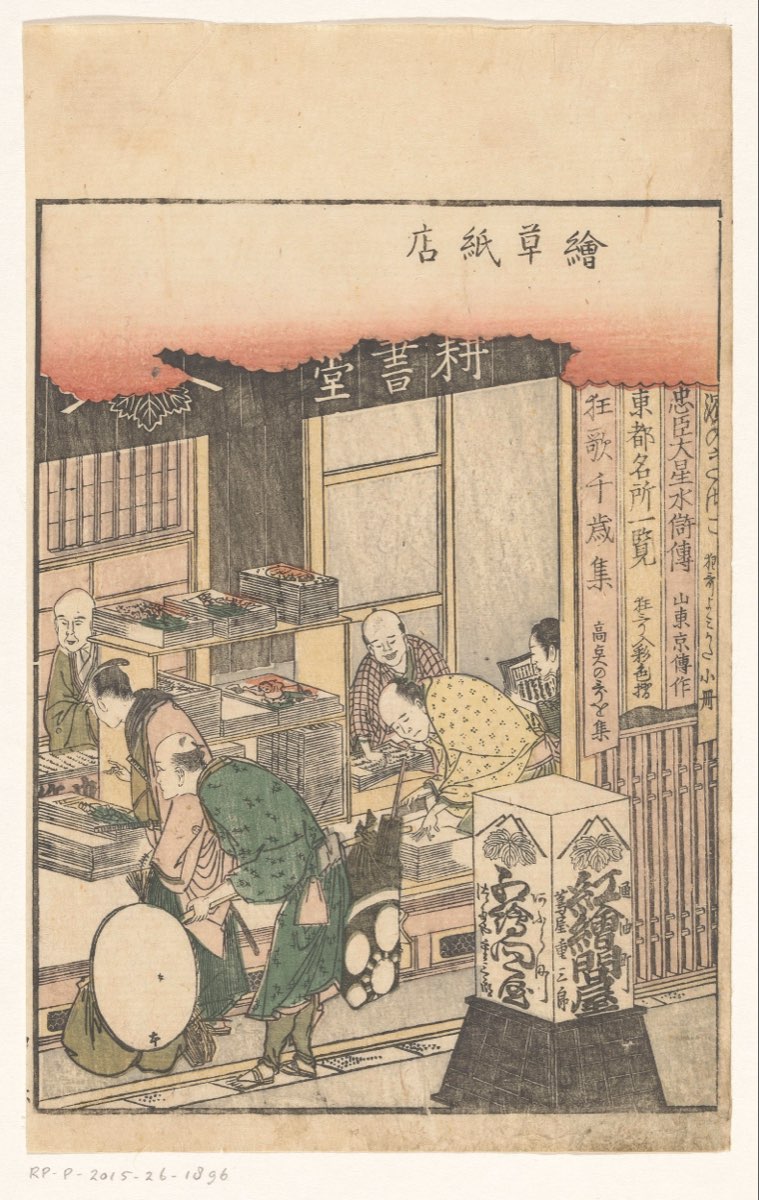
By the late eighteenth century, according to the National Diet Library, the life of Edo's townspeople had grown richer and culture was flourishing. The library tells this story through one publisher, Tsutaya Jūzaburō (1750–1797).
Tsutaya was born in 1750 in the Yoshiwara, the shogunate's licensed pleasure quarter. Around 1772 he began a book business near its main gate, a shop later called Kōshodō.
Both the library and the Tokyo National Museum say he started out in the book-lending trade. His publishing began with the Yoshiwara saiken, a guide to the quarter; he obtained the rights in 1775, and by early 1783 he alone was publishing it.
He then turned to jihon, popular books such as illustrated storybooks. Kibyōshi, illustrated comic stories woven with current events and satire, reached their peak in the Tenmei era (1781–1789).
Sharebon told stories set in the pleasure quarters, mostly through dialogue. According to the library, many of the writers who supported Tsutaya's early books were samurai who wrote fiction as a pastime.
In 1783 he moved to Tōriabura-chō in Nihonbashi, where leading publishers had their shops, and joined the ranks of Edo's major publishers.
In the same years a craze for kyōka, comic verse in the 31-syllable form of classical poetry, swept Edo. The Tokyo National Museum notes that it drew in people of many ranks, from samurai and townspeople to actors and artists.
Tsutaya joined a kyōka circle himself and published kyōka books. His illustrated kyōka books with pictures by Kitagawa Utamaro became well known, according to the library.
Reform and the turn to prints
The mood changed after 1787, when Matsudaira Sadanobu led the Kansei Reforms, which cracked down on extravagant customs and tightened discipline among samurai. Some samurai writers withdrew from fiction.
In 1791 three sharebon by Santō Kyōden, published by Tsutaya, were punished. According to the library, Tsutaya is said to have lost half his property and Kyōden to have been placed in handcuffs for 50 days.
From about the same year Tsutaya turned seriously to ukiyo-e prints. He published Utamaro's close-up portraits of women and, from 1794, the actor prints of Tōshūsai Sharaku, who is said to have made about 140 prints in just ten months.
Tsutaya died of illness in 1797. The library sums up his career as a rise, within one lifetime, from a lending-book business in the Yoshiwara to one of Edo's leading publishers, and calls him a fūunji, a bold figure who rode the changes of his age.
Visiting today
Parts of the Honmaru, Ninomaru, and Sannomaru enclosures of Edo Castle form the East Gardens of the Imperial Palace, open to the public since 1968. The Imperial Household Agency's guide shows the Tenshudai, the base of the castle keep, and admission is free. The gardens close on set weekdays and for court events, so check the agency's website before you go.
The Edo-Tokyo Museum in Sumida ward reopened on 31 March 2026 after about four years of large-scale renovation, according to a Tokyo Metropolitan Government press release and the museum's own website. Please check the latest official information before visiting.
Sources
- 重要文化財 旧江戸城田安門・清水門について(資料3-2)Agency for Cultural Affairs (document published by the Ministry of the Environment)
- 1657 明暦の江戸大火 報告書 第1章 明暦期にいたる歴史的背景Cabinet Office of Japan, Central Disaster Management Council (Expert Panel on the Transmission of Disaster Lessons)
- 東京都年表Tokyo Metropolitan Government
- 時代の風雲児・蔦屋重三郎(NDLギャラリー)National Diet Library
- 特別展「蔦屋重三郎 コンテンツビジネスの風雲児」プレスリリースTokyo National Museum
- The East Gardens of the Imperial Palace in TokyoImperial Household Agency
- 2026年3月31日 江戸東京博物館リニューアルオープン(報道発表)Tokyo Metropolitan Government
- 江戸東京博物館リニューアルオープン後 常設展示室来場者100万人を達成しました!Edo-Tokyo Museum