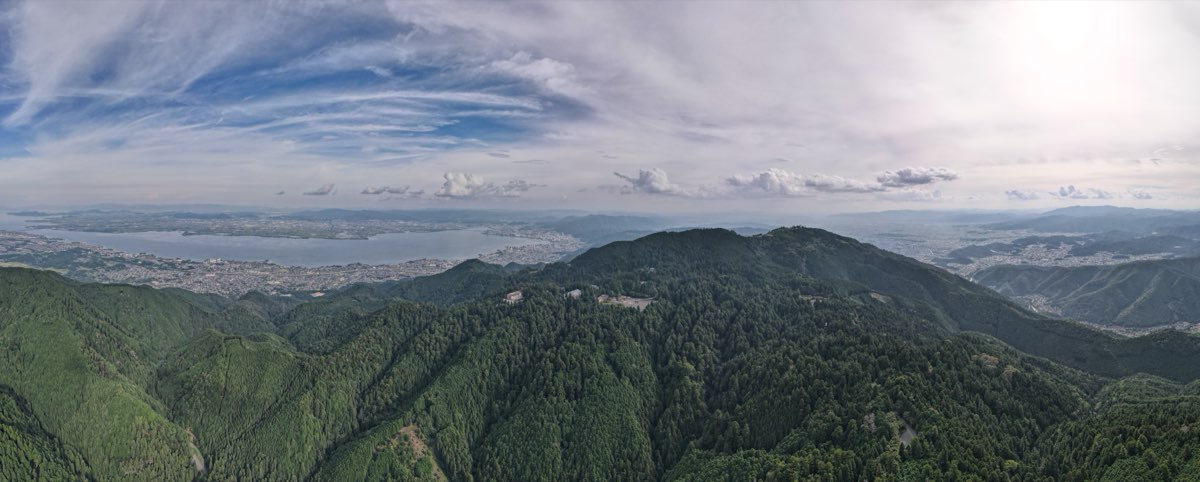
Mount Hiei rises above Sakamoto, a town on the western shore of Lake Biwa in today's Ōtsu, Shiga Prefecture. On the mountain stands Enryakuji, the head temple of the Tendai school of Buddhism. According to the temple, the name does not refer to a single building: it covers about a hundred halls and pagodas spread over 1,700 hectares of temple land, divided into three areas called the Tōdō (east), the Saitō (west) and Yokawa (north).
This article follows Enryakuji from its founding by the monk Saichō in the eighth century, through its centuries as a center of Japanese Buddhism, to its burning by Oda Nobunaga in 1571 and its rebuilding.
Saichō and the hall on the mountain
According to Enryakuji, Saichō was born at Mitsu on the western shore of Lake Biwa, today's Sakamoto, in 767 (other dates have also been proposed). He became a pupil at the provincial temple of Ōmi at the age of twelve and in 785 received the full precepts at Tōdaiji in Nara, becoming an officially recognized monk.
About three months later he left Nara and went into the mountains of Hiei to train. In 788 he founded a hall called Ichijō Shikan-in and carved a statue of Yakushi Nyorai, the healing Buddha, as its main image. This hall later became the Konponchūdō, the central hall of Enryakuji.
With the support of Emperor Kanmu, Saichō traveled to Tang China to study the teachings of the Tiantai (in Japanese, Tendai) school. The temple records that he also received teachings in Zen and in esoteric Buddhism there, and returned in 805.
On the 26th day of the 1st month of Enryaku 25 (806, lunar calendar), the court approved two official ordinations a year for Saichō's school, one for students of Tendai teaching and one for students of esoteric Buddhism. The Tendai school counts this day as its founding. Saichō based his teaching on the Lotus Sutra, which holds that all people can become Buddhas.
Saichō died in 822. Seven days later, the court allowed Mount Hiei to confer its own Mahayana precepts, which he had long requested. After his death the hall received the name Enryakuji from the emperor.
A mountain of learning
Saichō's successors expanded the temple. The temple writes that Ennin, the third head of the school, opened the Yokawa area and developed the Tōdō. In 866 Emperor Seiwa gave Saichō the title Dengyō Daishi and Ennin the title Jikaku Daishi, which the temple describes as the first such titles in Japan.
In the mid-Heian period, the eighteenth head, Ryōgen, rebuilt and improved the halls. His pupil Genshin wrote the Ōjōyōshū, a work that, according to the temple, laid the foundation for the later growth of Pure Land Buddhism in Japan.
From the end of the Heian period into the early Kamakura period, the founders of several later schools studied on Mount Hiei, among them Hōnen, Eisai, Shinran, Dōgen and Nichiren. The temple notes that for this reason Mount Hiei later came to be called the "mother mountain" of Japanese Buddhism.
At the foot of the mountain, the Hiyoshi Shrine in Sakamoto grew closely tied to the temple. The Agency for Cultural Affairs explains that in the Heian period the shrine developed as the protector of Enryakuji, as Shinto worship and Tendai Buddhism became intertwined.
The temple and its town
Enryakuji was not only a religious center. The Otsu City Museum of History explains that it produced many eminent monks and spread religious culture, including Buddhist art, but also held many estates and was active in economic life.
Its gate town, Sakamoto, grew with it. In the Muromachi period, according to the museum, transport workers who carried goods by horse and cart, and moneylenders, were active there.
The temple itself writes that during its history of more than 1,200 years it met many trials through clashes with powerful houses, warriors among them. Each time, it says, it was carried through by those who inherited Saichō's teaching and by the faith of many people.
The burning of 1571
In the 1570s Mount Hiei was drawn into the wars of the warlord Oda Nobunaga. The Fukui Prefectural Ichijōdani Asakura Family Site Museum writes that the Asakura of Echizen, who refused Nobunaga's order to submit, joined with the Honganji and Enryakuji against him. In 1570 the Asakura, allied with the Azai of Ōmi and the Ikkō ikki, sent troops to Sakamoto and held Mount Hiei.
On the 12th day of the 9th month of Genki 2 (1571, lunar calendar), according to the Otsu City Museum of History, Nobunaga advanced on Enryakuji and set fire to Sakamoto, the Hiyoshi Shrine and the halls on the mountain. The museum writes that the temple, which had opposed Nobunaga, suffered a devastating blow.
The Fukui museum describes the attack as a warning to others, aimed at the temple and shrine that had helped the Asakura the year before.
The Agency for Cultural Affairs records that the Hiyoshi Shrine, which through the medieval period had gained Buddhist buildings and more auxiliary shrines, was left in ruins by Nobunaga's attack.
After the burning, Akechi Mitsuhide built Sakamoto Castle, and the Otsu museum notes that Sakamoto came under the watch of warriors.
Rebuilding
The temple's recovery began in earnest in the time of Toyotomi Hideyoshi. According to the Agency, Hideyoshi's donations set off the rebuilding of the halls. The Otsu museum adds that the castle was moved to Ōtsu, and Sakamoto took shape again as a gate town.
The Hiyoshi Shrine was also rebuilt step by step. Its West Main Hall dates from 1586 and its East Main Hall from 1595, and both are now National Treasures.
The main halls were restored over the sixteenth and seventeenth centuries. The Agency dates the present Konponchūdō to 1640, while the temple says it was completed in 1642 on the orders of the shogun Tokugawa Iemitsu. Saichō's mausoleum at the Jōdoin is thought to date from about 1662 to 1666, and the Monjurō gate was rebuilt after a fire in 1668.
In the Edo period, the Otsu museum explains, Sakamoto was the gate town of a temple holding 5,000 koku. Monks chosen from the three areas headed its administration, and the retirement residences of Enryakuji monks, called satobō, lined the road to the Hiyoshi Shrine.
In 1994 Enryakuji was inscribed on the World Heritage List as part of the Historic Monuments of Ancient Kyoto, a property covering Kyoto, Uji and Ōtsu. According to Shiga Prefecture, it is the component of that property located in Shiga.
Places to visit
The Tōdō, where Enryakuji began, centers on the Konponchūdō, the temple's head hall, where the temple keeps the "inextinguishable Dharma light" before the main image. The hall is a National Treasure. As of 2026 it is under major renovation, so check the temple's website for what can be seen.
The Monjurō, a two-storey gate at the top of the main approach path up from Sakamoto, serves as the entrance to the Tōdō. The temple notes that a cable car links the Tōdō with Sakamoto.
The Otsu City Museum of History writes that Sakamoto still has the distinctive atmosphere of a gate town of Enryakuji and the Hiyoshi Shrine. At Hiyoshi Taisha, as the shrine is now called, the two main halls of 1586 and 1595 are National Treasures.
The museum itself displays a model of the approach to the Hiyoshi Shrine in the late Edo period, lined with satobō and with buildings enclosed by stone walls of Anōshū masonry. Check each official website for opening hours before visiting.
Sources
- 歴史|延暦寺についてEnryakuji (Tendai head temple, official site)
- 滋賀の世界遺産Shiga Prefecture
- 比叡とその山麓(テーマ展示)Otsu City Museum of History
- 延暦寺 慈眼堂Agency for Cultural Affairs (Cultural Heritage Online)
- 日吉神社境内Agency for Cultural Affairs (Cultural Heritage Online)
- 朝倉氏の歴史Fukui Prefectural Ichijodani Asakura Family Site Museum
- 概要|境内案内Enryakuji (Tendai head temple, official site)
- 東塔(とうどう)|境内案内Enryakuji (Tendai head temple, official site)
- 根本中堂改修見学会|比叡山体験Enryakuji (Tendai head temple, official site)
- 延暦寺根本中堂Agency for Cultural Affairs (Cultural Heritage Online, 国指定文化財等データベース)
- 延暦寺文殊楼Shiga Prefecture (滋賀県; text in Cultural Heritage Online, 国指定文化財等データベース)
- 延暦寺浄土院Shiga Prefecture (滋賀県; text in Cultural Heritage Online, 国指定文化財等データベース)
- 日吉大社西本宮本殿及び拝殿 本殿Agency for Cultural Affairs (Cultural Heritage Online, 国指定文化財等データベース)
- 日吉大社東本宮本殿及び拝殿 本殿Agency for Cultural Affairs (Cultural Heritage Online, 国指定文化財等データベース)