Before dawn on 17 January 1995, a strong earthquake struck directly beneath the cities of southern Hyōgo and northern Awaji Island. It took the lives of 6,434 people, and 3 people were listed as missing. The Cabinet Office describes the damage as the worst in Japan since the end of the Second World War.
This article follows the disaster through the records of the Cabinet Office, Hyōgo Prefecture, and the City of Kobe: the shaking, the fires, the long road to rebuilding, and how the disaster is remembered today.
5:46 a.m., 17 January 1995
The earthquake struck at 5:46 a.m. Its source lay beneath northern Awaji Island, at a depth of 16 kilometers, and its magnitude was 7.3. The figure was first given as 7.2 and was revised by the Japan Meteorological Agency (JMA) in 2001.
Intensity 6 was recorded in Kobe and Sumoto. A field survey by the JMA then found that the shaking had reached intensity 7 in parts of Kobe, Ashiya, Nishinomiya, Takarazuka, and northeastern Awaji.
According to the Cabinet Office, the JMA applied intensity 7 for the first time on 20 January 1995. The Kobe City Fire Bureau describes it as an earthquake that struck directly beneath a large city and recorded intensity 7, the highest level in the history of observation.
It was an inland earthquake. On northern Awaji, new movement was confirmed on the Nojima Fault. The JMA named it the 1995 Hyōgo-ken Nanbu Earthquake, and on 14 February 1995 the government decided to call the disaster the Great Hanshin-Awaji Earthquake.
Lives lost
According to the Fire and Disaster Management Agency's final figures of 19 May 2006, 6,434 people died, 3 were missing, and 43,792 were injured. Of the dead, 6,402 were in Hyōgo Prefecture, and 4,564 of them in the city of Kobe.
In a survey announced in December 2005, Hyōgo Prefecture re-examined the records of each person who died in the prefecture to remove double counting. Of the 6,402, the survey counted 5,483 deaths caused directly by the disaster and 919 disaster-related deaths. The prefecture explains that a disaster-related death is one found to have a substantial link to the disaster, for example through stress, and that this idea was first recognized after this earthquake.
The survey found that 72.57 percent of the direct deaths, 3,979 people, were caused by suffocation or crushing. The survey also found that 49.6 percent of those who died were 65 or older.
About 105,000 houses were completely destroyed and about 144,000 half destroyed. The final figures count 104,906 buildings completely destroyed, home to 186,175 households.
The 2026 White Paper on Disaster Management notes that the damage was concentrated in older buildings that did not meet the earthquake-resistance standards of the time. This led to laws and support for checking and strengthening buildings.
Transport and services broke down across the region. Viaducts of the Sanyō Shinkansen collapsed, and lines of 13 railway companies, including JR West, were cut. At their peak, about 2.6 million homes lost electricity and about 860,000 lost city gas.
Fire in Kobe
In Kobe, fires broke out at once. The Kobe City Fire Bureau records that fires started in at least 50 places right after the earthquake, and 109 had broken out by the end of the first day. All 118 emergency lines lit up almost as soon as the earthquake struck.
Fighting the fires was extremely hard. Fire hydrants could not be used, and collapsed buildings and broken roads blocked the way. Large fires spread in Hyōgo ward, where wooden houses stood close together, and in Nagata and Suma wards, where many factories made chemical shoes, a local industry.
In the ten days after the earthquake, 175 fires broke out in Kobe, as many as the city usually sees in two months. The fire bureau counts (as of February 1996) 7,386 buildings damaged by fire, 4,834 of them in Nagata ward.
The fire bureau also records that residents themselves fought fires. In the early stage, when the fire service could not reach everyone, people rescued many family members and neighbors with their own hands.
From shelters to new homes
According to the fire bureau, many ambulance calls also came from shelters housing more than 200,000 people, and for days ambulances were dispatched three to four times as often as usual.
At the end of January 1995, Hyōgo Prefecture decided in principle to provide temporary housing to everyone who wanted it. By 11 August 1995, all 48,300 temporary homes had been completed, and on 20 August Kobe City closed its evacuation shelters.
Rebuilding took years. About 18,000 public housing units for survivors, built directly by Hyōgo Prefecture, Kobe, and other bodies, were all completed by May 1999. On 14 January 2000, almost five years after the earthquake, the last residents left the temporary housing.
The city also lost people. By the census of October 1995, Kobe's population was about 97,000 lower than at the start of the year. Its population grew again in 1997, for the first time in three years.
Volunteers and new laws
People came from all over Japan to help. According to the Cabinet Office, volunteers from across Japan took part more than 1.3 million times in total (a cumulative count).
The experience changed the law. In 1995 the Disaster Countermeasures Basic Act was revised to include, for the first time, provisions on supporting volunteer activity. In 1998 a new law on non-profit activities listed disaster relief as one of its fields.
Also in 1998, the Diet passed the Act on Support for Reconstructing Livelihoods of Disaster Victims.
Remembering
In Kobe, the Monument for Remembrance and Reconstruction was set up in Higashi Yūenchi park on 16 January 2000. Beneath it, in a quiet "meditation space," plaques bear the names of people who died in the disaster.
Kobe City reports that 5,082 names were shown as of 16 January 2026. Beside the monument burns the 1.17 Light of Hope. Its flame was made from seed flames carried around the 10 cities and 10 towns hit by the disaster and flames sent from all 47 prefectures.
Each year the 1.17 Gathering is held in the park. For 17 January 2026, Kobe City's program listed the sharing of the Light of Hope and the lighting of lanterns from 5 a.m., and a silent prayer at 5:46 a.m.
Places to visit
The Disaster Reduction and Human Renovation Institution (DRI), in Chūō ward, Kobe, was established by Hyōgo Prefecture in April 2002 to pass on the experiences and lessons of the earthquake. Its exhibits include a film and a full-scale diorama of the damaged streets, objects from the disaster, and storytellers who share their own experiences.
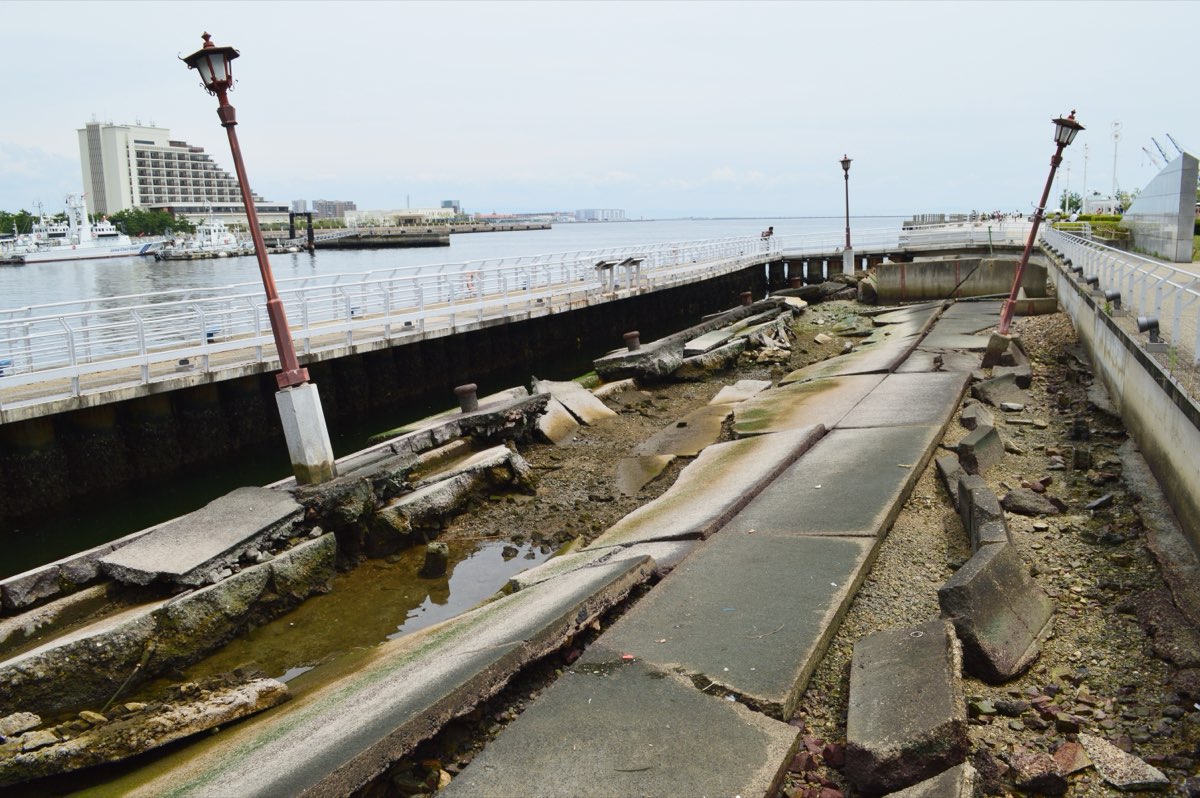
The Port of Kobe Earthquake Memorial Park, in the northeast of Meriken Park, opened in July 1997. It preserves about 60 meters of the damaged Meriken Wharf as it was after the earthquake. Its exhibits were renovated and reopened in January 2025.
The Monument for Remembrance and Reconstruction and the 1.17 Light of Hope are in Higashi Yūenchi park in Chūō ward, Kobe.
On Awaji Island, a stretch of about 185 meters of the Nojima Fault was designated a Natural Monument in 1998. Most of it was placed under a roof and opened in 1998 as a fault preservation museum; the designation text describes offset ground, drains and broken road paving inside. Today the Hokudan Earthquake Memorial Park runs the Nojima Fault Preservation Museum, where storytellers also talk about the disaster.
Opening hours and admission for all these places should be checked on their official websites.
Sources
- 阪神・淡路大震災の概要(阪神・淡路大震災教訓情報資料集)Cabinet Office (Disaster Management)
- 阪神・淡路大震災の被害確定について(平成18年5月19日消防庁確定)Hyogo Prefecture
- 阪神・淡路大震災の市町被害数値(平成18年5月19日消防庁確定)Hyogo Prefecture
- 阪神・淡路大震災の死者にかかる調査について(平成17年12月22日記者発表)Hyogo Prefecture
- 阪神・淡路大震災の概要Kobe City Fire Bureau
- 神戸市消防局の対応(阪神・淡路大震災)Kobe City Fire Bureau
- 阪神・淡路大震災被害の状況Kobe City Fire Bureau
- 阪神・淡路大震災教訓情報資料集 震災後の主な動き(年表)Cabinet Office (Disaster Management)
- 令和8年版 防災白書 特集 第1章 第2節 2-3 阪神・淡路大震災Cabinet Office (Disaster Management)
- 慰霊と復興のモニュメント/1.17のつどいボランティアCity of Kobe
- 阪神・淡路大震災1.17のつどいCity of Kobe
- 神戸港震災メモリアルパークCity of Kobe (Port and Harbor Bureau)
- About the DRI (Disaster Reduction and Human Renovation Institution)Disaster Reduction and Human Renovation Institution (人と防災未来センター, established by Hyogo Prefecture)
- DRI exhibitions - Re-experience the Earthquake (West 4F) and Memories of the Earthquake (West 3F)Disaster Reduction and Human Renovation Institution (人と防災未来センター, established by Hyogo Prefecture)
- 野島断層(天然記念物)Agency for Cultural Affairs (Cultural Heritage Online)
- 北淡震災記念公園|阪神・淡路大震災で現れた野島断層保存Hokudan Earthquake Memorial Park (北淡震災記念公園, the facility's own operating company)