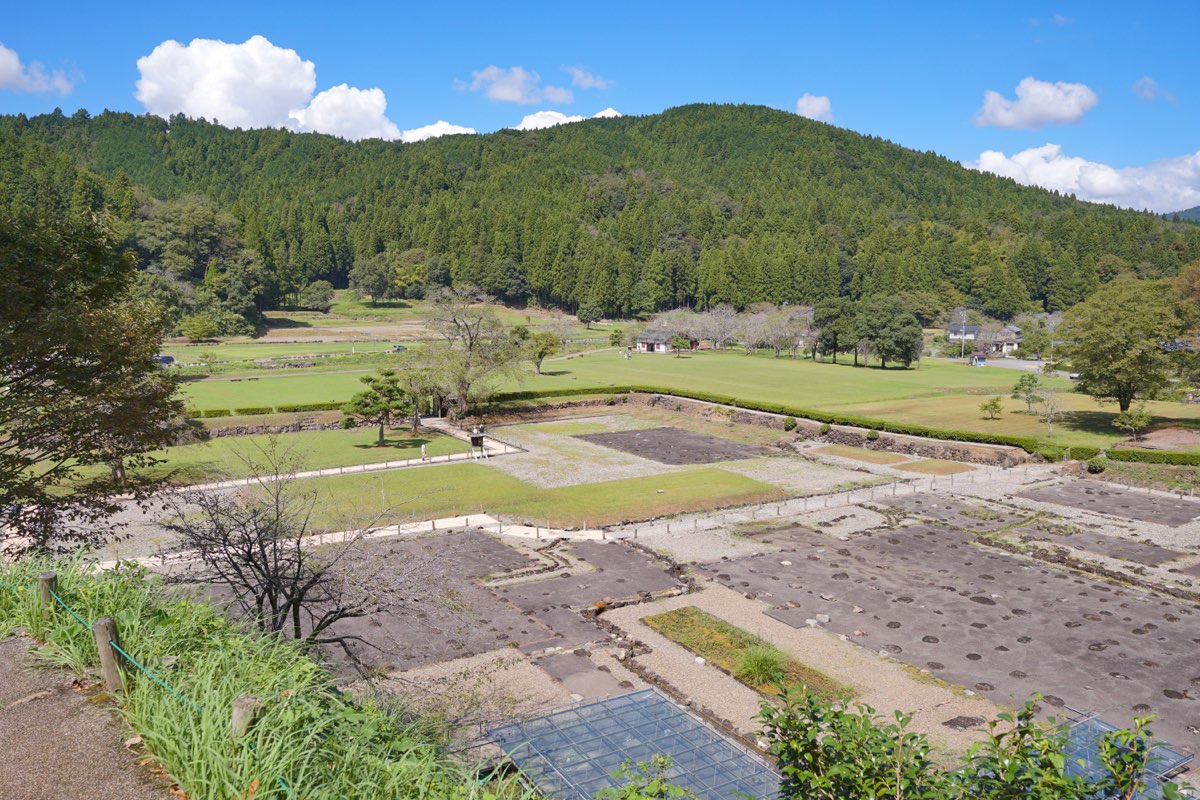
In a narrow valley in what is now Fukui City, the Asakura family built a residence and a castle town and ruled the province of Echizen from it for five generations. According to the Agency for Cultural Affairs, culture brought by people from Kyoto and Nara flourished there, and the town grew prosperous enough to be called the "little Kyoto of Hokuriku."
In 1573 the Asakura were defeated by Oda Nobunaga, and the town was burned. Its remains lay buried under fields until excavation began in 1967. This article follows the town from its rise to its destruction, and then to its rediscovery.
The Asakura come to Echizen
According to the Fukui Prefectural Ichijōdani Asakura Family Site Museum, the Asakura were a warrior family from Asakura-no-shō in Tajima Province, in today's northern Hyōgo Prefecture. Asakura Hirokage entered Echizen in 1337, following the Shiba family, who had been made governors of the province.
During the wars of the fourteenth century, Hirokage's son Takakage gained land rights in seven places in Echizen. One of them, Usaka-no-shō, contained the valley of Ichijōdani.
Interpretations differ
The museum infers from the family's branches and religious foundations that by the end of the time of Takakage's son Ujikage, who died in 1404, the Asakura already had their power base in the area from Ichijōdani to Tōgō.
Asakura rule over all Echizen came with the Ōnin War, which began in Kyoto in 1467. The museum explains that Asakura Takakage, counted as the first lord of the Ichijōdani line, first fought for the Western army in Kyoto. He returned to Echizen in 1468.
In the fifth month of 1471 he obtained a letter from the shogun Ashikaga Yoshimasa and took up arms on the Eastern side. By 1475, Echizen was under Asakura control.
The Agency for Cultural Affairs database dates Ichijōdani as the Asakura base from 1471, when the head of the family moved his residence there from Kuromaru Castle, and counts five generations over 103 years.
Takakage died in 1481. He left a set of seventeen house rules for his son and grandson. According to the museum, they include appointing people for their ability and loyalty rather than by inheritance, having senior retainers live together at Ichijōdani, and frugality.
A planned town in a narrow valley
In the Agency's description, the hills come close on the east and west, and a narrow strip of flat land runs along the Ichijōdani River, which flows north. The Agency calls this kind of landscape easy to defend and the site a typical example of a medieval stronghold built in such a place.
Excavation has shown that earthwork gates (kido) closed the town at its north and south ends. According to the Agency, the area between them, about 1.7 kilometers long, held the Asakura residence, samurai houses, temples, and the townhouses of craftsmen and merchants, all laid out to a plan. Residences with gardens stood at the foot of the hills, and forts and lookouts were built on the surrounding mountains.
The museum notes that the town was planned on a unit of 30 meters, or 100 shaku. Streets had right-angle turns, T-junctions and dead ends for defense. Townspeople's houses stood side by side on narrow plots facing the street, about 6 to 9 meters wide and 12 to 15 meters deep.
There were more than forty temples. Excavated houses include a dyer's workshop with rows of large Echizen-ware jars, and the homes of rosary makers, plasterers, metal casters and makers of bent-wood boxes.
In one area, parts of matchlock guns, lead metal and more than 300 lead bullets were found together, and the museum suggests that this was the house of a head craftsman working on guns.
At Abaka, where the town met the world outside, there was a river port with a landing place. In 1498 it was called "the inlet of Echizen, where the Chinese live." According to the museum, it seems to have been a trading town where imported Chinese goods were bought and sold.
The museum also writes that many nobles, monks, scholars and performers came down from Kyoto, which had been laid waste by war, and were received generously.
Under the fourth lord, Asakura Takakage (who shared the first lord's name), Echizen was never invaded from outside, and the museum describes this as the province's peak. Agriculture, fishing and crafts developed, and the town, its temples and the lord's residence are thought to have been improved. At a viewpoint in the site today, the museum invites visitors to picture a large city where 10,000 people lived.
Yoshikage, the future shogun and Oda Nobunaga
The fifth and last lord, Asakura Yoshikage, received Ashikaga Yoshiaki, the younger brother of the murdered shogun Ashikaga Yoshiteru. Yoshiaki stayed in Echizen for three years. In 1567 he moved to Ichijōdani, where Yoshikage lodged him at a temple, Anyōji, outside the southern gate.
In the third month of 1568, according to tradition, Yoshikage entertained Yoshiaki at the convent of Nan'yōji with a poetry gathering under the cherry blossoms. Yoshiaki, however, went on to rely on Oda Nobunaga, entered Kyoto with his backing, and became shogun.
Nobunaga ordered the Asakura to come to Kyoto and submit. The museum states that they refused, strengthened their border castles, and allied with the Honganji and Enryakuji temples against him. Four years of conflict followed, known as the Genki disturbances after the era name of 1570 to 1573.
The fall of 1573
In 1573 Yoshikage led his army out to help his allies, the Azai of Ōmi. On the retreat, at Tonezaka on the way back to Tsuruga, he suffered a heavy defeat. He returned to Ichijōdani and then, on the advice of his cousin Asakura Kageakira, moved to Ōno.
Nobunaga set up his camp at Ryūmonji in Fuchū and sent troops to destroy Ichijōdani. According to the museum, his advance forces set fire to the town for three days and nights, from the 18th to the 20th day of the 8th month (lunar calendar), and not a single building in the valley was left standing.
On the 20th, Yoshikage was surrounded by Kageakira's soldiers and took his own life. He was 41 by the traditional Japanese count.
His mother and his son were captured by Kageakira and handed over to Nobunaga at Fuchū. On the 26th they were put to death at Imajō. With this, the museum writes, the main line of the Asakura came to an end.
The museum records that the buildings of Abaka Kasuga Shrine burned when Ichijōdani was engulfed in flames. Its priests are said to have fled to Kai Province with the sacred object of worship, and the shrine was rebuilt in 1697 by the Matsudaira lords of Fukui.
In the first month of 1574, Ichijōdani was surrounded and taken by ikki forces, uprisings of people who, in the museum's words, had long suffered under warrior rule in Echizen, and the deputy governor (shugodai) Nobunaga had installed, Katsurada (Maeba) Nagatoshi, was defeated and died. According to the museum, Nobunaga's brief camp there in 1575 is its last record as a stronghold.
Merchants and religious institutions moved to Kitanoshō, the castle town of Shibata Katsuie, where streets such as Ichijō-machi were formed. Some of Ichijōdani's large temples were moved to the edges of Kitanoshō and remain there today.
A town under the fields
According to the Agency for Cultural Affairs, the burned town was buried beneath fields, keeping its layout almost unchanged. Excavation began in 1967.
In 1971, 278 hectares were designated a national Special Historic Site, and as of 2026 excavation and restoration have continued for more than fifty years. Four gardens became national Special Places of Scenic Beauty in 1991, and 2,343 excavated objects were designated Important Cultural Properties in 2007.
The museum states that this long excavation revealed, for the first time in Japan, a concrete example of a Warring States castle town. The garden of the Asakura residence had been completely buried and was found again after about 450 years.
The museum describes the residence of Yoshikage as the only Warring States daimyo residence in Japan that has been excavated and laid out for display. Its plot covered about 6,400 square meters.
Visiting today
The Fukui Prefectural Ichijōdani Asakura Family Site Museum opened in October 2022. Its exhibits are based on about 1.7 million excavated objects, and it includes a full-scale reproduction of part of the Asakura lord's residence.
In the valley, visitors can see the site of the Asakura residence and its gardens, and a district where a samurai house and streets have been reconstructed. The samurai house was built on 60 centimeters of fill laid over the excavated remains, after careful study of the materials, tools and techniques of the time.
The earthwork of the northern gate, 4 meters high and 38 meters long, also survives, together with the grave of the first lord, Takakage. Check the official website for opening hours before visiting.
Sources
- 一乗谷朝倉氏遺跡Agency for Cultural Affairs
- 一乗谷朝倉氏遺跡Agency for Cultural Affairs (Cultural Heritage Online)
- 遺跡散策Fukui Prefectural Ichijodani Asakura Family Site Museum
- 朝倉氏の歴史Fukui Prefectural Ichijodani Asakura Family Site Museum
- 遺跡のご紹介Fukui Prefectural Ichijodani Asakura Family Site Museum
- ご利用案内・観覧料/展示案内Fukui Prefectural Ichijodani Asakura Family Site Museum