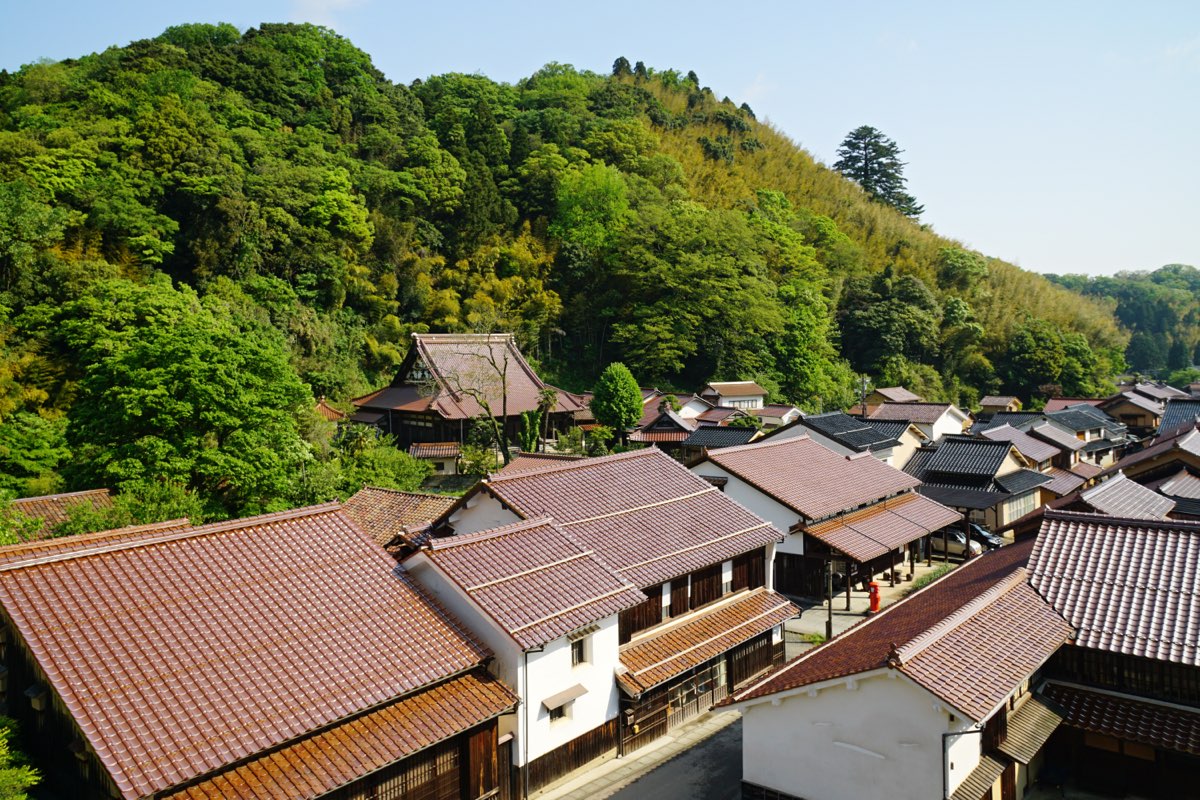
In the hills of Ōda City, in Shimane Prefecture, lies a mine that produced silver for about four hundred years. Shimane Prefecture describes Iwami Ginzan as a mine site representative of Japan. It was discovered in 1527 and worked until operations were suspended in 1923.
In July 2007, "Iwami Ginzan Silver Mine and its Cultural Landscape" was inscribed on the World Heritage List. According to the prefecture, it was the fourteenth World Heritage site in Japan and the first mine site in Asia to be inscribed. This article follows the mine from its discovery to the age of global trade, and then to the quiet landscape that remains today.
Discovery and a new way to refine silver
According to Shimane Prefecture, the mine was discovered in 1527 by Kamiya Jutei, a merchant from Hakata in northern Kyushu. Six years later, in 1533, a refining method called haifuki was introduced. Silver production at Iwami then began in earnest, and large amounts of silver were produced.
The Iwami Ginzan World Heritage Center, run by Ōda City, explains that haifuki reached Iwami from the Korean peninsula in 1533 and made it possible to produce high-purity silver in large quantities. In its statement of the site's value, the Agency for Cultural Affairs describes the method as an Asian technique that came from China by way of Korea. It says that Iwami improved it and combined it with a labour-intensive system of small-scale production done by hand.
At first the mine was under the control of the Ōuchi, a family of provincial military governors (shugo daimyo). Control then passed to the Mōri family, who held it for about forty years. In the Edo period it became land ruled directly by the Tokugawa shogunate.
Under the shogunate, magistrates and intendants sent by the shogunate ran the mine. The prefecture notes that silver output gradually stagnated while production costs rose, and conditions for running the mine grew worse.
Silver in a global economy
The World Heritage Center explains that from the mid-1500s, silver mined at Iwami had a large impact on the world economy. The warlords who controlled the mine used its silver in overseas trade.
One reason was demand from China, then ruled by the Ming dynasty. The Ming had created a system in which taxes were paid in silver, and it needed silver in great quantities.
According to the center, Japanese silver at first went directly to China, but leadership of the trade soon passed to Europeans. Portuguese merchants based in Macau bought raw silk in Southeast Asia, exchanged it for silver in Japan, and carried the silver into China. The center writes that the Portuguese called Japan the "kingdom of silver mines."
Interpretations differ
How large was Iwami's share of the world's silver? The sources give different figures, and they measure different things. The World Heritage Center says that, by estimate, at least 10 percent of all the silver traded in the world in the late 1500s came from Iwami Ginzan. A page by Shimane Prefecture's Cultural Properties Division, written before the World Heritage inscription, says that silver exported from Japan in the first half of the 1600s accounted for one third of the silver produced worldwide. It adds that much of that silver is said to have been from Iwami.
The Agency for Cultural Affairs states that in the Age of Discovery, from the sixteenth to the early seventeenth century, the great production of silver at Iwami brought important commercial and cultural exchange. It names the parties as Japan and the trading countries of East Asia and Europe. According to the World Heritage Center, the trade flourished until the early 1600s, when the shogunate restricted contact with other countries.
Modern revival and the end of mining
In the Meiji period, after Japan reopened to the world, the Osaka company Fujita-gumi carried out modern development, and the mine became busy again. The World Heritage Center says that Fujita-gumi obtained the mining rights in 1886.
The revival did not last. According to the prefecture, the business worsened, partly because of a fall in copper prices. Mining was suspended in 1923, ending some four hundred years of history as a mine.
The end of mining helped to preserve the site. According to the center, mining equipment and methods were modernized only in the late 1800s. Because the mine effectively closed in 1923, the archaeological evidence of traditional mining, smelting and refining was left as it was.
The Agency for Cultural Affairs makes a similar point. It says that the seclusion of the Edo period delayed the introduction of European technology. Together with the end of traditional production in the late nineteenth century, when the silver ore was exhausted, this left the traces of production in good condition.
A landscape of mines, towns, roads and ports
The World Heritage site is not only a mine. According to the Agency for Cultural Affairs, it is made up of three kinds of places: silver mine sites and mining towns, ports and port towns, and the roads that link them.
Together they represent the whole process of mining, from digging and refining the ore to carrying and shipping the silver. The site has fourteen components, including the Ginzan mine area, the site of the intendant's office, the town of Ōmori, the Kumagai Residence, the Rakan-ji Five Hundred Rakan, the ports of Tomogaura, Okidomari and Yunotsu, and two roads to the coast.
Much of this landscape is now green. The Agency notes that many traces of mines, refining sites, roads and port facilities survive almost as they were, and are again widely covered by forest. It adds that the mining town keeps traditional wooden buildings from the seventeenth to the twentieth century.
The World Heritage Center says that excavations have been made in some tunnels, production facilities and parts of the settlements. Many sites on the wooded slopes and valleys of Sen'noyama, the mountain of the mine, still remain almost untouched. There are nearly a thousand mine tunnels, called mabu, at Iwami Ginzan.
Research continues. Since 1996, Shimane Prefecture and Ōda City have jointly carried out surveys, including excavations and studies of stone monuments, old documents and scientific analysis.
Places to visit
Ryūgenji Mabu is a mine tunnel that was once operated directly by the shogunate. According to the World Heritage Center, it is the only one of the nearly thousand tunnels that is always open to visitors.
About 157 metres of it can be seen from the entrance. Chisel marks remain on its walls, and visitors can also see a vertical shaft dug 100 metres for drainage.
The town of Ōmori lies below the mine. The center's walking guide describes the area around the site of the intendant's office, where the Iwami Ginzan Museum introduces the history of the mine.
Nearby is the Kumagai Residence, an Important Cultural Property. It belonged to the most powerful merchant family of Iwami Ginzan, which served the office as its purveyor for generations.
The guide also mentions the former Kawashima house, home of a family of local officials, and the Rakan-ji Five Hundred Rakan, where five hundred rakan statues are enshrined in rock caves.
On the coast, the prefecture writes that the ports of Tomogaura and Okidomari still strongly keep the appearance of their prosperity since medieval times. The prefecture also points to the atmospheric townscape of Yunotsu.
The Iwami Ginzan World Heritage Center, also in Ōmori, serves as the entrance to the site. It explains the three values for which the site was inscribed and the results of the surveys since 1996, mainly through models, videos and replicas.
Its exhibition rooms are closed for renovation from October 2026 to the end of March 2027, so check the official website before visiting. Opening hours for all of these places should also be checked on their official websites.
Sources
- 世界遺産「石見銀山遺跡とその文化的景観」の概要Shimane Prefecture
- 石見銀山遺跡とその文化的景観(世界遺産)Agency for Cultural Affairs (Cultural Heritage Online)
- 石見銀山遺跡とその文化的景観 顕著な普遍的価値(OUV)の言明(日本語)Agency for Cultural Affairs (Cultural Heritage Online)
- 世界遺産「石見銀山」の価値Iwami Ginzan World Heritage Center, Ōda City (石見銀山世界遺産センター・大田市)
- 石見銀山の見方・歩き方Iwami Ginzan World Heritage Center, Ōda City (石見銀山世界遺産センター・大田市)
- 世界遺産センターについて/展示案内/施設利用案内Iwami Ginzan World Heritage Center, Ōda City (石見銀山世界遺産センター・大田市)
- 石見銀山遺跡(島根県内の主な史跡・資料館等)Shimane Prefectural Board of Education, Cultural Properties Division (島根県教育庁文化財課)