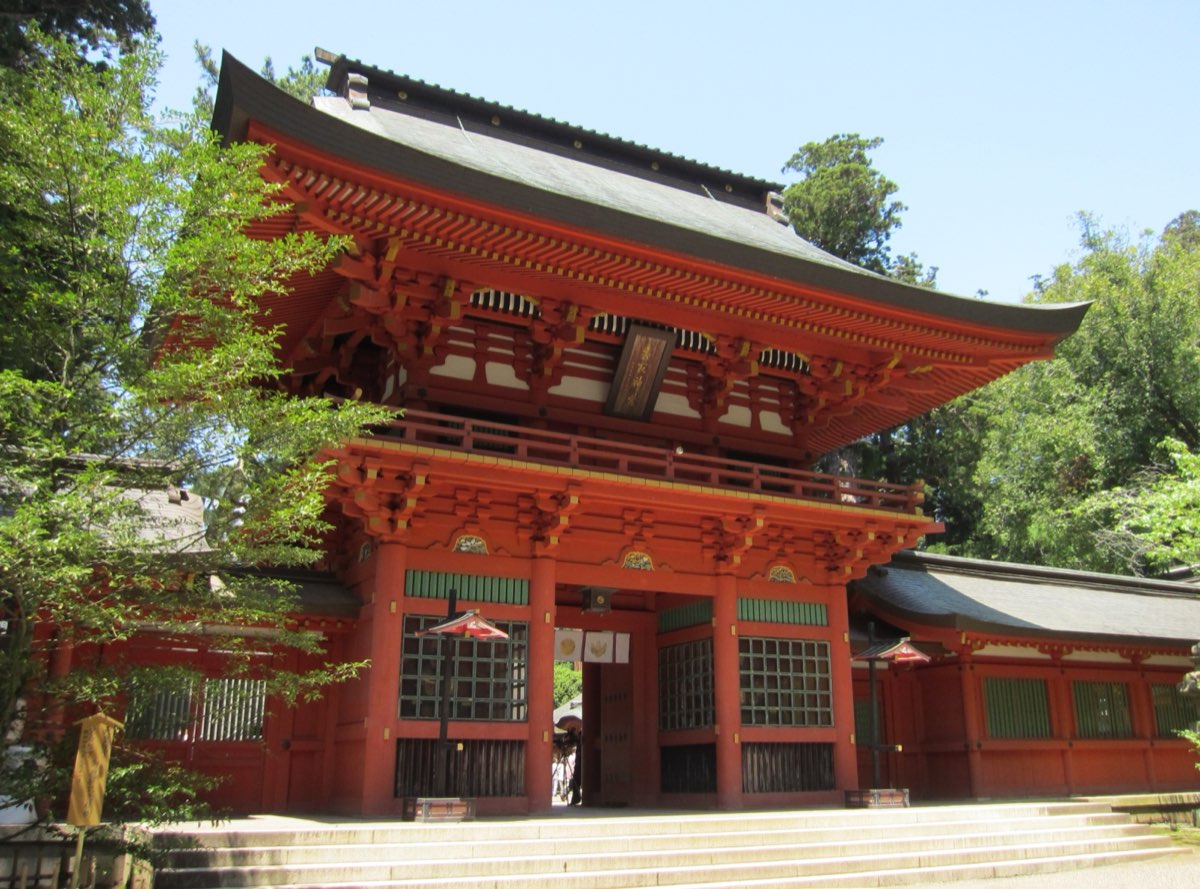
Katori Jingu stands in a forest of old cedars in Katori City, Chiba Prefecture. The prefecture describes it as an old shrine representing the former province of Shimōsa. Its deity is Futsunushi no Ōkami, a god who appears in the myth of the transfer of the land.
The shrine is a place of living worship, and its history can be read in three kinds of evidence: the myths the shrine tells, the documents its priestly families kept, and the buildings the shogunate raised. This article follows each in turn, keeping myth and tradition apart from what written records show.
The deity and the myth
Katori Jingu explains its deity through the myth of the "transfer of the land" in Izumo. In the shrine's telling, Amaterasu Ōmikami, who ruled the heavenly plain, decided that her son should rule the land below, which was troubled by unruly gods. Two envoys sent to Ōkuninushi, the god of Izumo, failed to return.
The gods then agreed that Futsunushi was the right deity to send, and Takemikazuchi, the deity of Kashima Jingu, offered to go with him. At the shore of Inasa in Izumo, the two drew their swords and showed their might, and Ōkuninushi handed over the land.
Chiba Prefecture summarizes the same myth, adding that Futsunushi has been worshipped as a god of war since ancient times. These are the shrine's sacred stories, not records of datable events.
The shrine's own tradition places its founding in the 18th year of Emperor Jimmu. The prefecture reports this date as shrine tradition.
A shrine of the state in the east
Katori also appears in the court histories. According to the prefecture, the Nihon shoki records the deity as being at Katori in the eastern provinces. The prefecture says that in ancient times the shrine was revered as a deity protecting the state and played a part in the Yamato court's administration of the east.
In the ancient east, the prefecture notes, Katori and Kashima were the shrines that bore the title jingu. Katori Jingu itself says that before the Meiji period only Ise, Katori and Kashima carried that title.
Like the Ise shrines, Katori was once rebuilt at fixed intervals. The prefecture cites the Nihon kōki for the year 812, which records that the shrine buildings were to be remade every twenty years. In the Heian period the shrine had this twenty-year rebuilding system, but it lapsed in the Sengoku (Warring States) period.
Priests, lands and patrons
The documents of the priestly Katori family begin in the late Heian period. The office of Ōnegi, the shrine's chief priest, was hereditary in the Katori family, and the family preserved 381 documents running from the late Heian to the Edo period. They are designated an Important Cultural Property.
According to the prefecture, the documents show how the office was handed down, how the shrine's lands were organized, and how the shrine changed over time. They include 14 documents issued from 1156 by the household office of the Fujiwara regents, a transfer deed of 1162, and a survey register of the shrine lands from 1399 that shows the Ōnegi house establishing control over all of them.
The prefecture calls them a representative body of shrine documents in the Kantō region and the most complete group of medieval documents in Chiba.
In the medieval period Katori became the ichinomiya, the leading shrine, of Shimōsa Province. Documents from warrior rulers survive as well. Among the documents the shrine itself holds is a letter of donation from Ashikaga Takauji dated the seventh month of Kan'ō 3 (1352).
A martial tradition is also linked to the shrine. The founder of the Tenshin Shōden Katori Shintō-ryū, Iizasa Chōisai Ienao, is said to have trained for a thousand days at a site next to the shrine around the mid-Muromachi period and to have received a scroll from the Katori deity. The prefecture designates the school an intangible cultural property.
Rebuilt by the shogunate
In the Edo period, the prefecture says, the shrine received the protection of the Tokugawa shogunate. The present main hall was built by the shogunate in 1700 (Genroku 13), under Tokugawa Tsunayoshi, according to the prefecture's page on the shrine forest.
The main hall is black-lacquered with a roof of cypress bark, and its carved brackets and beams are richly coloured in a manner carried over from the Momoyama style of the earlier Keichō-era rebuilding. The prefecture describes it as among the largest halls of its type in Japan.
The tower gate in front of it, also built in 1700, is painted vermilion; the plaque on its upper storey is in the hand of Tōgō Heihachirō, according to the shrine. Both buildings are Important Cultural Properties.
The old worship hall from 1700 also survives. It was moved when the present worship hall was built in 1938 and is now used as a prayer hall. The prefecture calls it important for understanding the shrine buildings of the Genroku rebuilding.
A living shrine
After the Meiji Restoration, Katori was ranked as a kanpei taisha in the modern system of shrine ranks, and in 1942 it was made a shrine to which the emperor sends an envoy. Its annual festival is held on 14 April, and once every six years an imperial envoy attends, the shrine says.
According to the shrine, shrines that enshrine the Katori deity are found throughout Japan, beginning with Kasuga Taisha in Nara and Shiogama Jinja in Miyagi. People pray to the deity for the safety of their households, for farming and business, for safety at sea, for marriage and safe childbirth, and for protection on the road.
The shrine's calendar is full of rites. They include a rice-planting festival in two parts in early April and a prayer for the safety of brewing in January.
The Jinkōsai procession is held every year on 15 April. In a year of the horse, once every twelve years, it is held over two days on a grand scale. The shrine says the festival was originally held every twenty years as a great rebuilding festival; when rebuilding was no longer carried out from the Sengoku period on, a Jinkōsai every twelve years took its place.
On the first day, thousands of parishioners escort the portable shrine to the Torii-gashi landing on the Tone River, where, by tradition, the deity came ashore. There it is carried onto a boat for a rite on the water, and a welcoming rite is performed by Kashima Jingu before the boat goes up the river.
The shrine also keeps local legends. Its precinct guide tells of the kaname-ishi, a "pivot stone" said to have been driven deep into the ground by the gods of Katori and Kashima to pin down a giant catfish that people believed caused earthquakes. Tokugawa Mitsukuni is said to have had it dug in 1684 without ever reaching its base.
Visiting Katori Jingu
The shrine grounds include the vermilion tower gate, the main hall behind it, the inner shrine (Okunomiya) and the kaname-ishi. The forest around them is a prefectural natural monument, with many cedars more than three metres around.
The shrine holds many treasures, including a National Treasure: a white-bronze mirror decorated with grapevine scrolls, lions and other animals and birds. Its treasure hall, however, has been closed for renovation since 23 October 2023, and as of the shrine's notice of July 2026 no reopening date had been set.
Opening times for the shrine office and the treasure hall can change, so check the shrine's official website before you visit.
Sources
- 香取神宮の御由緒Katori Jingu
- 宝物・文化財Katori Jingu
- 境内案内Katori Jingu
- 祭典と催しKatori Jingu
- 「宝物館」長期休館のお知らせKatori Jingu
- 香取神宮本殿 楼門Chiba Prefectural Board of Education
- 香取大禰宜家文書Chiba Prefectural Board of Education
- 香取神宮の森Chiba Prefectural Board of Education
- 香取神宮旧拝殿Chiba Prefectural Board of Education
- 武術 天真正伝香取神道流Chiba Prefectural Board of Education
- 香取市の国・県指定および国登録文化財Chiba Prefectural Board of Education