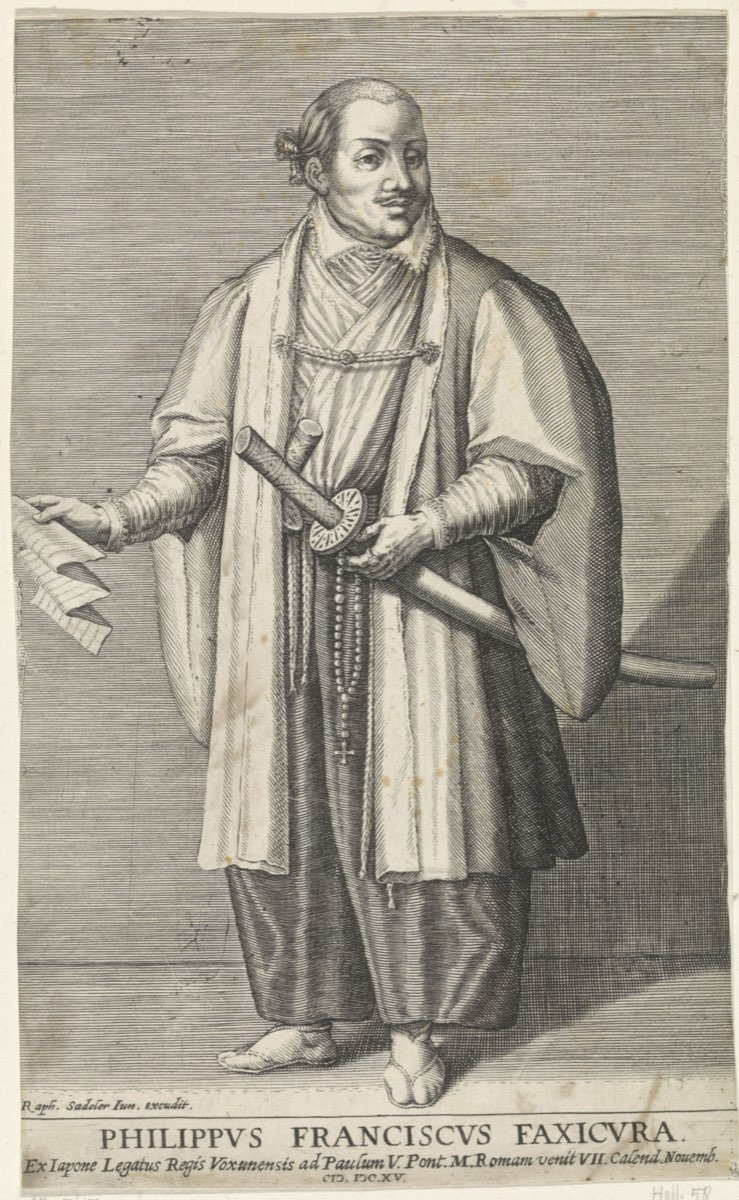
In 1613 Date Masamune, the first lord of the Sendai domain, sent a group of envoys led by his retainer Hasekura Tsunenaga across the oceans. They travelled by way of Spanish-ruled Mexico to Spain and then to Rome.
According to the Sendai City Museum, this was an official diplomatic mission that the shogunate also approved. Masamune had two aims: to meet the King of Spain and gain permission for direct trade with Mexico, and to meet the pope and ask for Franciscan friars to be sent to spread Christianity in the Sendai domain.
The journey lasted seven years. It ended in disappointment, and in a Japan where Christianity was now banned. Yet the objects Hasekura brought home survive in Sendai today, and they let us follow one of the most remarkable journeys of early seventeenth-century Japan.
A new castle town and a wider world
Masamune moved his base from Iwadeyama to Sendai in 1601. According to the Agency for Cultural Affairs, he began building the main enclosure of Sendai Castle that year, on the Aobayama hills above the Hirose River. Around the castle he laid out a castle town and promoted the opening of new farmland.
This was also the age the Sendai City Museum calls the "Age of Discovery." Spain had opened a westward sea route, taken vast colonies in the Americas, and built up trade with Asia from its base in Manila. Catholic missionaries were also sent to Asia and the Americas, and Christianity had first reached Japan with Francis Xavier in 1549.
Hasekura Tsunenaga was born around 1570, according to the museum's chronology. In 1608 Masamune granted him lands in the Sendai domain. With him went Luis Sotelo, a missionary born in Seville in 1574.
Across two oceans
The ship left Tsukinoura, in what is now Ishinomaki in Miyagi Prefecture, on the 15th day of the 9th month of Keichō 18 (1613), by the lunisolar calendar. Spanish records call it the San Juan Bautista. About 180 people were on board.
Carried by westerly winds and ocean currents, the ship crossed the Pacific and reached Acapulco in Mexico about three months later. According to the Sendai City Museum, the envoys were the first Japanese on record to cross both the Pacific and the Atlantic.
Most of the passengers stayed in Mexico. The envoys, about 30 people led by Hasekura and carrying letters for the Spanish king and the pope, joined a Spanish fleet in June 1614. After a storm forced them to call at Havana, they landed in Spain in October.
They received a great welcome in Seville, Sotelo's home city, and reached Madrid in early December. Masamune had also sent a letter to the city of Seville asking for friendship and for help in reaching the king and the pope.
Audiences in Madrid and Rome
On 30 January 1615 Hasekura met King Philip III and handed over Masamune's letter. On 17 February he was baptized in the presence of the king, taking the Christian name Felipe Francisco Hasekura Rokuemon.
The welcome was warm, but the news reaching Madrid was not. According to the museum, Vizcaíno, a rival of Sotelo, and the Jesuit side sent a stream of unfavourable reports. They spoke of the ban on Christianity and the persecution in Japan, of inaccurate reports by Sotelo, of trade being the mission's only real aim, and of Masamune being only one lord in Japan.
The envoys waited eight months in Madrid without a favourable answer. Back in Japan, the shogunate had issued a nationwide ban on Christianity in the 12th month of Keichō 18 (1614 in the Western calendar), around the time they reached Mexico.
Hoping the pope could help, the envoys set off for Rome in August 1615. They entered the city in late October and held a formal entry procession on 29 October. On 3 November Hasekura met Pope Paul V.
The letter he handed over, written on paper sprinkled with gold and silver leaf in both Japanese and Latin versions, asked for Franciscan friars and for the pope's help with the Spanish king over trade with Mexico. The museum says both letters are kept today in the Vatican Library.
Rome honoured the visitors. Hasekura was made a noble, and he and seven others received Roman citizenship. His certificate of citizenship, on parchment with gold lettering, names "Sandai" (Sendai), "Voxu" (Ōshū) and "Idate Masamune."
A long road home
The pope replied that he would arrange for the papacy and the Spanish government to discuss the requests. The envoys returned to Madrid, but they were not allowed to stay there and were moved on to Seville. Hasekura and Sotelo stayed behind to wait for the king's written reply.
On 4 July 1617 they finally left Spain without it. From Acapulco they sailed to Manila in the Philippines, where Hasekura stayed for two years.
He returned to Nagasaki on another ship, leaving Sotelo in Manila. According to the museum's chronology, he arrived in Sendai and reported to Masamune on the 24th (or 26th) day of the 8th month of Genna 6 (1620), seven years after leaving Tsukinoura.
Why the results were limited
Miyagi Prefecture sums up the outcome plainly. The envoys got no definite answer on trade or on missionaries, and the shogunate had already banned Christianity while they were in Europe, so the aims were not achieved.
The Sendai City Museum explains that news of the increasingly harsh suppression of Christians in Japan had reached the pope. By the time the envoys came home in 1620, Christianity was banned throughout Japan and believers were being executed.
The Sendai domain issued its own ban on Christianity immediately after Hasekura's return, and the search for Christians spread across the domain. In 1624 the Portuguese Jesuit missionary Father Carvalho and Christians in the domain were arrested and put to death by water torture in the Hirose River. Masamune, the museum says, had no choice but to follow the shogunate's policy.
The people of the embassy shared in these hardships. Hasekura died aged 52, probably in Genna 7 (1621); a Hasekura family record gives Genna 8.
Sotelo, who had entered Japan secretly, was executed by burning in 1624. In 1640 Hasekura's son Tsuneyori was executed because his brother and three servants were Christians, and the three servants were also put to death.
The museum's own judgement is balanced. Given the position of Christianity in Japan and colonial policy in the world at the time, it says, the failure to win direct trade with Mexico and Franciscan missionaries was perhaps unavoidable. But it argues that negotiating with Spain as diplomats seeking an agreement deserves high praise.
Hidden objects, rediscovered
Under the strict ban, the objects Hasekura brought home were confiscated by the domain in his son's time as Christian items and kept out of sight. According to the museum, the embassy was then forgotten for about 250 years.
It came back to light in 1873, when the Iwakura Mission, sent by the Meiji government to Europe and America, found a letter of Hasekura's in Venice.
Today 47 items in 24 groups make up the Keichō Embassy materials. In 2001 they became the first historical materials to be designated a National Treasure. In 2013 three of them were registered in UNESCO's Memory of the World: the Roman citizenship certificate, the portrait of Hasekura, and the portrait of Pope Paul V.
The portrait of Hasekura shows him praying, rosary in hand, before Christ on the cross. According to the Sendai City Museum, it can be called the oldest surviving oil painting in Japan of a real Japanese person, and recent research suggests it was painted in Rome.
Visiting today
The Sendai City Museum keeps the Keichō Embassy materials. It stands on the site of the third enclosure (san-no-maru) of Sendai Castle and changes its displays with the seasons, so check the museum's website to see which items are on show before you visit.
The main parts of the Sendai Castle site have been laid out by Sendai City as a public park, according to the Agency for Cultural Affairs. The site is a national Historic Site. Check the official sites for access and any restrictions.
Sources
- 慶長遣欧使節関係資料Sendai City Museum
- 慶長遣欧使節Sendai City Museum
- 伊達政宗関係年表Sendai City Museum
- 主な収蔵品 12 支倉常長に関する資料(2)Sendai City Museum
- 主な収蔵品 12 支倉常長に関する資料(3)Sendai City Museum
- 主な収蔵品 12 支倉常長に関する資料(4)Sendai City Museum
- 主な収蔵品 12 支倉常長に関する資料(5)Sendai City Museum
- 主な収蔵品 12 支倉常長に関する資料(6)慶長遣欧使節関連年表Sendai City Museum
- 博物館の概要Sendai City Museum
- 常設展(2026年 秋の常設展)Sendai City Museum
- 指定文化財〈国宝〉慶長遣欧使節関係資料Miyagi Prefecture
- 仙台城跡(文化遺産オンライン)Agency for Cultural Affairs