Yamanashi Prefecture calls itself the birthplace of wine production in Japan. According to the prefecture, about 100 wineries are gathered there and produce about 30 percent of the country's Japan wine, a name reserved for wine made in Japan only from grapes grown in Japan. On August 7, 2019, the governor declared Yamanashi a "Wine Prefecture."
That industry began in the first decades of the Meiji era, when private brewers, the prefectural government, and young men from the grape-growing village of Katsunuma all tried to turn local grapes into wine. This article follows those beginnings, including a debate over the year the first wine was made.
Grapes before wine
Yamanashi Prefecture explains that the Koshu grape, a leading raw material of Japan wine, is thought to have originated in the Caucasus and the area around the Caspian Sea, reached Japan from China by way of the Silk Road together with Buddhism, and settled in Katsunuma, where the climate suited it. The prefecture also notes that Koshu, the variety grown longest in Japan, is registered with the International Organisation of Vine and Wine (OIV).
Interpretations differ
Local legend places the start of grape growing much earlier. A prefectural bulletin, drawing on a history of wine published by the town of Katsunuma, retells two stories. In one, the monk Gyōki had a dream in 718 of the healing buddha Yakushi holding grapes, which became the origin of the temple Daizenji and of Koshu grape growing. In the other, a Katsunuma resident named Amemiya Kageyu found an unusual wild vine in 1186 and improved it. The bulletin presents both as legends.
According to a research paper published by the Yamanashi Prefectural Archaeological Museum, grapes and other fruit were grown at Kofu Castle in the Edo period, and records survive of grapes from Kai being presented to the shogun's family. The prefectural bulletin adds that in the Edo period grapes are said to have been sold at Katsunuma, a post town on the Koshu Kaido highway, and to have become a local specialty.
Wine itself was not unknown. The same bulletin says European wine is thought to have reached Japan in the Warring States period, but was used only as medicine or enjoyed by a few, such as daimyo. In the mid-Edo period, it adds, grape liquor made by steeping grapes in sake or shochu is said to have been sold as medicine.
Two brewers in Kofu
According to the museum paper, full-scale wine making in Yamanashi was begun by two private individuals in Kofu, Yamada Hironori and Takuma Norihisa. The paper says their effort is regarded as the origin of Japan's wine industry. They opened a joint winery in Kofu, and the business got on track around 1874, shipping in quantity to the Tokyo and Yokohama area and supplying the army and navy.
The venture struggled, however. According to the same paper, lack of money and skills led the two to petition the governor in 1876 for funds and technical help. A report of 1879 from the governor to the Home Ministry, cited in the paper, notes that the two had by then closed their business.
Interpretations differ
When exactly they first made wine is a matter of debate.
Interpretations differ
Yamanashi Prefecture's wine page says production in the prefecture began around 1870, when Yamada and Takuma made wine from wild grapes and Koshu grapes. The museum paper cites a book of 1915 that records an attempt by Yamada around 1870 or 1871 to make wine from wild grapes, regarded as the first record of wine making in Japan. A statistics bulletin published by the prefecture in 2026, however, says that recent research using the Kofu newspaper of the time and old documents has shown the year to be 1874.
The prefectural winery at Kofu Castle
The prefecture soon stepped in. The museum paper explains that Governor Fujimura Shirō agreed to support the private venture and planned to invite Ōfuji Matsugorō, a government technician who had returned from the United States, to give technical guidance. In 1877 a prefectural winery was set up inside the former Kofu Castle, attached to an agricultural experiment station opened the year before.
Records cited in the paper show that 28,896 bottles of various liquors were produced in 1877, and Emperor Meiji visited the experiment station and winery in June 1880. But according to research cited by the paper, brewing stopped after the 1883 vintage. The winery was closed in 1884, and the prefecture applied that year to sell it off, ending its work in less than ten years.
Two young men sent to France
The other path ran through Katsunuma. In 1877 the Dainihon Yamanashi Budōshu Gaisha (Great Japan Yamanashi Wine Company) was founded in Iwai village, now part of Katsunuma in Koshu City. Yamanashi Prefecture calls it the first private company of its kind.
The company sent two young men from Katsunuma, Takano Masanari and Tsuchiya Ryūken, to France to learn Western winemaking. After returning, according to the prefecture, they worked hard to develop wine making in Japan. The prefecture's wine page says Yamanashi's wine industry grew steadily after the two spread what they had learned in France.
The company itself was short-lived. According to the Yamanashi Tourism Organization, it was dissolved in 1886.
Miyazaki Kōtarō then took over all of its brewing equipment and began making wine with Tsuchiya Ryūken. Miyazaki's winery and tourist vineyard at his home became known as Miyakoen.
From Meiji to today
In July 2013, according to Yamanashi Prefecture, "Yamanashi" became the first wine region in Japan to be designated under the national system of geographical indications, which protects the place of origin of alcoholic drinks.
In 2020 the Agency for Cultural Affairs recognized a Japan Heritage story about 140 years of Japan wine. According to the Yamanashi Tourism Organization, the Château Mercian Wine Museum in Katsunuma and its collection are among the cultural properties named in it.
Visiting today
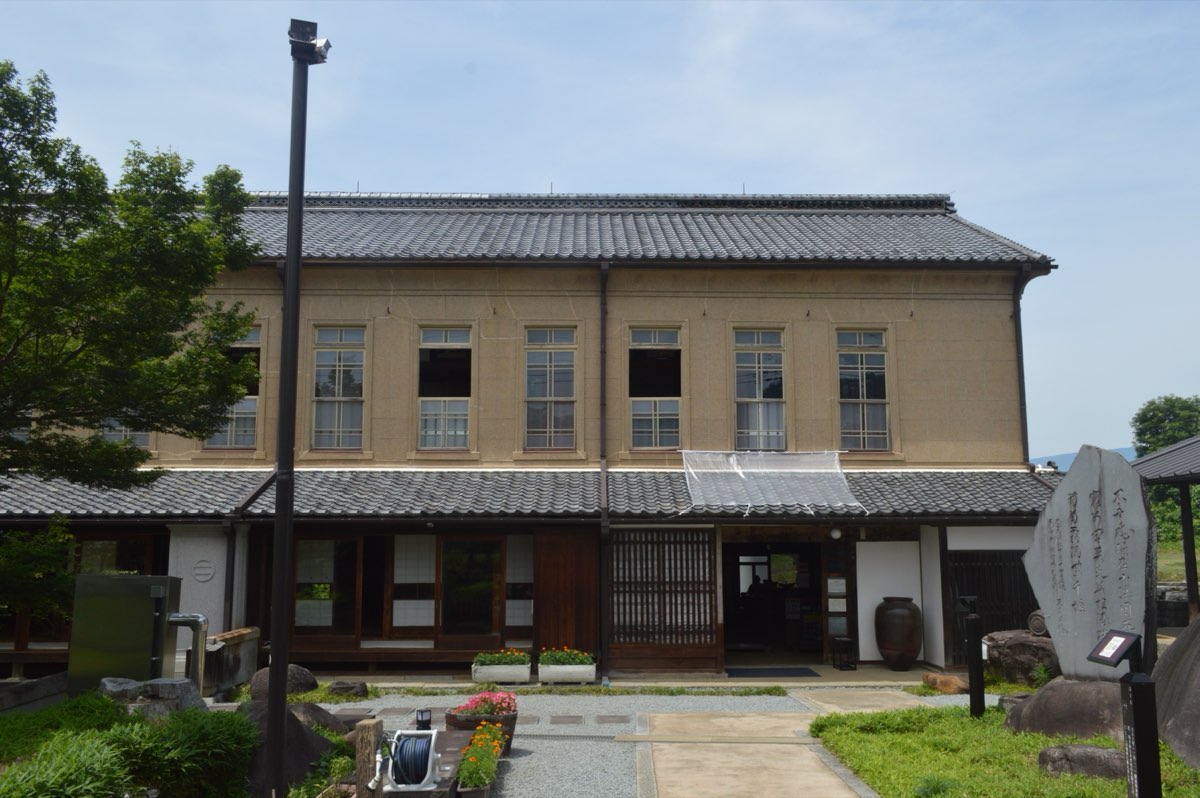
Miyakoen in Katsunuma, listed as a Koshu City modern industrial heritage site, is open to visitors. According to the Yamanashi Tourism Organization (information as of October 2024), its three exhibition rooms show wine labels, signs, and the history of wine and of Miyakoen.
Also in Katsunuma, the Château Mercian Wine Museum presents the history of wine making in Japan. The tourism organization (information as of October 2022) says it was partly renovated in summer 2020, has bilingual displays, and can be visited without a reservation. Please check each official website for hours and closing days before you go.
Sources
- 山梨ワインの歴史Yamanashi Prefecture
- 日本ワイン生誕の地(富士の国やまなしの魅力)Yamanashi Prefecture
- ワイン(美酒美県やまなし)Yamanashi Prefecture
- 甲府城内葡萄酒醸造所について―国産ワインの発祥地甲府―Yamanashi Prefectural Archaeological Museum / Yamanashi Prefectural Archaeological Center (研究紀要18)
- 甲州市近代産業遺産 宮光園(富士の国やまなし観光ネット)Yamanashi Tourism Organization (公益社団法人やまなし観光推進機構)
- シャトー・メルシャン 勝沼ワイナリー(富士の国やまなし観光ネット)Yamanashi Tourism Organization (公益社団法人やまなし観光推進機構)