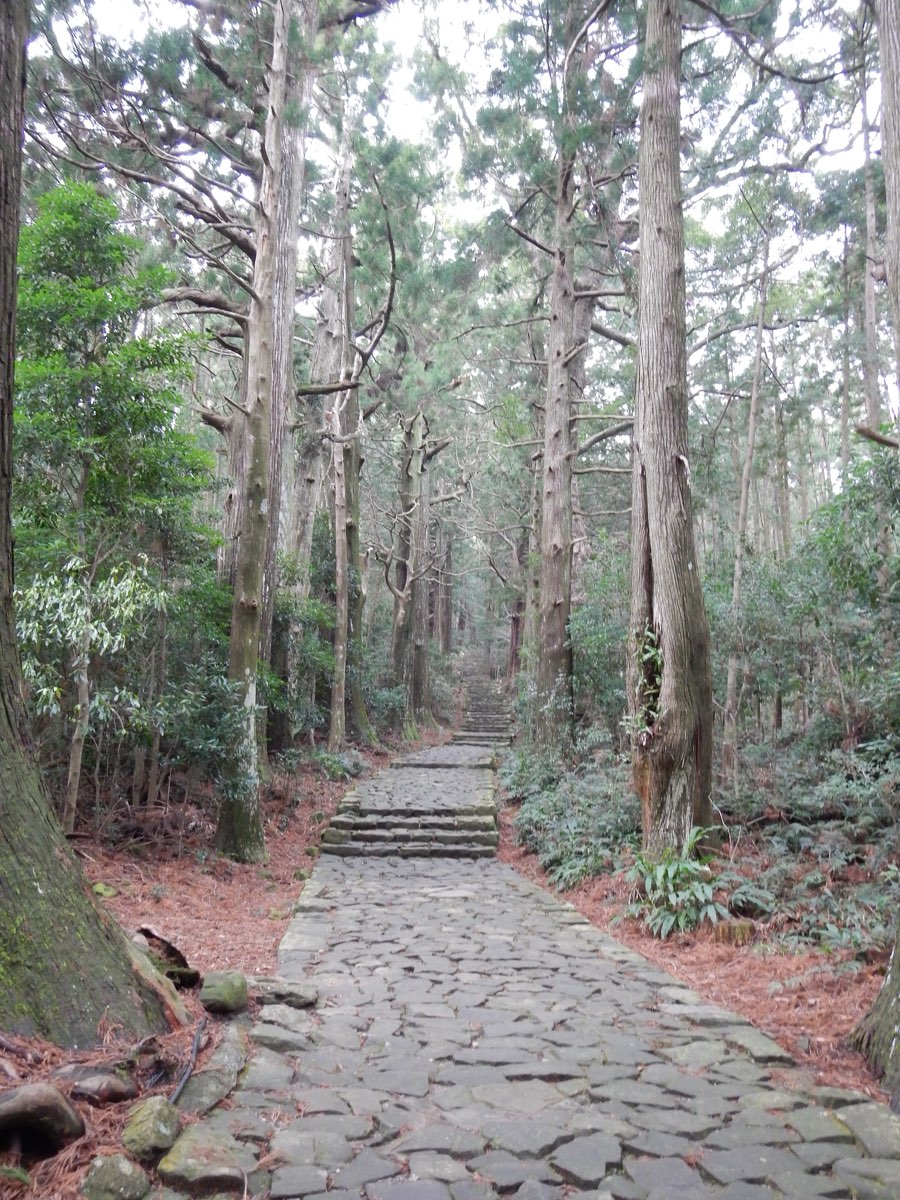
Deep in the south of the Kii Peninsula, far from the old capital of Kyoto, stand three great shrines known together as Kumano Sanzan: Hongū, Shingū and Nachi. For centuries, retired emperors, nobles, ordinary people and the sick walked mountain roads to reach them.
Those roads and shrines are now part of a World Heritage site that spans Mie, Nara and Wakayama prefectures. This article follows the Kumano pilgrimage from its rise in the Heian period to its inscription on the World Heritage List in 2004.
Three shrines in the mountains and by the sea
The Kumano Sanzan are Kumano Hongū Taisha, once called Kumano-ni-masu-jinja; Kumano Hayatama Taisha in Shingū; and Kumano Nachi Taisha. According to the Agency for Cultural Affairs, the Kumano shrines lie in the southeast of the Kii Peninsula, a long way from Kyoto and from the rest of Japan. For this reason several routes developed, depending on where pilgrims set out from.
Hongū first appears in written records in 859. In the late tenth century, it began to worship the main deities of Hayatama and Nachi together with its own, as the three Kumano Gongen. In the eleventh century, further deities were added, and the form of worship called the Twelve Gongen of Kumano took shape.
Each shrine has its own sacred landscape. At Shingū, the Agency describes a cliff-lined mountain behind the shrine, where Kamikura Shrine stands at the spot where the deity is said to have descended. A great rock there, Gotobiki-iwa, is worshipped as the body of the deity.
At Nachi, worship began with the waterfall. The Agency explains that Kumano Nachi Taisha has its origin in ancient nature worship of the Nachi falls, 133 meters high and 13 meters wide. The falls are both the starting point of faith at the shrine and the neighboring temple, Seigantoji, and an object of worship in themselves.
Retired emperors on the road
Pilgrimage to Kumano began in the early tenth century and flourished until about the fifteenth century, according to the Agency. So many pilgrims walked the roads in long lines that the journey was described as the "ants' pilgrimage to Kumano."
The most famous pilgrims were retired emperors. In the period of rule by retired emperors (insei), the Agency counts 34 pilgrimages by Retired Emperor Go-Shirakawa, 28 by Go-Toba, 21 by Toba and 9 by Shirakawa. Women of imperial rank went too: Taikenmon-in made the journey 13 times.
Wakayama Prefecture sums up that these four retired emperors made more than 90 journeys to Kumano over about 150 years. As the pilgrims passed, the roads themselves were improved.
Courtiers described the journeys in detail in their diaries, among them the diary of Fujiwara no Munetada and the record of Go-Toba's pilgrimage kept by Fujiwara no Teika. According to the Agency, these records show that the pilgrims were not only people of high rank: many ordinary people and sick people also made the journey.
The way through the mountains
In the medieval period, the most used road was the Nakahechi. Coming south from Kyoto, the pilgrimage road divided at Tanabe. The Ōhechi went on along the coast, while the Nakahechi turned east and wound through the mountains toward Hongū.
After praying at Hongū, pilgrims went down the Kumano River by boat to Shingū. From there they followed the coast to Hama-no-miya and turned inland again to Nachi.
To return, they either retraced their route up the river or crossed the mountain passes of Ōkumotori-goe and Kokumotori-goe back to Hongū. A road also led from Hongū to the hot spring of Yunomine, where pilgrims bathed and rested.
Scattered along the Nakahechi are ōji, shrines to the child deities of Kumano, or their remains. The Agency calls them the most distinctive feature of the route. When retired emperors and nobles made their pilgrimages in the eleventh to thirteenth centuries, offerings and sutra readings were held at the ōji under the direction of mountain ascetics (shugenja), together with dances, sumo and poetry gatherings.
The Agency describes the pilgrimage roads of the Kii Mountains as places of religious practice, where people approached a pure realm in which gods and buddhas dwelt. Shinto and Buddhism were closely mixed. Before the order separating Shinto and Buddhism in 1868, Seigantoji developed together with Kumano Nachi Taisha as part of one sacred site.
From Kumano pilgrims to Saigoku pilgrims
After about the fifteenth century, pilgrimage to the Kumano shrines alone declined. The roads did not fall silent, however.
From the seventeenth century, when visiting shrines and temples became popular among ordinary people, pilgrims on the Saigoku route of 33 Kannon temples came to Kumano. According to the Agency, they are said to have numbered as many as 30,000 in a busy year.
These pilgrims visited Ise Jingū first and then took the Iseji, the eastern route, to the first temple of the Saigoku pilgrimage, Seigantoji at Nachi, stopping at Hayatama on the way. From Seigantoji they continued by the Nakahechi toward the next temple, also visiting Hongū.
The Iseji runs about 160 kilometers between Ise Jingū and the Kumano shrines. Pilgrims' diaries suggest that it was already in use as a pilgrimage road by the late tenth century, but the Agency notes that travelers increased from the seventeenth century. About 34 kilometers of mountain passes, including stone-paved sections, survive in good condition.
Pictures also spread the faith. The Agency notes that the Nachi falls always appear in the fourteenth-century Kumano mandalas and in the sixteenth-century Nachi pilgrimage mandalas, which were made to explain the faith of Nachi to ordinary people.
A World Heritage site
In 2000 the Kumano pilgrimage roads were designated a national Historic Site. The Agency describes them as an old road walked from the end of ancient times into the early modern and modern periods by people of high rank, ordinary people, and the sick, all drawn by faith in and longing for the Kumano shrines.
On July 7, 2004, the Sacred Sites and Pilgrimage Routes in the Kii Mountain Range were inscribed on the World Heritage List. The property spans Mie, Nara and Wakayama.
It consists of three sacred sites, Kumano Sanzan, Yoshino and Ōmine, and Kōyasan, together with the roads that link them. According to Wakayama Prefecture, the good condition of the roads and the cultural landscape of forests closely tied to faith and daily life were especially valued.
Mie Prefecture points out that few pilgrimage roads are on the World Heritage List. Another example it gives is the Routes of Santiago de Compostela in Spain and France. In Mie, the listed road is the Iseji.
On October 24, 2016, the World Heritage Committee approved the addition of 22 more places, including sections of the Nakahechi and Ōhechi and roads to Kōyasan. With this addition, the total length of the listed roads grew from 307.6 to 347.7 kilometers.
Places to visit
Kumano Hongū Taisha no longer stands on its original site. After a flood of the Kumano River in 1889, the three main buildings that survived were moved to the present site in 1891. The old site, Ōyunohara, lies about half a kilometer to the southeast on a sandbank in the river, where a nineteenth-century stone platform remains.
At Kumano Hayatama Taisha in Shingū, the present buildings were rebuilt in 1951, but the shrine has stood on the same riverside site since at least the twelfth century. Kamikura Shrine and its great rock are on the mountain behind it.
At Nachi, Kumano Nachi Taisha stands at about 500 meters above sea level, with Seigantoji next to it. The main hall of Seigantoji was rebuilt in 1590 and faces the Nachi falls.
The Nakahechi section included in the World Heritage site starts at the ruins of Takijiri-ōji, which the Agency calls the entrance to the sacred area of Kumano in the broad sense, and runs about 40 kilometers east to Hongū. Check the official websites of the shrines and of Wakayama Prefecture for access and visiting information before you go.
Sources
- 熊野参詣道Agency for Cultural Affairs (Cultural Heritage Online)
- 知事からのメッセージ 令和6年3月1日Wakayama Prefecture
- 世界遺産熊野参詣道Mie Prefecture
- 熊野参詣道伊勢路Agency for Cultural Affairs (Cultural Heritage Online)
- 熊野本宮大社(世界遺産「紀伊山地の霊場と参詣道」構成資産解説)Agency for Cultural Affairs (Cultural Heritage Online)
- 熊野速玉大社(世界遺産「紀伊山地の霊場と参詣道」構成資産解説)Agency for Cultural Affairs (Cultural Heritage Online)
- 熊野那智大社(世界遺産「紀伊山地の霊場と参詣道」構成資産解説)Agency for Cultural Affairs (Cultural Heritage Online)
- 青岸渡寺(世界遺産「紀伊山地の霊場と参詣道」構成資産解説)Agency for Cultural Affairs (Cultural Heritage Online)
- 那智大滝(世界遺産「紀伊山地の霊場と参詣道」構成資産解説)Agency for Cultural Affairs (Cultural Heritage Online)
- 熊野参詣道中辺路(世界遺産「紀伊山地の霊場と参詣道」構成資産解説)Agency for Cultural Affairs (Cultural Heritage Online)
- 世界遺産「紀伊山地の霊場と参詣道」の追加登録Wakayama Prefectural Board of Education (Cultural Heritage Division)