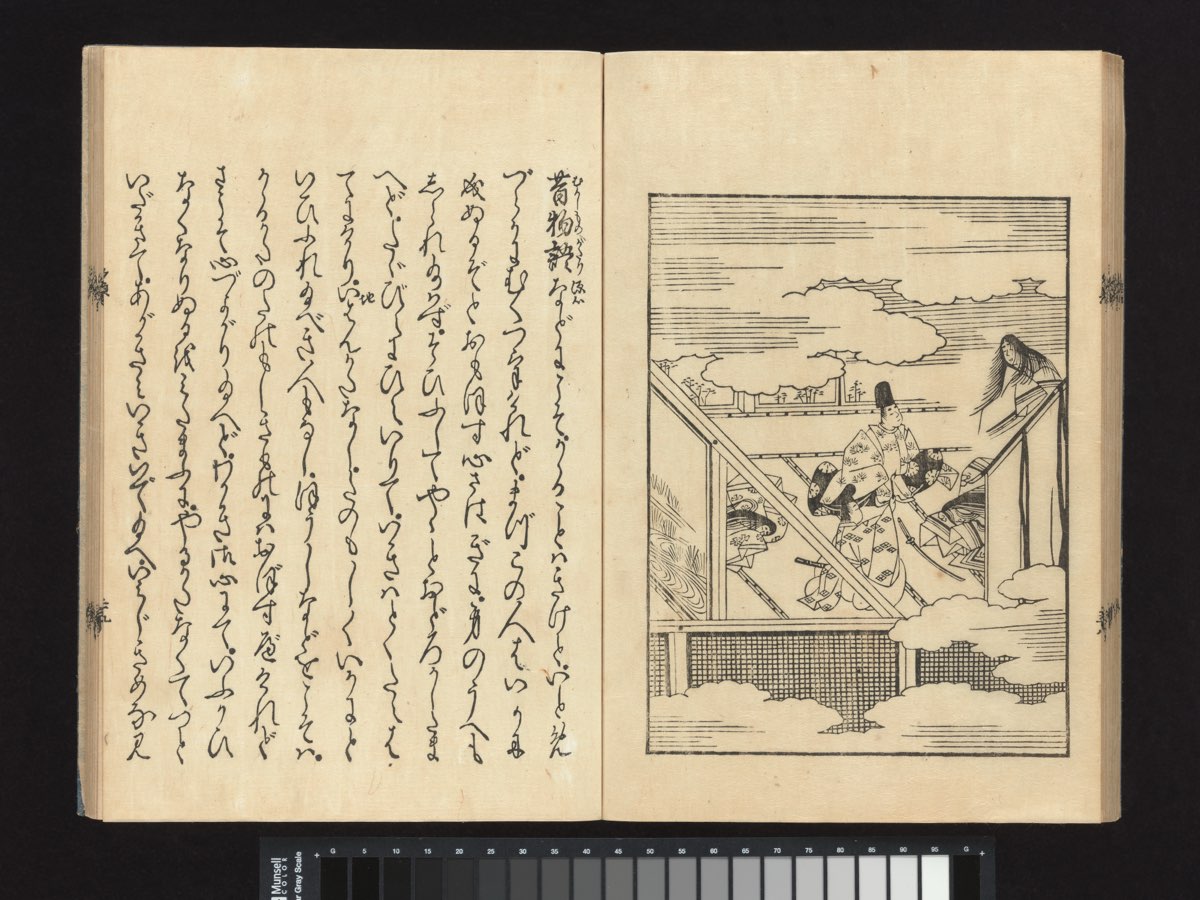
In the early eleventh century, a woman serving at the imperial court in Kyoto wrote The Tale of Genji, which the Kyoto National Museum calls Japan's most esteemed literary classic. We know her as Murasaki Shikibu. She also left a diary of her life at court, which shows the world in which the tale was written and read.
This article looks at what can be known about her, what her diary records, and how her tale was copied, illustrated and translated over the following thousand years. It also explains why later pictures of her are not portraits.
A writer with an uncertain life story
Interpretations differ
Much of Murasaki Shikibu's life is unknown. The Gotoh Museum, the Fujita Museum and the Kyoto National Museum all describe her birth and death dates as unknown. One scholar, Takagi Kazuko, places her birth around 973; a Fujita Museum curator says only that she was probably born toward the end of the 900s.
Interpretations differ
Even her name is not her own in the modern sense. According to the Fujita Museum, "Shikibu" was a court name taken from a government office held by her father. Since her family name was Fujiwara, she seems also to have been called Tō Shikibu. Where "Murasaki" came from is not settled. It is said to come from the heroine Murasaki in Genji, but there are several theories, and her personal name is not known.
According to Takagi's overview, published by Kwansei Gakuin University Library, she was the daughter of Fujiwara no Tametoki, a noble of middle rank. Around 999 she married Fujiwara no Nobutaka, who was some twenty years older.
She had a daughter, later known as Daini no Sanmi. Her husband died after little more than two years of marriage.
Her diary contains a famous memory from childhood. When her brother was studying Chinese texts, she listened nearby and understood them far more quickly than he did. Her father, Tametoki, is said to have lamented that she had not been born a boy.
Serving Empress Shōshi
Murasaki served Shōshi, the daughter of the powerful courtier Fujiwara no Michinaga and principal consort (chūgū) of Emperor Ichijō. Both Takagi and the Fujita Museum place the start of this service around 1005. Takagi writes that Michinaga had heard of her writing and invited her, though she presents this as an assumption, not a recorded fact.
Michinaga gathered many talented women around his daughter, among them Izumi Shikibu and Akazome Emon as well as Murasaki. Emperor Ichijō had another consort, Teishi, and Sei Shōnagon, the author of The Pillow Book, served her.
Murasaki also taught Shōshi Chinese works such as the collected writings of Bai Juyi. Takagi relates that Emperor Ichijō, who enjoyed Genji, praised her as someone who must have read the official histories of Japan. This earned her the nickname Nihongi no mitsubone (roughly "Lady of the Chronicles"), and she seems to have felt embarrassed by the praise.
Writing at court used two scripts. As a Fujita Museum curator explains, official documents and public records were written in Chinese. Tales, poems and letters were written in kana, called "women's hand," which was a private script and not used for official papers.
The diary, 1008 to 1010
The Diary of Murasaki Shikibu covers about a year and a half, from the 7th month of 1008 to the 1st month of 1010. The Gotoh Museum describes it as centred on Shōshi's two births of imperial princes and the celebrations that followed. It also shows the courtiers around Michinaga, the most powerful man of the day.
The Fujita Museum describes it as a mixture of a diary and essays, with recollections and reflections alongside the events of court. Murasaki's own manuscript is lost; it survives in later copies.
The diary also gives the earliest documentary evidence that Genji existed. On the 1st day of the 11th month of 1008 (lunar calendar), the court held a celebration for the fiftieth day of the new prince Atsuhira, later Emperor Go-Ichijō.
At the banquet, the courtier Fujiwara no Kintō called out, asking whether "young Murasaki" was there. The name points to a character in the tale, and Takagi concludes that at least part of Genji was already being read by then.
The diary also describes tales being copied and bound around Shōshi. In one episode, a carefully revised manuscript was taken away by Michinaga, and a draft that Murasaki was not happy with went into circulation.
The tale and its long life
The Tale of Genji has fifty-four chapters, usually divided into three parts. The first two follow the life of the "Shining Prince" Genji; the third follows the next generation after his death. Its final ten chapters, set mainly in Uji, are known as the Uji chapters.
The tale contains 795 poems. It is narrated by a lady-in-waiting inside the story, and its world is thought to be set several decades before it was written. Though it draws on historical facts, Takagi stresses, it is a world of fiction of its own.
Interpretations differ
When and how it was written is not certain. Takagi suggests it was written gradually over several years from around 1000, notes that scholars disagree about which chapters came first, and mentions a theory that parts were written by someone else.
No manuscript in Murasaki's hand survives, and no copy made in the Heian period has been found, so, Takagi writes, reconstructing her original text is close to impossible. What survives are later copies. Among the manuscripts highlighted by the Kyoto National Museum is the Blue-Cover edition, edited by Fujiwara no Teika (1162–1241).
The tale was popular from the start. The author of the Sarashina Diary, for example, was an eager reader. According to the National Diet Library, the oldest surviving Tale of Genji picture scrolls were made in the first half of the twelfth century.
In the Edo period, printing let ordinary people read the tale in summaries and everyday-language versions, and ukiyo-e artists made many Genji pictures. In modern times writers such as Yosano Akiko and Tanizaki Jun'ichirō translated it into modern Japanese. In English it has been translated by Arthur Waley, Edward Seidensticker and Royall Tyler, and it has appeared in many other languages.
Pictures made long after
Many people know Murasaki's world through pictures, but the ones that show her were made long after her lifetime. The illustrated handscroll of her diary, now a National Treasure, was made in the Kamakura period. The Gotoh Museum dates it to about 250 years after the diary.
A Fujita Museum curator places it in the first half of the thirteenth century, some two centuries later. It probably once filled about ten scrolls; about a quarter survives, divided among several collections.
Nor were court pictures of her own time meant as likenesses. The Fujita curator explains that Heian pictures of nobles, such as the twelfth-century Genji scrolls, drew faces in a standard way, with thin lines for eyes and hooked noses, and did not capture individual features. Realistic likenesses only began to appear at the end of the Heian period.
In the Fujita Museum's section of the diary scroll, Murasaki is shown from behind, seated before the sleeping Shōshi. In one of the Gotoh Museum's scenes, the museum only suggests that a woman at the lower right may be her.
Places to visit
The Tale of Genji Museum in Uji, run by Uji City, introduces the tale and the life of the Heian nobility. Its Uji room presents the Uji chapters with sound and lighting, and original short films explore the Uji chapters and how the tale came to be written. Check the museum's official website for opening days and hours.
The illustrated diary scroll is divided between the Gotoh Museum in Tokyo, the Fujita Museum in Osaka, the Tokyo National Museum and a private collection. The Gotoh Museum plans to show its section for about a week each autumn. Check each museum's website for current exhibitions.
Sources
- 国宝 紫式部日記絵巻The Gotoh Museum
- 華やかな平安宮中の世界Fujita Museum
- 源氏物語概説/男読み源氏物語―光源氏の生涯を読む―(時計台 No.79)Kwansei Gakuin University Library
- The Tale of Genji: Radiant Culture of the Japanese Imperial CourtKyoto National Museum
- 源氏物語と源氏絵National Diet Library
- 源氏物語ミュージアム The Tale Of Genji Museum, UJIUji City (宇治市源氏物語ミュージアム)