At 11:02 in the morning on 9 August 1945, three days after Hiroshima, a second atomic bomb exploded over Nagasaki. It burst above the Urakami district in the north of the city.
This article follows the bomber's route from Kokura to Nagasaki, the damage in Urakami as Nagasaki City records it, the ruins that became a national Historic Site in 2016, and how the experiences of survivors are passed on.
From Kokura to Nagasaki
According to Nagasaki City, the bomb was assembled on the island of Tinian on 6 August. On 8 August, Field Order No. 17 of the US Army's 20th Air Force headquarters on Guam named Kokura as the first target and Nagasaki as the second, for a drop on the next day.
The city's account follows the record of Frederick Ashworth, the officer in charge of the bomb aboard the B-29 Bockscar, while noting that times differ slightly between sources. The plane took off from Tinian at 2:47 a.m. Japan time.
It reached the starting point of its bombing run over Kokura at 9:44 and tried three runs, but the crew could not see the target, and after 45 minutes they turned toward Nagasaki. The city states that smoke from incendiary bombing prevented the drop over Kokura.
Nagasaki was also under cloud. In his memoir, quoted by the city, the pilot Charles Sweeney writes that fuel was left for only one bombing run and that he was ready to drop by radar. Seconds before release, the bombardier glimpsed part of the city through a gap in the clouds, between the Mitsubishi sports ground and the Mitsubishi steel and arms works, and the bomb was dropped by sight.
The morning in Urakami
Urakami, in the north of the city, had many munitions factories. On the clear, windless morning of 9 August, workers, mobilized students and members of the women's volunteer labor corps crowded into the district by train and tram.
A warning sounded at 7:48 and an air-raid alert at 7:50, but no enemy aircraft appeared. The alert was lifted at 8:30, and most people came out of the shelters. At about 10:52, two B-29s flew in over the northern Shimabara Peninsula.
The bomb exploded above a tennis court at 171 Matsuyama-machi, about 500 to 600 meters north of the target area. There are several estimates of the height of the burst; the city regards 503 meters, plus or minus 10 meters, as a highly reliable value.
The Nagasaki bomb used plutonium, compressed by surrounding explosives. The Hiroshima bomb, by contrast, used uranium in a gun-barrel design. The city gives the Nagasaki bomb's energy as an estimated 22 kilotons of TNT, later recalculated as 21, of which about 35 percent was heat, about 50 percent blast and about 15 percent radiation.
The damage in Urakami
A survey by the prefectural air-defense headquarters, reproduced by the city, found that within one kilometer of the hypocenter almost all people and animals were killed instantly by the blast and heat, and buildings were smashed. Within two kilometers, some people died instantly and most were injured, about 80 percent of buildings collapsed, and most of them burned.
The shape of the land mattered. On the slopes facing away from the hypocenter, behind the Mount Konpira ridge that runs through the center of the city and the hills in the east, damage was comparatively light even though they were only two to five kilometers away. In the western Urakami area, by contrast, parts burned even on hills more than five kilometers from the hypocenter.
The city states that burns from heat rays on uncovered skin reached about four kilometers, and that people with nothing to shield them within about 1.2 kilometers suffered fatal burns. Radiation within one kilometer was lethal, and within two kilometers it was strong enough to seriously harm the body, so that even survivors untouched by heat or blast collapsed and died.
Urakami Cathedral stood about 500 meters from the hypocenter. Built mainly by Urakami's Catholics, it took 30 years of laying red brick and was completed in 1925.
In an instant the domes fell and the building collapsed, leaving only parts of its walls, and that night it burned. Two priests and more than ten parishioners died there.
Shiroyama National School, about 500 meters west, was the national school closest to the hypocenter. Of the 152 people at the school that morning, school staff and workers of a munitions-factory office that had moved in, including mobilized students, 132 died. The school's records burned, so the number of its pupils is not known; the city estimates about 1,500, of whom more than 1,400 died at home.
At Nagasaki Medical College, about 700 meters southeast, more than 890 staff and students died, and most of its buildings collapsed or burned.
How many died
Interpretations differ
Because the area around the hypocenter was almost totally destroyed and most neighborhood leaders were killed or went missing, it was difficult to establish the exact number of deaths and injuries. Based on a report published in July 1950 by the city's committee for preserving atomic-bomb materials, Nagasaki City estimates that 73,884 people had died and 74,909 had been injured by the end of December 1945. The city describes this as today's generally accepted figure. It estimates the city's population just before the bombing at around 210,000. The Agency for Cultural Affairs states that about 74,000 people are said to have died within the year.
The Nagasaki Atomic Bomb Ruins
On 3 October 2016, five places were designated together as a national Historic Site, the Nagasaki Atomic Bomb Ruins. The Agency for Cultural Affairs describes them as ruins that convey the historical fact of the atomic bombing at the end of the Second World War, the damage caused by nuclear weapons and the misery of war.
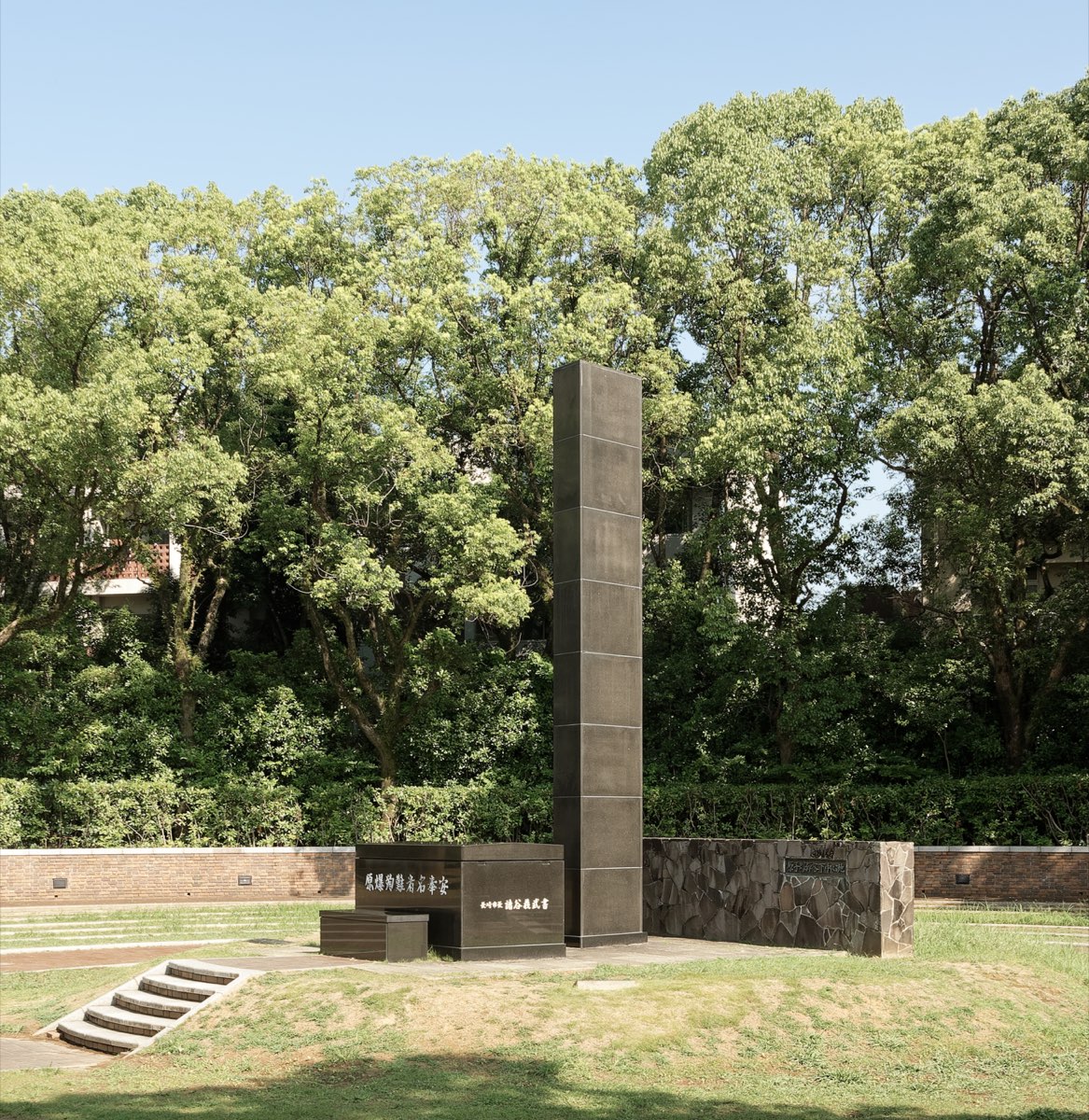
The hypocenter itself is the first. Its exact position has been studied since the bombing and revised as research advanced, but every current estimate falls within the Peace Park's Prayer Zone, commonly called Hypocenter Park.
Layers of earth from the time of the bombing remain there. In 1948 the hypocenter was the stage for Nagasaki's first Peace Declaration.
At the former Shiroyama National School, the staircase section of the north building survives. Wooden blocks set into its concrete frame remain charred, a known sign of the intense fire.
One bell-tower dome of Urakami Cathedral slid down into the stream below the cliff, where it still lies. It is 5.5 meters across and is said to weigh an estimated 50 tons. Because the cathedral was taken down in 1958 and rebuilt the following year, the city calls the dome a valuable remnant showing that the cathedral was bombed.
One stone gatepost of the former Nagasaki Medical College shifted 9 centimeters on its base and still stands tilted. At Sannō Shrine, about 800 meters southeast, the blast brought down one pillar of the second torii gate, while the other still stands alone; its surface facing the hypocenter peeled under the heat rays.
Passing on the memory
Nagasaki City began collecting and displaying atomic-bomb materials in 1949, four years after the bombing, as traces of the damage were disappearing. Survivors and their families have since donated many belongings. In April 1996 the Nagasaki Atomic Bomb Museum opened in place of the earlier Nagasaki International Culture Hall.
The museum presents the damage, the events that led to the bombing and the history of nuclear weapons development, with texts in Japanese, English, Chinese and Korean. It states that it will keep conveying the reality of the bombing and sending out a message of peace toward a world without nuclear weapons.
As survivors grow older, fewer people can hear their stories directly. In fiscal 2014 and 2015 the city recruited family members of survivors to carry on their testimony, and from fiscal 2016 it has also invited people who are not family but have close ties with survivors.
Places to visit
Nagasaki Atomic Bomb Museum.* Check the official site for hours, fees and any changes, since the museum has announced an upcoming renewal.
Nagasaki Atomic Bomb Ruins (national Historic Site).* The hypocenter in Hypocenter Park in Matsuyama-machi, near the Heiwa-kōen tram stop; the former Shiroyama National School building, within Shiroyama Elementary School; the bell-tower dome at the Catholic Urakami Church; the gatepost on the Sakamoto campus of Nagasaki University; and the one-pillar torii on the approach to Sannō Shrine.
Sources
- 第2 原子爆弾の投下と被害状況Nagasaki City
- 原爆投下の指令Nagasaki City (Nagasaki Peace website)
- 原爆の威力Nagasaki City (Nagasaki Peace website)
- 国指定史跡「長崎原爆遺跡」Nagasaki City (Nagasaki Peace website)
- 原爆搭載機の進入経路と投弾Nagasaki City (Nagasaki Peace website)
- 11時2分(原爆の惨状)Nagasaki City (Nagasaki Peace website)
- 8月9日(原爆の惨状)Nagasaki City (Nagasaki Peace website)
- 浦上天主堂(被災写真)Nagasaki City (Nagasaki Peace website)
- 城山国民学校(被災写真)Nagasaki City (Nagasaki Peace website)
- 原子爆弾とはNagasaki City (Nagasaki Peace website)
- 原爆資料館Nagasaki City (Nagasaki Peace website; Nagasaki Atomic Bomb Museum)
- 開館30周年特別展「閃きのあとー長崎原爆資料館の軌跡」Nagasaki City (Nagasaki Peace website; Nagasaki Atomic Bomb Museum)
- 家族・交流証言 募集についてNagasaki City (Nagasaki Peace website)
- 長崎原爆遺跡(文化遺産オンライン)Agency for Cultural Affairs (Cultural Heritage Online)