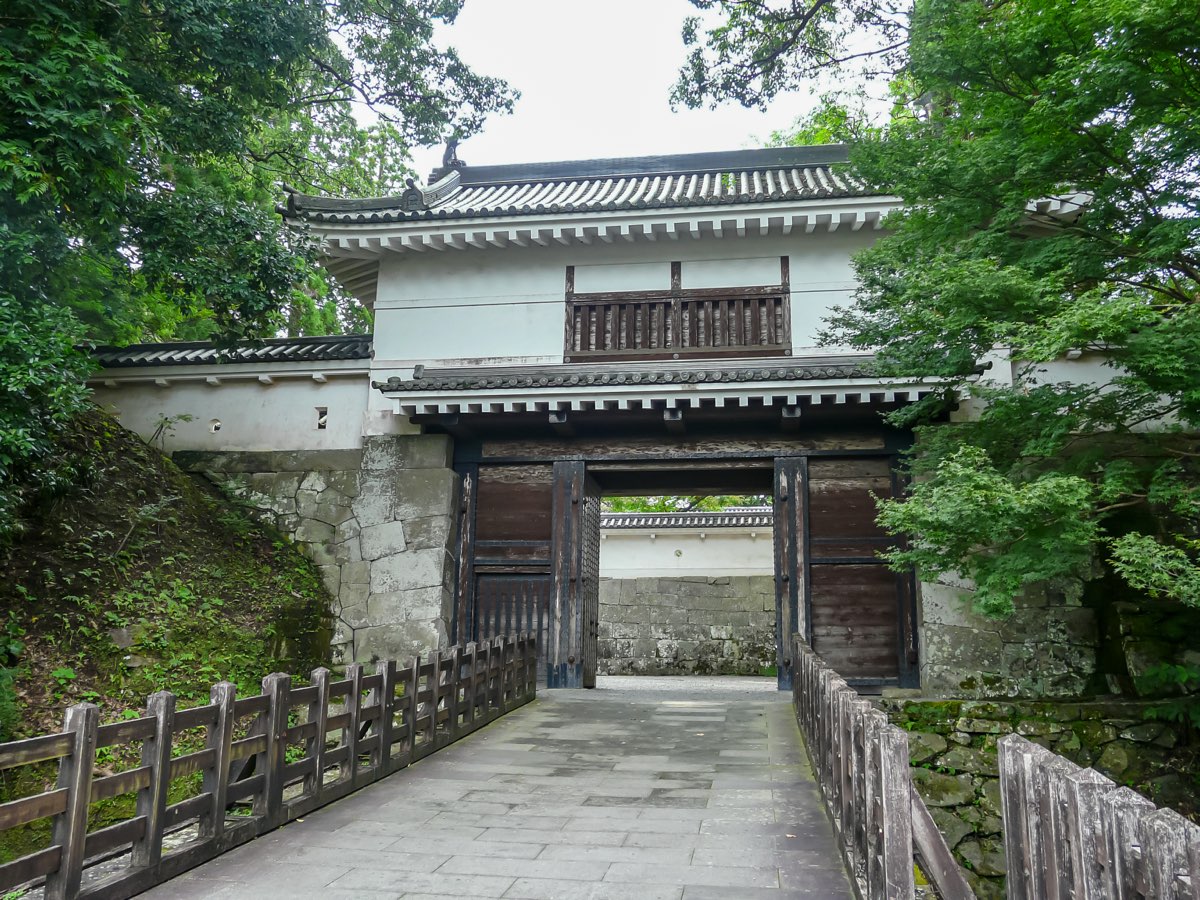
In southern Miyazaki Prefecture, the town of Obi keeps the street plan of an Edo-period castle town. According to the Agency for Cultural Affairs, Obi was the castle town of the Itō family, whose domain was assessed at 51,000 koku of rice, and its moss-covered stone walls, gates and long gatehouse walls, among plantings and trees, recall the samurai residences of the past.
In 1977 the samurai district of Obi was selected as a national Important Preservation District for Groups of Traditional Buildings. Nichinan City, to which Obi now belongs, says it was the first such district in Kyushu. This article follows how the Itō came to Obi, how they laid out their town, and how its people have kept it.
The Itō and the long contest for Obi
Obi is an old place name. According to the Nichinan City Board of Education, it appears in the Heian-period dictionary Wamyō ruijushō as Obi-gō in Miyazaki district, which suggests that the area was developed early.
The Itō family came from the Itō estate in Izu Province. The Agency for Cultural Affairs explains that the family received land rights in Hyūga in the Kamakura period.
In the fourteenth century it served Ashikaga Takauji and was given Tonokōri in Hyūga. The family moved there and built Tonokōri Castle, in today's Saito City, as its base.
From Tonokōri the Itō extended their power across central Hyūga, and their rivalry with the Shimazu of Satsuma, who sought to advance into Hyūga, grew sharper. According to the city's board of education, the two families often fought over Obi. The Agency notes that in the second half of the sixteenth century the Itō for a time succeeded in taking Obi Castle.
Their fortunes then turned. In 1572 the Itō were heavily defeated by the Shimazu at the Battle of Kizakibaru. In 1577 they left Hyūga for Bungo, relying on the Ōtomo family, and Hyūga came under Shimazu rule.
A new beginning under Hideyoshi
The Itō returned through national politics. In 1587 Toyotomi Hideyoshi, answering a request from the Ōtomo, sent a large army to Kyushu and subdued the Shimazu. In the settlement, the Agency records, Obi was given to the Itō, while the Shimazu received Sadowara and other lands.
The city's board of education adds that Itō Suketake had served as a guide in Hideyoshi's Kyushu campaign and was given Obi for this service.
In 1588 Suketake entered Obi Castle as the first lord of the domain and began to build the castle town. He also founded Hōonji, a temple of the Rinzai school, as the family temple of the Itō.
Hōonji was abolished in 1872, but its garden, set against a rock face of Obi stone about 15 meters high with a three-span stone bridge, is now a nationally registered monument.
From then on, the board of education notes, the Itō ruled Obi until the end of the Edo period without ever losing the domain. The Obi Castle Town Preservation Society, which runs the castle facilities, counts fourteen generations of Itō lords who made Obi their base until the domains were abolished in 1871.
Laying out the castle town
According to the Agency for Cultural Affairs, the street plan was completed in the early Edo period. Since then, as a small castle town, Obi has kept its samurai and townspeople's quarters together around the castle site.
Nichinan City describes the plan in more detail. The Sakatani River surrounds the town on three sides, and the lots are close to square. Closest to Obi Castle lived the upper-ranking retainers, then the middle-ranking retainers, then the townspeople, and farthest out the lower-ranking retainers.
The board of education points out that the lot divisions on a map of the castle town drawn in 1652-1655 almost match those of today.
The samurai houses were built according to rank. Each set up a gate suited to its standing and surrounded its plot with stone walls of Obi stone or river stones, topped with hedges of tea and other plants. Nichinan City notes that the widths of the streets have stayed almost unchanged, and that the stone walls, hedges and gates facing them are preserved as they were.
Obi stone is a welded tuff, formed when shirasu deposits hardened. The Agency describes the hedge-topped stone wall as a common feature of samurai houses in Obi, many of which survive.
The Preservation Society adds that the walls vary in style, including one peculiar to Obi in which cut stones are fitted together without gaps, known as Obi-zumi.
The former residence of the Itō Denzaemon family, whose plot is ringed by Obi-stone walls topped with hedges, lies in a district where upper-ranking retainers lived. According to the Agency, this branch of the Itō was related to the lords and served for generations as chief retainers (karō). Its garden, with a dry waterfall and a stone bridge, is a registered monument that conveys the gardens of senior retainers in the castle town.
Learning in the domain
In 1831 the domain founded a school, Shintokudō. Its long gatehouse and main building are preserved within stone walls more than two meters high.
According to the National Diet Library, the diplomat Komura Jutarō, born in 1855 as the son of an Obi samurai, studied at Shintokudō and was then sent by the domain to the Daigaku Nankō, later the University of Tokyo. In 1875 he was chosen as one of the first Ministry of Education students to study abroad and entered Harvard.
Yoshōkan was built in 1869 as the residence of the Itō lords' family. The Preservation Society calls it the samurai residence of the highest standing in Obi; its garden is a dry landscape garden.
Keeping the town
Nichinan City records the steps taken in the 1970s. A project to restore Obi Castle ran from 1974 to 1979.
In 1976 the city decided the preservation district and passed a preservation ordinance, and on May 18, 1977, the district was selected by the national government.
The selection gave the reason that Obi, as a typical small regional castle town, shows the historic character of samurai residences well and is of high value for the country. The protected area covers about 19.8 hectares.
A summary of the district prepared by Nichinan City and dated May 8, 2026 lists 14 buildings and 128 other structures, such as walls and gates, as traditional structures, together with 23 protected natural features such as trees and hedges.
A leaflet that the board of education issued for residents in 2021 reminds them that a town that has survived since the Edo period did not survive by chance. It notes that it was kept by the efforts of earlier generations and of the people living there now.
Places to visit
The Ōtemon gate of Obi Castle and the castle grounds lie within the district. The Obi Castle History Museum displays and keeps about 220 items connected with the domain, such as armor, swords and documents handed down in the Itō family and among its retainers.
Matsuo-no-maru is a modern building, put up in 1979 after historical research as a palace in the shoin style of the early Edo period; it is not a surviving Edo-period building.
Yoshōkan and its garden and the former domain school Shintokudō are among the facilities open to visitors, and the Itō Denzaemon garden also lies within the preservation district. A walk along the streets between hedges and stone walls shows the plan described above.
On the right bank of the Sakatani River, outside the castle town, the garden of the former Hōonji survives at the shrine that now stands on the temple site. Check the official websites of Nichinan City and the Obi Castle Town Preservation Society for opening hours before visiting.
Sources
- 日南市飫肥Agency for Cultural Affairs (National Cultural Heritage Database)
- 日南市飫肥伝統的建造物群保存地区Nichinan City
- 日南市飫肥伝統的建造物群保存地区の町並み保存についてNichinan City Board of Education (Lifelong Learning Section, Cultural Properties)
- 日南市飫肥(宮崎県)(重要伝統的建造物群保存地区の紹介資料)Nichinan City (prepared by the city; published on the Agency for Cultural Affairs website)
- 都於郡城跡Agency for Cultural Affairs (Cultural Heritage Online)
- 穆佐城跡Agency for Cultural Affairs (Cultural Heritage Online)
- 旧報恩寺庭園Agency for Cultural Affairs (Cultural Heritage Online)
- 旧伊東伝左衛門庭園Agency for Cultural Affairs (Cultural Heritage Online)
- KOMURA Jutaro (Portraits of Modern Japanese Historical Figures)National Diet Library
- 飫肥藩主伊東氏Obi Castle Town Preservation Society (general incorporated foundation)
- 石垣のまち"飫肥"Obi Castle Town Preservation Society (general incorporated foundation)
- 飫肥城歴史資料館Obi Castle Town Preservation Society (general incorporated foundation)
- 豫章館Obi Castle Town Preservation Society (general incorporated foundation)
- 旧藩校振徳堂Obi Castle Town Preservation Society (general incorporated foundation)
- 松尾の丸Obi Castle Town Preservation Society (general incorporated foundation)