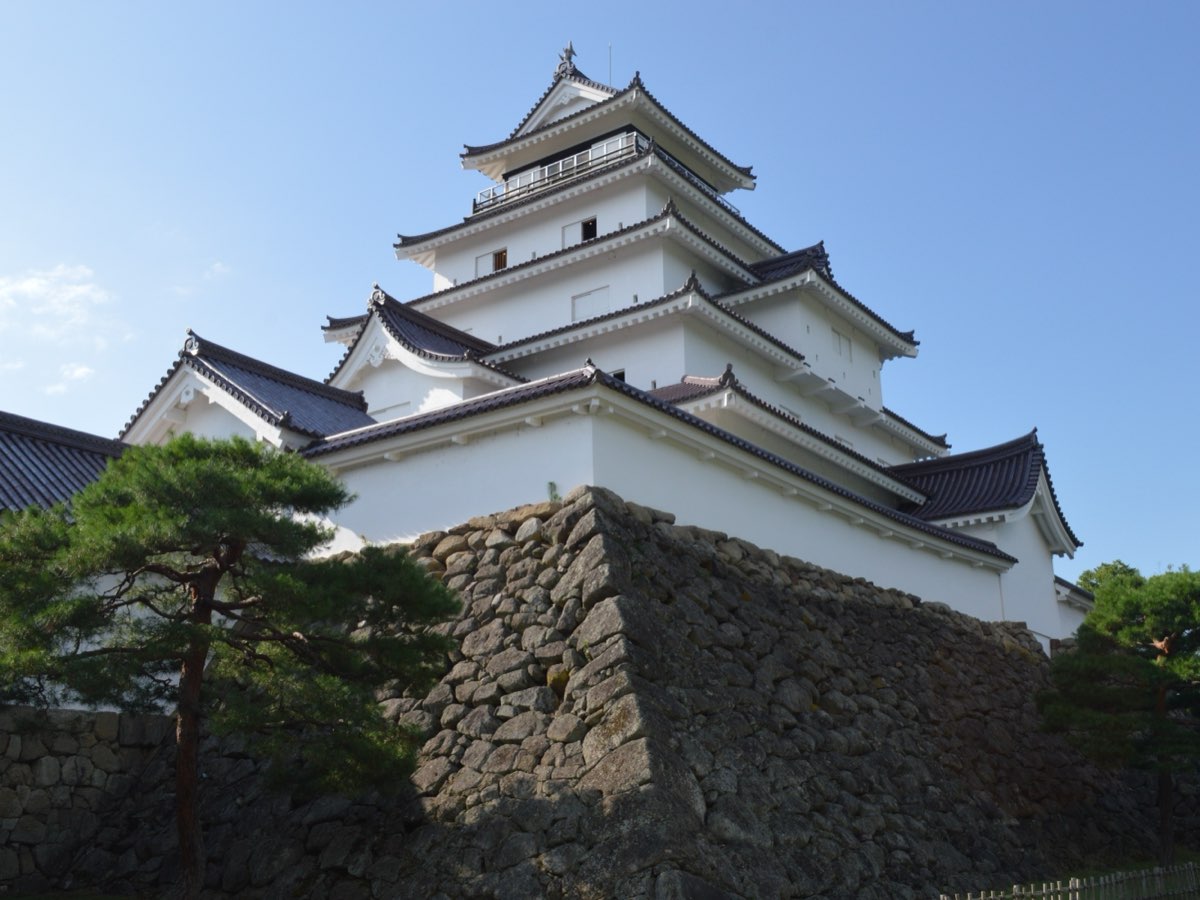
Aizu, centered on today's Aizuwakamatsu in Fukushima Prefecture, was ruled by a long succession of lords. This article follows the domain from the arrival of Hoshina Masayuki in 1643 to the war of 1868 that ended its rule over Aizu.
The story of Aizu is often told through the Byakkotai, the teenage soldiers who died on Mount Iimori. This article keeps four things apart: how the domain was governed, what the war meant for the people who lived through it, the military and political decisions behind it, and the ways the war has been remembered since.
A Tokugawa house in Aizu
Aizu had many rulers before 1643. Gamō Ujisato arrived in 1590, built a keep in 1593, named the castle Tsurugajō, and renamed the town of Kurokawa as Wakamatsu. Later, after an earthquake in 1611 damaged the castle, Katō Yoshiaki and his son Akinari carried out a major rebuilding.
In 1643 (Kan'ei 20), Hoshina Masayuki was moved to Aizu from Mogami (Yamagata) with a domain of 230,000 koku. A son of the second shogun, Hidetada, and half-brother of the third, Iemitsu, he had been adopted by Hoshina Masamitsu, lord of Takatō in Shinano. From 1696, by the shogun's order, his successors used the Matsudaira surname and the Tokugawa hollyhock crest.
In 1668 (Kanbun 8) Masayuki laid down fifteen house precepts. As quoted by Aizuwakamatsu City, the first article demands loyal service to the shogun's house and says that if a lord turns disloyal, his retainers must never follow him. A domain reference work cited by a Saitama prefectural library calls the precepts the spiritual pillar of Aizu's lords and retainers until the end of the Edo period.
According to the foundation that manages Tsurugajō, red glazed roof tiles were developed in Aizu on Masayuki's orders to withstand cold and snow.
The domain school, the Nisshinkan, was built just west of the castle between 1799 and 1803. According to the city, pupils could enter from age ten; it taught 28 subjects in letters and arms and is said to have had well over a thousand pupils.
Fukushima Prefecture notes that the Nisshinkan became a model for schools in other domains.
From Kyoto to war
In 1862 (Bunkyū 2) Matsudaira Katamori, the ninth lord, was appointed to the new post of Protector of Kyoto. According to Aizuwakamatsu City, the ill Katamori declined several times.
Matsudaira Shungaku urged him on by citing Masayuki's precepts, while senior retainers such as Saigō Tanomo pressed him to refuse. He finally accepted and entered Kyoto with 1,000 retainers.
Interpretations differ
As Protector, Katamori cracked down hard on activists of the "revere the emperor, expel the barbarians" movement. The National Diet Library notes that many samurai of Satsuma, Chōshū, and Tosa, the core of the new government's army, held grudges against Katamori, Aizu, and the Shinsengumi, and that the attack on Aizu is said to have had a different background from campaigns against other domains.
The Boshin War began with fighting at Toba and Fushimi near Kyoto on the third day of the first month of Keiō 4 (1868, lunar calendar). Aizu at first indicated that it would obey the court and the new government's army.
The first surrender terms, however, demanded Katamori's beheading, the opening of the castle, and the loss of the domain's lands. In the face of this hard line, those who favored fighting gained ground within Aizu, and the domain turned to full resistance.
The siege of Wakamatsu
Fighting between the government army and Aizu began at Shirakawa Castle on the 24th day of the intercalary fourth month (lunar calendar). Against troops with new rifles and cannon, the Aizu side was gradually pushed back.
In the eighth month the fighting reached Aizu itself. Siege warfare at the castle continued for about a month.
About 5,000 people held out inside the castle, including around 1,000 elderly people, children, and women. The castle was surrounded and shelled. The general bombardment on the 14th day of the ninth month is said to have involved 50 guns each firing 50 shells.
Wounded people filled the castle, and accounts quoted by the National Diet Library describe shells bursting in rooms for the sick and for women.
On the 22nd day of the ninth month of Keiō 4 (lunar calendar), Aizu opened the castle to the new government's army and surrendered. A Chōshū soldier later recalled that people were sheltering in trenches lined with tatami mats, with only 20 or 30 bales of rice left.
People caught in the war
Interpretations differ
The National Diet Library gives about 2,400 Aizu war dead, and mentions a view that the total reaches several thousand if farmers, women, and others killed in the fighting are included.
Women and boys took part in the fighting. In one case remembered today, 21 members of the family of the senior retainer Saigō Tanomo took their own lives at their home in the castle town rather than enter the castle and become a burden. Yamamoto Yae, later the wife of Niijima Jō, was among those who fought from inside the castle with a gun.
The Byakkotai
After the defeat at Toba and Fushimi, Aizu reorganized its army on Western lines and grouped samurai units by age. It also recruited farmers and townspeople as militia. The Byakkotai, or White Tiger Corps, was made up of youths aged 16 and 17, numbering about 300 in all.
One company of these 16- and 17-year-olds retreated from the battlefield at Tonoguchihara and reached Mount Iimori. From there they saw thick black smoke hiding the castle keep, and they chose to take their own lives. Nineteen of them are buried at the site.
Interpretations differ
Even the city's own document describes their reasoning in two ways. In its main text, the boys debated whether to return to the castle or charge the enemy before choosing death rather than capture, while its closing summary has them asking whether the castle had fallen and resolving to die for their lord. One member, Iinuma Sadakichi, survived, and it was through him that the story became widely known.
Defeat, exile, and memory
After the surrender, Katamori retired, and the Matsudaira house was moved to the Nanbu region of Mutsu Province, its domain cut from 230,000 to 30,000 koku. About 17,000 former Aizu retainers moved there; many suffered hunger in the harsh climate, and many died of starvation or disease.
Some former Aizu samurai later rose in the new state. Many served in the government army in the Satsuma Rebellion of 1877; Yamakawa Hiroshi became a major general, and his brother Yamakawa Kenjirō became president of Tokyo Imperial University. Niijima Yae served as a volunteer nurse in the Sino-Japanese and Russo-Japanese wars.
Memory took organized form. The graves on Mount Iimori were laid out in 1883 and enlarged in 1890 and 1925.
A memorial association was recognized in 1917, and ceremonies are held there every 24 April and 24 September. The grounds also hold graves of 31 other members of the corps and, since 2001, a memorial to 62 boy warriors aged 14 to 17.
According to the head of the tourism bureau, the sense of having been branded "enemies of the court" lasted a long time. He writes that in 1928, when Setsuko of the former lord's Matsudaira family was to marry into the imperial Chichibu household, people in Wakamatsu reportedly rejoiced that the stigma had finally been lifted.
On 22 September 2018, Aizuwakamatsu City issued a declaration for the 150th anniversary. It called the war one that Aizu had not wanted, fought with a sense of gi (righteousness), and pledged to console the dead, pass on the tragedy of war and the value of peace, and research new historical records so that Aizu's history would be correctly understood.
Interpretations differ
How the war is judged still depends on the viewpoint. Writing in the city's magazine, Yanagisawa Hideo, head of the Aizukai association, observes that for Aizu the anniversary is "Boshin 150" rather than "Meiji Restoration 150," because the evaluation of history differs according to one's standpoint.
Visiting today
Tsurugajō, in Aizuwakamatsu, is a national historic site, designated under the name Wakamatsu Castle Site. Its buildings were demolished by 1874, the keep was rebuilt in 1965, and the roof was changed in 2011 to red tiles like those of the late Edo period.
Inside the keep is a local history museum about Aizu's samurai era, with a section that presents the Boshin War, or Aizu War, from several points of view.
On Mount Iimori, visitors can see the graves of the Byakkotai and look across to the castle keep, a view the city now protects under its landscape plan. Check the official websites for opening hours before visiting.
Sources
- 会津戦争National Diet Library
- 会津の歴史と戊辰150年Contributors to the Aizuwakamatsu City Boshin 150th anniversary book (named individuals)
- 大名 - 11.千年の松(デジタル展示「大名」)National Archives of Japan
- 親善交流都市締結後の交流のあゆみ(伊那市)Aizuwakamatsu City
- 会津と新選組~幕末の会津と新選組の歴史を紐解く~Aizuwakamatsu City
- 松平容保|近代日本人の肖像National Diet Library
- 会津藩家訓15カ条を知りたい。(レファレンス協同データベース)Saitama Prefectural Kuki Library (published in the National Diet Library's Collaborative Reference Database)
- 市政だより「あなたの声に市長が答えます」Aizuwakamatsu City
- 会津若松市戊辰150周年記念宣言Aizuwakamatsu City
- 近世Fukushima Prefecture
- 4.飯盛山と白虎隊をはじめとする先人慰霊にみる歴史的風致Aizuwakamatsu City
- 鶴ヶ城のご案内一般財団法人 会津若松観光ビューロー (Aizuwakamatsu Tourism Bureau)