Beppu, on the east coast of Ōita Prefecture, spreads over an alluvial fan at the foot of volcanoes where geothermal activity continues. According to the Agency for Cultural Affairs, the city has the largest number of hot springs and the greatest volume of hot-spring water in Japan, and plumes of steam rise from about 400 places across it.
Beppu City calls these steam plumes the symbol of Beppu. This article follows how a hot spring known since ancient times became a resort town in the Meiji era, and how, in 1950, a national law set out to build it as an international city of tourism and hot-spring culture.
A hot spring in the old records
Beppu's hot springs appear in records as early as the eighth century. The Agency for Cultural Affairs notes that descriptions of the blood-red Chi-no-ike Jigoku and the blue Umi Jigoku appear in the eighth-century gazetteer of Bungo Province, the Bungo fudoki. They also appear in an account of travels in the region written by a scholar at the end of the seventeenth century, and in the Wakan sansai zue, compiled in the early eighteenth century.
Beppu City dates that travel account to 1694 and says that it describes the bustle of the hot-spring places.
The springs were used for more than bathing. At Myōban, people have made yunohana since the Edo period. They build special huts in which crystals form from steam rising from the ground and blue clay, and the product has been used as medicine and as a bath additive.
The Agency explains that steam at Myōban was used to make alum in the early modern period and, from the Meiji era, the bath additive. The technique was designated an Important Intangible Folk Cultural Property in 2006.
Drilling and the Meiji resort
The Agency describes how Beppu changed in the Meiji era. A harbor was built, visitors began to arrive from places around the Seto Inland Sea, and the town developed as a tōji (hot-spring cure) resort.
New technology changed the supply of hot water. According to the Agency, in the middle of the Meiji era Kazusa-bori, a well-boring method that had developed in the Kazusa area of Chiba, was introduced to Beppu. It made artificial drilling possible, and the number of hot springs increased dramatically.
The Agency adds that the method was partly adapted to local geology as a "Beppu style," and that the drilling technique became widely known along with the name of Beppu Onsen. A set of 394 tools used for this hand drilling, known locally as yutsuki, was registered as a Tangible Folk Cultural Property in 2020. Beppu City says that by the late Meiji era there were said to be about 1,000 drilled wells.
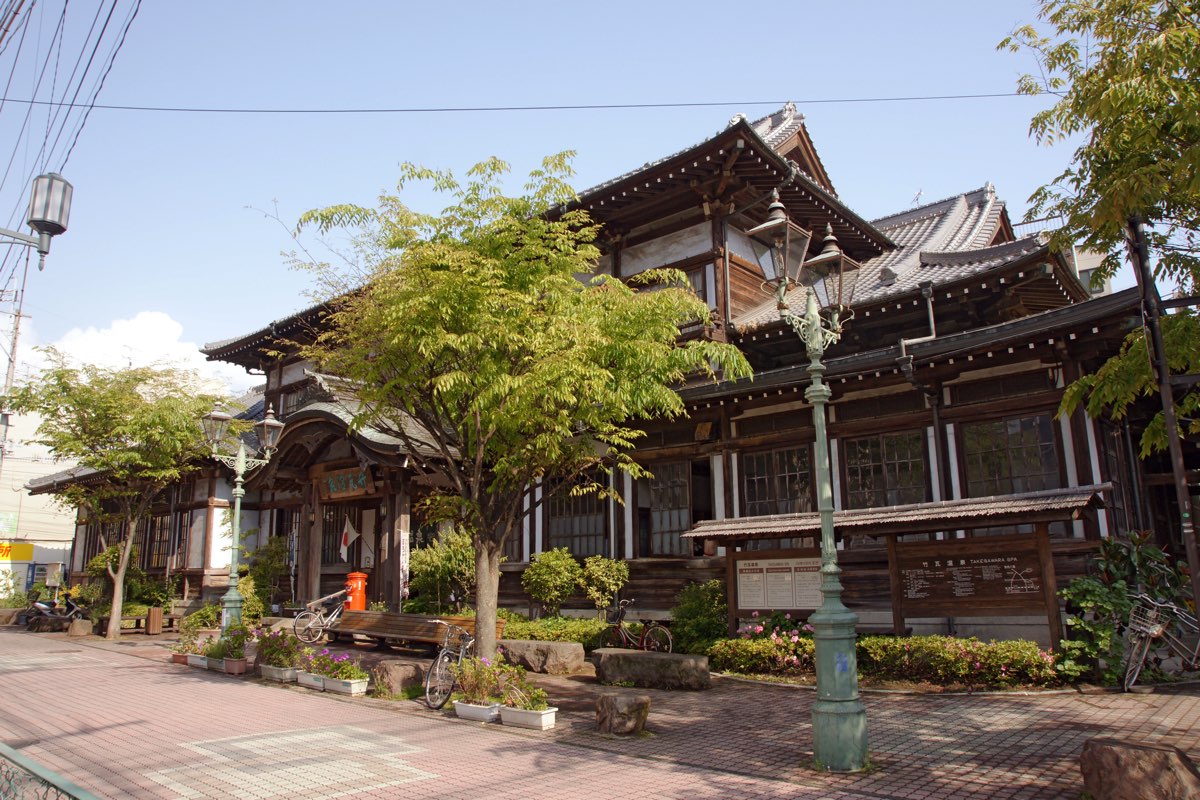
Takegawara Onsen, a public bath run by the city, was founded in 1879; the city explains that the name is said to come from its first roof of bamboo (take) and a later roof of tiles (kawara). The present building, with its ornate curved gable over the entrance, dates from 1938, and the city calls it a symbol of Beppu Onsen.
In Kannawa, the main building of the Fujiya inn, built in 1898, is a Registered Tangible Cultural Property. The Agency describes it as a long-established inn of Kannawa Onsen, the core of the hot-spring areas known as Beppu Hattō.
A set of five bird's-eye views of the hot springs of Bungo, dated 1905, shows the townscape of 1902. According to the Agency's database, the views show houses lining the hot-spring districts and the streetcar that ran between Beppu and Hamawaki.
The hells and the sightseeing tour
Among Beppu's sights are the jigoku, or hells. The Agency explains that in Kannawa a group of springs pour out large amounts of very hot water with unusual colors and forms, and that people have long called them "hells."
In the modern era, new hells were drilled alongside the old ones. Tatsumaki Jigoku, a geyser, appeared in 1923, and Shiraike Jigoku, with its cloudy white water, in 1931. A tour around the springs, the jigoku-meguri, began and came to be promoted as the centerpiece of sightseeing in Beppu.
Four of the hells, Chi-no-ike, Umi, Tatsumaki and Shiraike, were designated a national Place of Scenic Beauty in 2009. The Agency values them for the scenic appeal of their unusual and varied colors and forms, and for their value as famous sights and for science.
The 1950 law
On July 18, 1950, Law No. 221, the Beppu International Tourism and Hot Spring Culture City Construction Act, was promulgated. Its first article states its purpose: to build Beppu as an international tourism and hot-spring culture city, in order to raise international culture and achieve the ideal of lasting world peace, and to contribute to economic recovery by developing hot springs as a tourist resource.
The law required the city plan to include facilities suited to such a city. It required the national and local governments to give as much help as possible, and it allowed the state to transfer state property to public bodies paying for the work.
Those carrying out the work were to report on its progress to the Minister of Construction at least every six months. The Prime Minister was to report to the Diet once a year, and the mayor of Beppu was to work without pause to complete the city, with the cooperation of its residents. The law took effect on the day it was promulgated.
Steam over a tourist city
Beppu City explains that in the postwar years, as society stabilized and the economy recovered, hot-spring development gained momentum, and that the two decades from 1955 were a time of rapid development.
The Agency links the dense steam that now covers parts of the town to this period. Most of it, it says, comes from wells drilled with boring methods introduced in earnest from the mid-1950s, when company trips and honeymoons brought a boom in mass tourism.
Many tourist facilities, such as Beppu Tower, were built in those years. In 1964 the opening of the Kyushu Ōdan Road placed Beppu on a touring route to Aso and Kumamoto, and many inns were built. In the 1960s, about 100 new wells were drilled each year for ten years, and the landscape of steam seen today took shape.
In 2012 the steam and the hot-spring landscape were selected as an Important Cultural Landscape. The Agency values the way the land is used: communal baths and cooking with steam in jigoku-gama ovens in daily life, and inns, rented rooms and the making of yunohana as livelihoods. It also notes that Beppu faces the challenge of conserving a limited hot-spring resource while using it.
Figures on Beppu City's website, taken from an Oita Prefecture report, count 2,831 hot-spring sources in the city with a total flow of 101,856 liters a minute, as of the end of March 2025. The city also notes that about 3,700 international students study at universities in Beppu.
Places to visit
Takegawara Onsen offers ordinary baths and a sand bath, in which attendants cover bathers with sand warmed by hot-spring water. In Kannawa and Myōban, the Agency notes, about half of the city's steam plumes rise, and Kannawa is crowded with communal baths and inns with rented rooms for tōji guests.
The four hells designated as a Place of Scenic Beauty are in the Kannawa and Noda districts. Check the official websites for opening hours and fees before visiting.
Sources
- 別府国際観光温泉文化都市建設法(昭和25年法律第221号)House of Representatives, Japan
- 別府の地獄Agency for Cultural Affairs (Cultural Heritage Online)
- 別府の湯けむり・温泉地景観(昭和の文化財)Agency for Cultural Affairs
- 別府の湯けむり・温泉地景観Agency for Cultural Affairs (Cultural Heritage Online)
- 別府の湯突き用具Agency for Cultural Affairs (Cultural Heritage Online)
- 別府明礬温泉の湯の花製造技術Agency for Cultural Affairs (Cultural Heritage Online)
- 冨士屋旅館主屋Agency for Cultural Affairs (Cultural Heritage Online)
- 豊後各温泉案内図Agency for Cultural Affairs (Cultural Heritage Online)
- 別府温泉のなぞと歴史(温泉百科)Beppu City (Hot Springs Division), produced jointly with NPO 別府温泉地球博物館事業研究会
- 温泉データ(温泉百科)Beppu City (Hot Springs Division)
- 別府市の概要Beppu City (Policy Planning Division)
- 竹瓦温泉Beppu City