Hakodate lies at the southern tip of Hokkaido, across the Tsugaru Strait from Aomori. Hakodate City describes it as one of Japan's first ports opened to the world for trade, a city that took in foreign cultures and grew on fisheries and shipbuilding.
On the 2nd day of the 6th month of Ansei 6, or 1 July 1859 in the Gregorian calendar, Hakodate opened for free trade together with Yokohama and Nagasaki. This article follows how a northern harbour became a treaty port, what it traded, who came to live there, and how the opening shaped the streets that visitors walk today.
A harbour before the treaties
Hakodate City's chronology begins in 1454, when Kōno Masamichi built a residence at Usukeshi. The place is said to have been called Hakodate, "box residence," after this building.
According to the city's account of its preservation district, Hakodate had long been known as a fine natural harbour and prospered as a collecting point for the trade in marine products. In 1793 the Russian envoy Laxman sailed into the port on the Ekaterina.
In the 2nd month of Kyōwa 2 (1802) the shogunate set up a magistracy for Ezo, as Hokkaido was then called, and in the 5th month renamed it the Hakodate Magistracy (Hakodate bugyō). In 1821 the area was returned to the Matsumae domain.
From supply port to free trade
In 1854 the shogunate concluded the Treaty of Peace and Amity with the American commodore Matthew Perry. Five American ships entered Hakodate to survey the harbour. Under the treaty the shogunate decided to open Hakodate and Shimoda, and foreign ships began to call at Hakodate to rest their crews and take on supplies.
The same year, according to Hakodate Central Library, the shogunate again placed a Hakodate magistrate in the area, this time for foreign policy, the defence of the north and the government of Ezo. In 1855, Hakodate City's chronology records, the port opened as a place where foreign ships could obtain food and water.
The amity treaty allowed only the sale of supplies to foreign ships, not general trade. The Hakodate city history notes, however, that some dealings went beyond supplies. In 1857 (Ansei 4), records list soy sauce, rice, beans, kelp and lacquerware handed to two American merchant ships, which the history says do not look like ordinary resupply.
In 1858 the shogunate concluded treaties of amity and commerce with the United States, the Netherlands, Russia, Britain and France. Hakodate, Yokohama and Nagasaki were designated free trading ports, and Hakodate opened on the 2nd day of the 6th month of Ansei 6 (1 July 1859).
Kelp, customs and controls
The Hakodate magistrate issued a notice allowing "trade with foreigners" from the 5th day of the 6th month, and stated that merchants were free to trade with Russia, France, Britain, the Netherlands and the United States. A further notice dated the 29th, however, required merchants to report goods bought and sold to the trade office for inspection.
The same notice kept the products of Ezo under the existing controls of the wholesalers (ton'ya) and the Okinokuchi office. Goods such as dried sea cucumber and dried abalone could be traded only through the magistracy. The city history concludes that a system was envisaged in which the strict rules already applied to Ezo's products within Japan would be carried over unchanged into foreign trade.
When the port opened for trade in 1859, a trade office called the Hakodate Unjōsho was set up. Hakodate Customs traces its origin to this office. It was renamed when Hakodate's name changed in 1869, and in 1872 the offices across Japan were renamed customs houses (zeikan).
Most of Hakodate's trade, the city history explains, was the export of Hokkaido's marine products, above all kelp (konbu). Exports far exceeded imports. Raw silk and silkworm eggs brought in from the Tōhoku region were also shipped out.
Imports were small and varied: woollens and cottons, ships, iron for railways, daily goods, and rice in years of shortage. Except for the first year, 1859, Hakodate's share of Japan's foreign trade was about two to three percent or less, according to figures in the city history.
Consuls and foreign residents
The first foreigner to live in Hakodate was the American E. E. Rice, who arrived in 1857 and lodged in the grounds of Jōgenji temple in Ōmachi. He came as a "Commercial Agent," although the amity treaty did not provide for a consul at Hakodate.
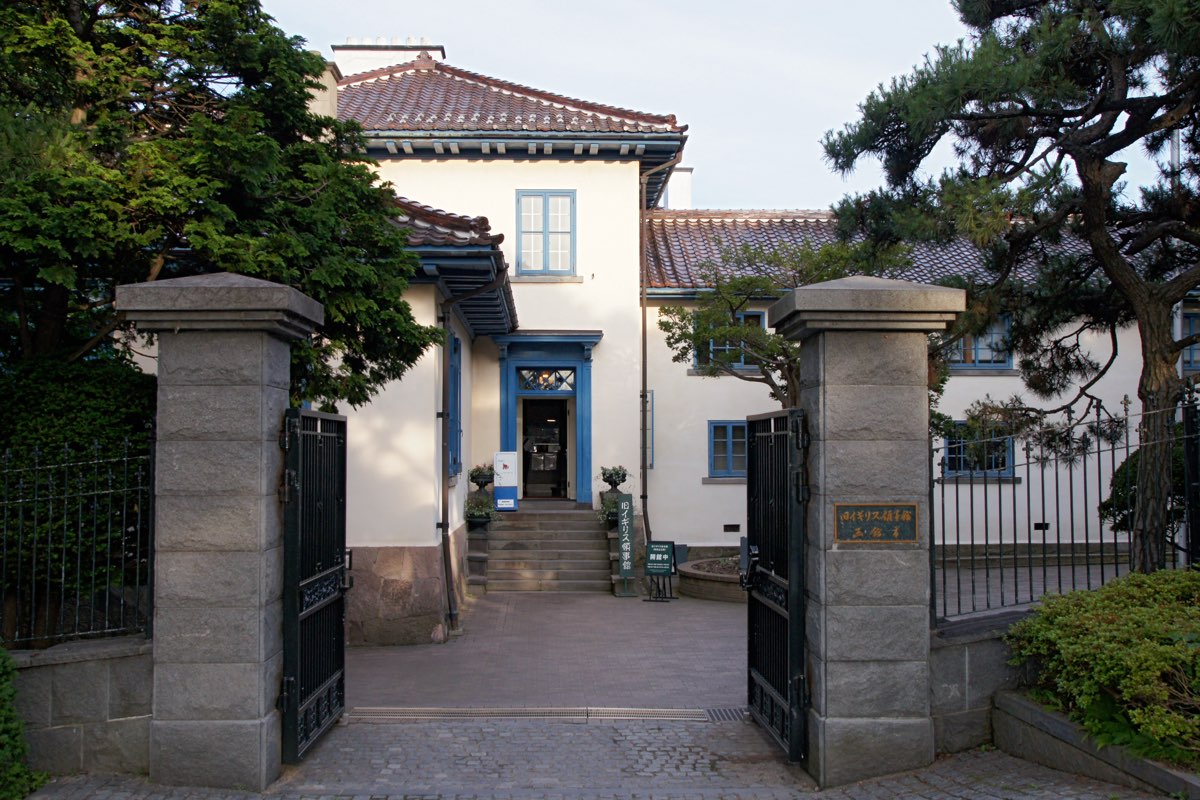
The first British consul, Hodgson, arrived in 1859 and began work at Shōmyōji temple, his temporary lodging. Britain's first consulate building went up in 1864, but it burned in 1866 and was hit by fire again in 1879 and 1907. The present building on its site in Motomachi dates from 1913.
Russia set up a consulate in 1859, and a chapel was built at the same time. According to the city history, the Orthodox missionary Nikolai came to Hakodate in 1861 (Bunkyū 1). Christianity was legally tolerated in Japan only after the notices banning it were taken down on 24 February 1873.
The city history counts 16 countries that placed consuls in Hakodate, 14 of them between the last years of the shogunate and the early Meiji period, though many left their affairs to another country's consul. The residents were mostly British, American and Russian consular staff, merchants and church workers.
No fixed foreign settlement was laid out at first. Foreigners rented merchants' houses and storehouses and lived among the townspeople. In 1860 the magistrate proposed reclaiming land on the Ōmachi shore to lease to foreigners, and for the first time used the phrase "foreign settlement" for Hakodate.
In practice, the city history concludes, foreign residents never gathered in one place. Compared with Yokohama and Nagasaki, trade was much weaker, and no firm foreign community took shape.
A town in two parts
The opening also moved the centre of government. According to the city history, the magistracy at the foot of Mount Hakodate was moved to the Kameda area, apparently out of concern that foreigners climbing the mountain could look down on the town and its offices. Goryōkaku was built for this move.
Hakodate Central Library dates Goryōkaku's construction from 1857, with the work largely complete in 1864 and finished in 1866. Its Western-style earthworks were designed by Takeda Ayasaburō with reference to fortified cities in medieval Europe.
The city history describes the result as a town divided in two: the western district by the harbour and the new Goryōkaku district. The division was short-lived. Goryōkaku was occupied by former shogunate forces in the 10th month of Meiji 1 (1868) and became the stage of the Hakodate War until it surrendered in the 5th month of the following year.
In 1869 Ezo was renamed Hokkaido, and Hakodate took its present written form. In 1871 the Kaitakushi, the government's development agency for Hokkaido, demolished most of the buildings inside Goryōkaku.
Fires and the Motomachi streets
The streets of the western district took their present form after fire. Hakodate City explains that after the fires of 1878 and 1879 (Meiji 11 and 12), the reconstruction rebuilt the town's structure from the ground up.
Motoizaka and Nijikken-zaka were widened to about 36 meters as firebreaks, and straight streets laid out in a regular grid. The street pattern has changed very little since.
After later fires, Japanese houses were rebuilt alongside Western-style buildings and buildings mixing Japanese and Western styles, many of which keep their appearance today. The city calls the area the birthplace of Hakodate.
In 1989 about 14.5 hectares in parts of Motomachi, Suehirochō and three neighbouring districts were selected as a national Important Preservation District for Groups of Traditional Buildings. The district includes the Old Public Hall of Hakodate Ward and the Resurrection Church of the Hakodate Orthodox Church, both Important Cultural Properties, as well as brick warehouses near the harbour.
The opening also gained a day of its own. In 1935, a year the city's chronology marks as the 77th-anniversary commemoration of the opening, 1 July was set as Port Opening Day and the first Hakodate Port Festival was held.
Places to visit
The Old British Consulate in Motomachi, the 1913 building, is now the Port Opening Memorial Hall. Hakodate City lists exhibition rooms and a museum on the port's opening; admission to the exhibition rooms is charged. Check the official website for current details before visiting.
The Motomachi-Suehirochō district around it can be explored on foot, from the Motoizaka slope near the harbour to the area of the Old Public Hall and the Orthodox church, and down to the brick warehouses.
Inland, the Hakodate Magistrate's Office has been rebuilt inside Goryōkaku, a national Special Historic Site. Excavation began in 1985, and the rebuilt office, focused on the administrative part of the original, opened to the public on 29 July 2010. Check the official website for opening details.
Map of places to visit
- Motomachi, Hakodate, HokkaidoOfficial websiteOpen in Google Maps
- Goryōkaku-chō, Hakodate, HokkaidoOfficial websiteOpen in Google Maps
Markers show approximate locations. Check opening days and hours on the official website.
Location and website checked: November 2, 2026
AdTours and tickets nearby (Viator)
See tours and tickets in Hokkaido on ViatorWe may earn a commission if you book through this link.
Sources
- 函館市の概要City of Hakodate
- 函館市元町末広町伝統的建造物群保存地区の概要City of Hakodate
- 函館市史 通説編第2巻 第4編 序章 第3節 3「箱館における貿易開始の体制」函館市(函館市地域史料アーカイブ、ADEAC)
- 函館市史 通説編第2巻 第4編 序章 第3節 3「貿易の概況」函館市(函館市地域史料アーカイブ、ADEAC)
- 函館市史 通説編第2巻 第4編 序章 第4節 1「外国人の居留」函館市(函館市地域史料アーカイブ、ADEAC)
- 函館市史 通説編第2巻 第4編 序章 第4節 1「米・露・英の領事」函館市(函館市地域史料アーカイブ、ADEAC)
- 函館市史 通説編第2巻 第4編 第3章 第1節 1「外国人居留地の性格」函館市(函館市地域史料アーカイブ、ADEAC)
- 函館市史 通説編第2巻 第4編 第3章 第1節 1「開港による市街の二分化」函館市(函館市地域史料アーカイブ、ADEAC)
- 函館市史 通説編第2巻 第4編 第12章「函館開港とキリスト教」函館市(函館市地域史料アーカイブ、ADEAC)
- 函館税関の沿革と機構函館税関(財務省)
- 旧イギリス領事館文化庁 文化遺産オンライン(解説:函館市教育委員会生涯学習部文化財課)
- 旧イギリス領事館(開港記念館)函館市
- 箱館奉行所(パスファインダー)函館市中央図書館