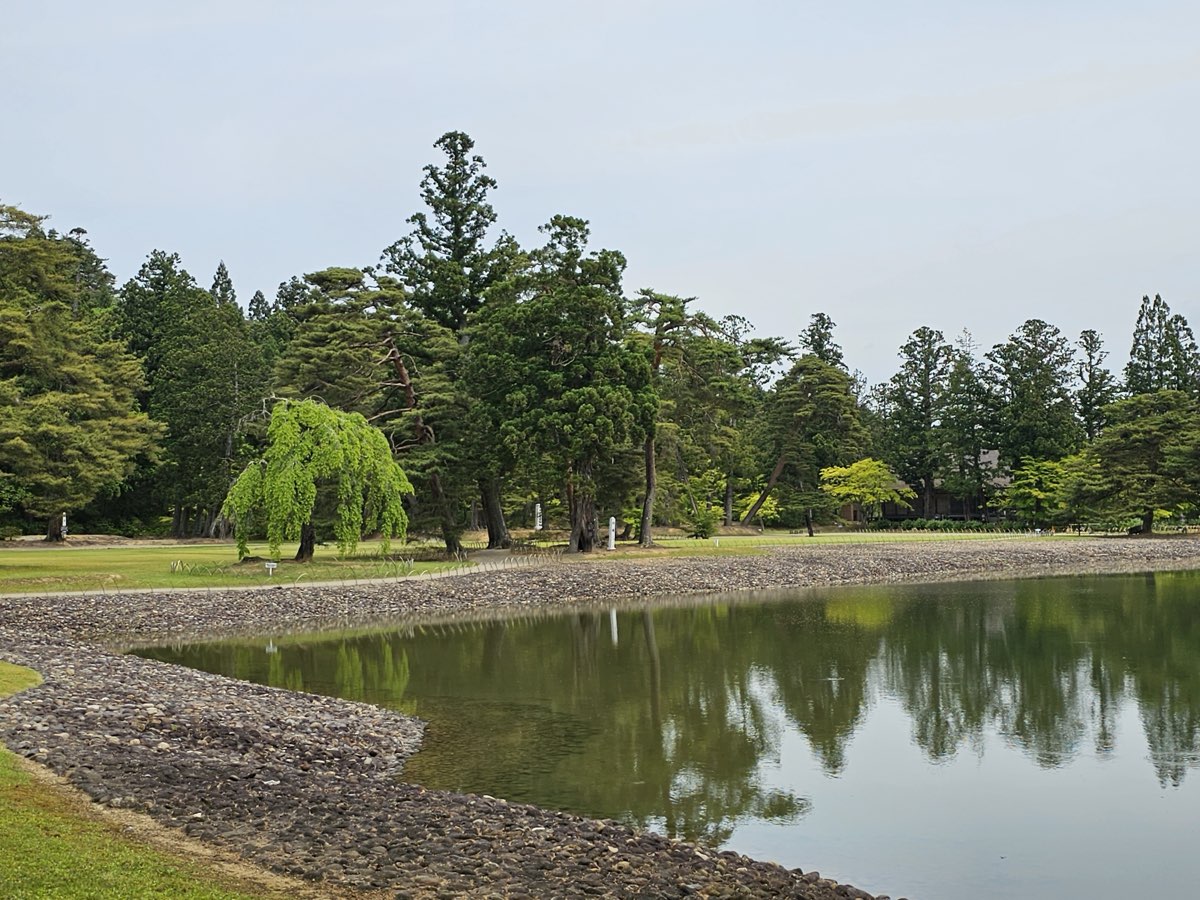
In the twelfth century, a place in what is now Iwate Prefecture became one of the most important centers in northern Japan. For about a hundred years, four generations of the Ōshū Fujiwara family governed from Hiraizumi and filled it with temples, gardens, and works of Buddhist art.
Today the town is known for a World Heritage property: "Hiraizumi – Temples, Gardens and Archaeological Sites Representing the Buddhist Pure Land." UNESCO inscribed it on 25 June 2011, during the 35th session of the World Heritage Committee in Paris. It has five components: Chūson-ji, Mōtsū-ji, the Kanjizaiō-in site, the Muryōkō-in site, and Mount Kinkeisan.
Much of what visitors see today, however, is not twelfth-century building. It is a mix of one surviving hall, excavated remains, restored gardens, and later reconstructions. This article follows how Hiraizumi was built, how it fell, and how its remains reach us.
Out of two wars
Hiraizumi grew out of violence. In the eleventh century, northern Honshu saw two long conflicts: the Former Nine Years' War (1051–1062) and the Later Three Years' War (1083–1087). The second was largely a struggle inside the Kiyohara clan, and Fujiwara no Kiyohira's own wife and children were killed in it.
When it ended in 1087, Kiyohira was the only Kiyohara heir left alive. He rose to the top of the local elite, managing estates, collecting taxes, and controlling trade. According to a study in PLOS ONE, the region produced horses and gold, two of the goods most coveted in the capital, and goods from farther north were also in high demand.
Interpretations differ
Hiraizumi Town's chronology says that around 1095 (another view gives 1099) Kiyohira moved his residence from Toyoda-no-tate in Esashi District to Hiraizumi. The exact year is not certain. Hiraizumi lay in the Kitakami River basin, linked by roads and waterways to trade with the north.
Interpretations differ
How independent the Ōshū Fujiwara were is a question on which historians disagree. The PLOS ONE study notes that one scholar describes at least a semi-autonomous enclave not entirely within the jurisdiction of the Japanese state, while other researchers have suggested that Hiraizumi was independent in practice. Written sources are scarce, and many were compiled by the court or the later shogunate, which raises questions of bias.
A temple for friend and foe
Kiyohira began the great temple complex of Chūson-ji in the early twelfth century; Hiraizumi Town's chronology dates the start to around 1105. According to the temple, he intended it to comfort the spirits of all who had died in the region's wars, friend and foe alike, and hoped to create a peaceful realm based on the teachings of the Buddha.
He set out this aim in a dedication text, the Chūson-ji Kuyō Ganmon. The town's chronology records the dedication ceremony for the main complex in 1126. Hiraizumi Town describes the text as a vow to build a country without war.
The work took about twenty years. Kiyohira summoned skilled craftsmen from Kyoto for Buddhist images, altar fittings, hall decoration, and sutras, including a sutra set written in alternating lines of gold and silver. The Azuma kagami, the official history of the Kamakura shogunate, counted more than 40 halls and pagodas and over 300 monks' residences.
The best-known building is the Konjikidō, or Golden Hall, completed in 1124. Chūson-ji describes it as the only twelfth-century structure at the temple that survives in its original form. The small hall is dedicated to Amida Buddha and, apart from the roof, is covered with gold leaf inside and out.
A protective shelter was built over the hall in 1288, and a major restoration was completed in 1968. According to Hiraizumi Town, the remains of three generations of the Fujiwara and the head of Yasuhira rest inside its altar. The PLOS ONE study notes that these identifications are not beyond doubt, though it judges them highly probable; the head was identified as Yasuhira's in a 1950 study.
Building a Pure Land in this world
Pure Land thought centers on the paradise of Amida Buddha. Hiraizumi Town explains that this faith grew as people believed the age of the decline of the Buddha's teaching was approaching, and that in Japan it blended with older reverence for nature. UNESCO's 2011 announcement describes the Pure Land as a place people hope for after death, and also as peace of mind in this life.
Kiyohira's successors carried the idea into the landscape. His son Motohira used the region's gold and the wealth of trade to build Mōtsū-ji; the Azuma kagami says its halls had no equal in the land.
The temple itself speaks of 40 buildings and 500 priests' quarters. Next to it stood Kanjizaiō-in, said to have been built by Motohira's wife.
Motohira's son Hidehira completed Mōtsū-ji, using Mount Kinkeisan as a reference point. He then built Muryōkō-in, modeled on the Phoenix Hall of Byōdō-in at Uji. According to Hiraizumi Town, it appears to have been somewhat larger.
Iwate Prefecture's heritage site explains that the main axis of Muryōkō-in ran through the east gate, the island, and the main hall straight to Kinkeisan. Twice a year, in spring and autumn, the sun sets on the ridge in line with it. Hidehira was appointed Chinjufu Shōgun, the commander of the northern frontier, in 1170 and later governor of Mutsu Province.
Kinkeisan itself was a sacred hill. Successive Fujiwara lords built sutra mounds on its summit, and it served as a reference point for laying out the town. A legend says that a pair of golden chickens was buried there to protect Hiraizumi.
The Agency for Cultural Affairs summarizes why this matters: Hiraizumi was a political and administrative center built to realize an ideal Buddhist world, and its gardens placed halls carefully in relation to ponds, trees, and the summit of Kinkeisan. Of the four gardens, two have been reconstructed on the basis of excavation, while two remain buried underground.
Near Muryōkō-in lies the Yanagi-no-Gosho site. Large excavations began in 1988, and Iwate Prefecture says it is highly likely to be the Hiraizumi-no-tachi, the government seat named in the Azuma kagami. It became a national Historic Site in 1997 and is now the candidate for an extension of the World Heritage property.
The fall of 1189
Hiraizumi's end came through the politics of the new warrior government in Kamakura. Minamoto no Yoshitsune, the younger brother of Minamoto no Yoritomo, took refuge in Hiraizumi after falling out with Yoritomo. In the winter of 1187, his protector Hidehira died of illness.
Hidehira's heir, Yasuhira, gave way to pressure from Yoritomo. In 1189 he attacked Yoshitsune, who took his own life.
Yoritomo then sent an army against Hiraizumi anyway. Yasuhira fled north and was killed by one of his own retainers, and the rule of the Ōshū Fujiwara ended.
The fall of the family was not the instant destruction of Hiraizumi. According to the Iwate Prefectural Library, the Fujiwara residence burned in 1189, but Chūson-ji and the other temples escaped the fighting. Yoritomo confirmed the temples' holdings and, in 1195, ordered repairs.
Still, Hiraizumi lost its role as a center of the north. The PLOS ONE study says it gradually declined into a farming village.
The great buildings disappeared over the following centuries. Hiraizumi Town's chronology records fires at Mōtsū-ji's Enryū-ji and Kashō-ji halls in 1226, at Chūson-ji in 1337, and at Kanjizaiō-in and Mōtsū-ji in 1573. Hiraizumi Town says that by the Edo period every building except the Konjikidō had been lost.
What survives, and what was rebuilt
Many of Chūson-ji's treasures came through these losses. The temple says that more than 3,000 National Treasures and Important Cultural Properties survived, and that most are now kept in the Sankōzō museum, opened in 2000. The present Main Hall was rebuilt in 1909.
At Mōtsū-ji, all of the old buildings burned after the fall of the Fujiwara. According to the temple, its Pure Land garden around Ōizumi-ga-ike pond and the remains of its Heian-period halls are maintained in nearly complete condition. The present Main Hall was completed in 1989.
Kanjizaiō-in has been restored as a historic park on the basis of excavation, and work to restore the Muryōkō-in pond continues. Hiraizumi Town notes that, because almost nothing above ground survives, reconstruction drawings and models based on research help people understand the sites.
Visiting Hiraizumi today
Iwate Prefecture's Hiraizumi World Heritage Information Center introduces the property and is meant as a starting point for touring it. Chūson-ji, with the Konjikidō and the Sankōzō museum, and Mōtsū-ji, with its garden, are active temples that receive visitors for an admission fee.
The Kanjizaiō-in site is a historic park beside Mōtsū-ji, and the Muryōkō-in site, Mount Kinkeisan, and the Yanagi-no-Gosho historic park are all within the town. Opening times and fees change, so check the official websites before you go.
Sources
- Barbados enters World Heritage List with Bridgetown and its Garrison; Hiraizumi (Japan) and Germany's Beech Forests also inscribedUNESCO World Heritage Centre
- 平泉―仏国土(浄土)を表す建築・庭園及び考古学的遺跡群―文化庁 文化遺産オンライン
- 平泉の文化遺産とはHiraizumi Town
- 平泉年表Hiraizumi Town
- 奥州藤原氏Hiraizumi Town
- Oshu-Fujiwara ClanHiraizumi World Heritage Promotion Room, Hiraizumi Town
- Chūson-ji TempleChūson-ji
- About Motsuji TempleMōtsū-ji
- Admission & Transportation (Motsuji Temple)Mōtsū-ji
- Historic Site / Place of BeautyHiraizumi World Heritage Promotion Room, Hiraizumi Town
- 世界の平泉へIwate Prefectural Library
- The Ōshū Fujiwara—An interdisciplinary study on the history, culture and medical assessment of the oldest known mummified human remains in Japan (late Heian, 12th century AD)PLOS ONE
- 平泉世界遺産ガイダンスセンター(ひらいずみ遺産公式サイト)岩手県/世界遺産平泉保存活用推進実行委員会
- 無量光院跡(ひらいずみ遺産公式サイト)岩手県/世界遺産平泉保存活用推進実行委員会
- 金鶏山(ひらいずみ遺産公式サイト)岩手県/世界遺産平泉保存活用推進実行委員会
- 観自在王院跡(ひらいずみ遺産公式サイト)岩手県/世界遺産平泉保存活用推進実行委員会
- 柳之御所遺跡(ひらいずみ遺産公式サイト)岩手県/世界遺産平泉保存活用推進実行委員会