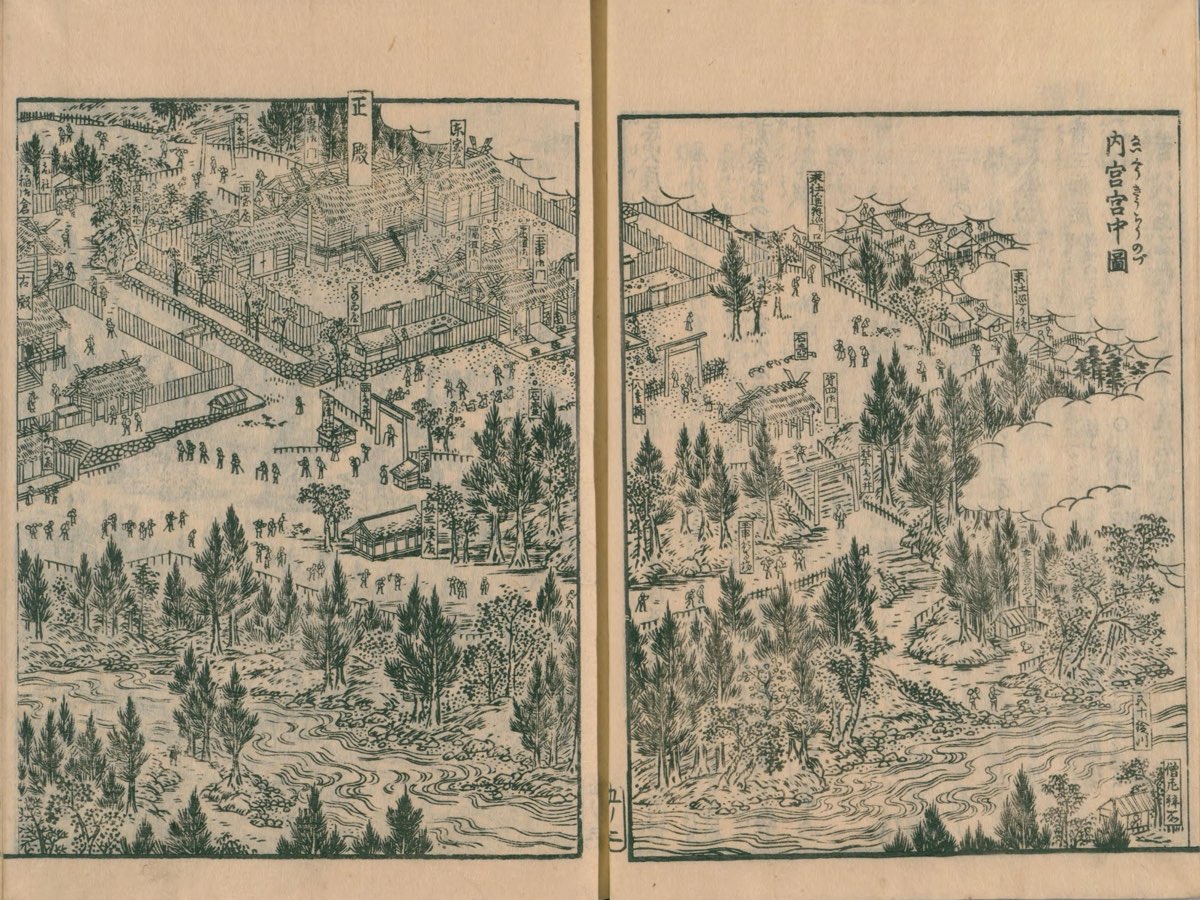
Ise Jingū, officially called simply Jingū, is a group of 125 shrines centered on the Inner Shrine and the Outer Shrine. In the Edo period, people came to it from all over Japan. The Mie Prefectural Museum calls the exchange of people, goods and culture that followed unparalleled in Japanese history.
In certain years, waves of sudden mass pilgrimage swept toward Ise. Mie Prefecture names 1650, 1705, 1771 and 1830 as the main ones, and in 1830 about five million people are said to have come.
A shrine for the imperial ancestral deity
The Inner Shrine (Naikū) enshrines Amaterasu Ōmikami, revered as the ancestral deity of the imperial family. The Outer Shrine (Gekū) enshrines Toyouke no Ōmikami, revered as the deity who provides Amaterasu's sacred food.
The shrine's own account of its origins follows the Nihon Shoki. Princess Yamatohime traveled through provinces such as Iga, Ōmi and Mino in search of a permanent place to worship the deity, and built a shrine on the upper reaches of the Isuzu River in Ise.
Every 20 years the shrine buildings, vestments and sacred treasures are made anew and the deity is moved to a new shrine on the neighboring plot. According to the shrine, this renewal, the Shikinen Sengū, has continued since 690, and the 62nd was held in 2013.
Mie Prefecture notes that the cycle broke down in the medieval period, with no renewal for more than 120 years in the Muromachi period. In the Edo period the Tokugawa shogunate paid the costs, and the renewals were held every 20 years again.
From imperial offerings to popular worship
In early times only the emperor could make offerings at Ise, but according to the shrine, this did not forbid visiting. People who traveled with the emperor's envoys spread word of the shrine after returning to the capital, and it is thought that over time it became known among ordinary people.
The shrine cites a record of 934 that speaks of great numbers attending the Kannamesai festival, although the shrine explains this as a record of the envoy's many followers. A Kamakura-period diary calls the visitors at the Outer Shrine's renewal in 1287 countless, which the shrine reads as a sign of many worshippers by the mid-Kamakura period.
The oshi: guides, hosts and messengers
A key role in spreading Ise faith was played by the oshi (also read onshi). The shrine explains that they carried people's prayers to the deity, each with client households (danka) in an assigned area.
Every year an oshi visited his clients to distribute the shrine's amulets and offer prayers. When clients came to Ise, he lodged them in his own house, guided them around both shrines and arranged sacred kagura dances.
Mie Prefecture notes that the oshi also gave out the Ise calendar (Ise-goyomi) with the amulets, which made it known all over Japan.
According to the shrine, more than 2,000 oshi were active in the Edo period, and there are said to have been 600 oshi houses in the Outer Shrine area alone. A survey of client households lists 4,218,584 households, which the shrine puts at 89 percent of all households at the time.
Interpretations differ
The Ise City library gives a figure for Ise as a whole: it is said that there were as many as 800 oshi houses in Ise in the mid-Edo period. Neither count is exact; both are given as what is said.
Saving up and setting out
Mie Prefecture explains that people who could not normally travel had a good reason to go if the journey was a pilgrimage to Ise. People formed groups called kō in their neighborhoods or among friends, saved money together, and sent representatives in turn.
Records of these groups and travel diaries survive in many regions. Uji and Yamada had facilities for travelers, including playhouses, and Ise became a center of kabuki second only to Edo, Kyoto and Osaka.
According to Mie Prefecture, the Ise road from Hinaga Oiwake to the Uji Bridge was said to be second only to the Tōkaidō in traffic, and people from Edo and the east traveled along it.
People from Kyoto and the west took the Ise Betsu Kaidō from Seki to Tsu, and other roads such as the Hase Kaidō and the Wakayama Kaidō were also busy with pilgrims. In the late Edo period, pilgrims are said to have numbered about 400,000 a year.
Night lanterns (jōyatō), some inscribed to the two shrines, stood along these roads. The donors of one in Tsu were cotton wholesalers from Iwatsuki, in today's Saitama Prefecture. Another, on the Ise Betsu Kaidō, bears names from Matsumae Esashi and Hakodate in Hokkaido.
The great waves of okage mairi
Pilgrimage to Ise was popular throughout the Edo period, but in certain years it became a frenzy. Mie Prefecture names 1650, 1705, 1771 and 1830 as the main years. The waves came roughly every 60 years.
Mie Prefecture states that why they happened is not clear.
The name okage mairi came into wide use with the wave of 1771. Earlier waves were called nuke mairi, "slipping-away pilgrimages." When rumors spread that the shrine's amulets had fallen from the sky, children left without asking their parents, wives without their husbands' permission, and servants without telling their masters.
Pilgrims wore white clothes and sedge hats, and often traveled in groups with banners, singing and dancing. Even without enough money, they were given food and lodging by households along the way. People saw this as the grace (okage) of the deity, and it was said that anyone who hindered the pilgrims would be punished by heaven.
Mie Prefecture cites records of the Yamada town council and Motoori Norinaga's essay collection Tamakatsuma. They put the 1705 wave at 3.62 million people in 50 days. The 1771 wave is not clearly counted, but judging by the numbers crossing the Miyagawa River ferry, it is said to have exceeded two million.
1830: one in six people
According to the Mie Prefectural Museum, many books and prints described the 1830 wave at the time. The museum explains that it came the year after a shrine renewal and 60 years after the previous wave, and that people expected another okage mairi.
A book published in 1832, Okage Mairi Bunsei Shin'iki, says that the wave began on the 20th day of the 3rd month (lunar calendar) of 1830. On that day, 20 to 30 children from Tokushima set off for Ise without permission. By the end of the 8th month, about five million people had come to Ise.
Figures differ by record. The museum gives about 4.86 million who crossed the Miyagawa by land and more than 100,000 who arrived by sea, with a record of 148,000 people on the busiest day.
With Japan's population estimated at a little over 30 million, the museum calculates that about one person in six visited Ise in about half a year, while noting that the count was probably not exact.
The book, written by Minowa Zairoku of Ise from what he saw and heard, also shows how pilgrims were received. A ladle was the mark of an okage pilgrim. With one, even a penniless traveler could receive help along the way.
On reaching the Outer Shrine, pilgrims left their ladles by the bridge at the north gate. An illustration of an alms house shows townspeople handing out coins and what appear to be paper notes issued in Yamada, beside bales of rice. More than 10,000 bales of rice were brought in by ship, and the book says food never ran short.
Mie Prefecture suggests that meetings between people from many provinces affected culture across Japan, for example through the exchange of rice varieties and the growth of Ise kabuki.
After the Edo period
In 1871 the Meiji government abolished the oshi system. According to the shrine, the devotion of worshippers did not change. Today cars with license plates from Hokkaido to Kyushu can be seen around the shrine, and visitors from around the world are increasing.
Places to visit
Ise Jingū in Ise City: the Inner Shrine, reached by the Uji Bridge over the Isuzu River, and the Outer Shrine. According to the Mie Prefectural Museum, a partly hollowed stone wall on the left, just after the Hiyoke Bridge inside the Outer Shrine's north gate, is said to be where pilgrims left their ladles.
The shrine's museums, the Jingū Chōkokan and the Sengūkan, show materials about the shrine and its renewal. The Mie Prefectural Museum (MieMu) in Tsu makes the exchanges brought by travel to Ise one of the main themes of its permanent exhibition.
In Ise City, the Maruoka Sōdayū house is a nationally registered tangible cultural property and, according to the city library, the only oshi house still standing on its original site. Check the official websites for opening days and hours before visiting.
Sources
- 神宮についてJingū (Ise Grand Shrine, official site)
- 神宮の歴史Jingū (Ise Grand Shrine, official site)
- 式年遷宮Jingū (Ise Grand Shrine, official site)
- 伊勢神宮、遷宮制度の衰退と復興(県史あれこれ)Mie Prefecture (三重県環境生活部文化振興課 歴史公文書班, 県史あれこれ)
- 人気の高かった「伊勢暦」(県史あれこれ)Mie Prefecture (三重県環境生活部文化振興課 歴史公文書班, 県史あれこれ)
- 御師について調べよう(ふるさと文庫 郷土資料案内)Ise City Ise Library (伊勢市立伊勢図書館)
- 盛況だった伊勢歌舞伎(県史あれこれ)Mie Prefecture (三重県環境生活部文化振興課 歴史公文書班, 県史あれこれ)
- 参宮客を見守り続けた常夜灯(県史あれこれ)Mie Prefecture (三重県環境生活部文化振興課 歴史公文書班, 県史あれこれ)
- 多くの民衆伊勢へ「おかげまいり」(県史あれこれ)Mie Prefecture
- 三重県の歴史年表(江戸時代)Mie Prefecture
- 御陰参宮文政神異記Mie Prefectural Museum (MieMu)