Izumo Taisha stands in Taisha-chō, in Izumo City, Shimane Prefecture. Shimane Prefecture says it is known as the god of en-musubi, the binding of ties between people, and that about two million worshippers visit each year.
According to the Shimane Museum of Ancient Izumo, Shimane is called the land of the gods and the home of myths. Its past can be approached through three different kinds of evidence. There are myths, written down in the eighth century.
There is a record of the province, the Izumo Fudoki, completed in 733. And there are objects found in the ground, from Yayoi-period bronzes to pillars thought to come from a medieval shrine hall. This article looks at each in turn and keeps the three apart.
The myths: Ōkuninushi and his palace
The deity of Izumo Taisha is Ōkuninushi. In the shrine's own account of the myth, Ōkuninushi developed the land together with the people in the age of the gods. He taught them farming, fishing and medicine.
According to the same account, he then handed over the land he had built to Amaterasu, the ancestor of the imperial family, in what is called kuni-yuzuri, the transfer of the land. He became the god who rules the unseen world and came to dwell in a vast palace.
The shrine explains that the Kojiki (712) and the Nihon Shoki (720) describe the grandeur of this palace. In the shrine's summary, they speak of thick pillars set deep into the ground, as far as the bedrock, and of roof ornaments that pierced the clouds.
These are myths. When and why the shrine was founded are questions that the Shimane Museum of Ancient Izumo explores through the many myths and traditions about it, together with the results of historical geography and archaeology.
The record: the Izumo Fudoki
In 713 the court ordered every province to record its products, the state of its land, the origins of place names and local traditions. These reports are called fudoki. According to the Shimane Museum of Ancient Izumo, the report for Izumo was completed in 733.
Shimane Prefecture explains that the editor responsible was Izumo no Omi Hiroshima, the kuni no miyatsuko (hereditary chief) of the province, who also headed Ou District. The writer was Miyake no Omi Kanatari.
The text describes the province as a whole and then each district in turn, with its villages, temples, shrines, mountains, rivers and products. It also has a section on roads, borders and defence.
Shimane Prefecture says that fudoki survive from only five provinces: Hitachi, Izumo, Harima, Bungo and Hizen. Most survive only in part, and the prefecture describes the Izumo Fudoki as the only one handed down in nearly complete form. The prefecture's Ancient Culture Center has studied it for more than thirty years, and the places it mentions are now shown on the prefecture's online map.
The Fudoki records many myths, which the museum describes as rich in local character. According to the museum, its most representative myth is the Kunibiki, or land-pulling, myth.
In it the god Yatsukamizuomitsuno pulls surplus land from several places and sews it on to form the distinctive shape of the Shimane Peninsula. The museum sees in it a sign of wide exchange across the Sea of Japan.
The Fudoki also tells its own story of the shrine. As the shrine summarizes it, the Fudoki praises Ōkuninushi as the great god who made the land under heaven.
Many gods gathered to build his dwelling, and so the place was named Kizuki. The shrine was formerly called Kizuki Taisha.
The ground: Yayoi bronzes
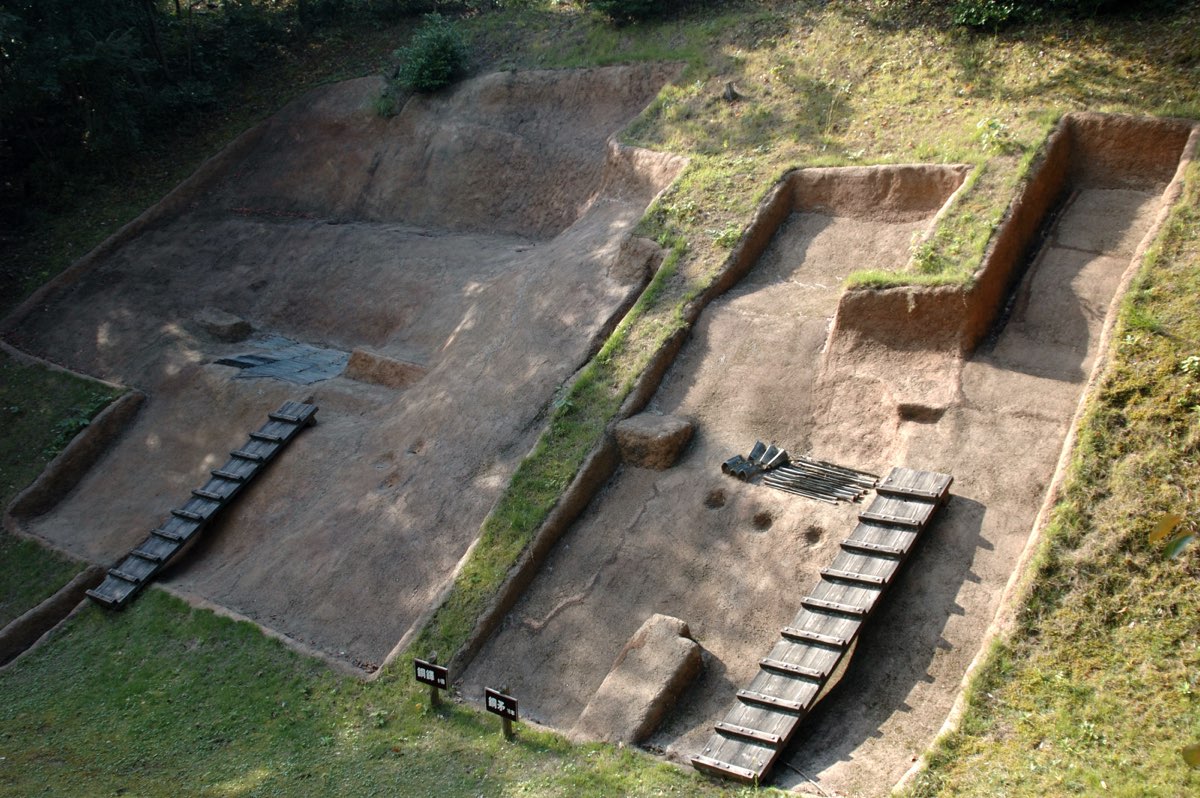
In 1984, a survey before the building of a farm road at Kōjindani uncovered 358 bronze swords. According to Shimane Prefecture, little more than 300 bronze swords had been found in all of Japan at that time.
The next year, 6 bronze bells and 16 bronze spearheads were found nearby. The prefecture says the find forced a review of research on Yayoi-period bronzes in Japan.
In October 1996, during farm-road construction at Kamo Iwakura, 39 bronze bells were found together; Kōjindani lies about 3 kilometres to the northwest. The Agency for Cultural Affairs says the bells were all made in the middle Yayoi period. They are thought to have been buried in the middle to late Yayoi period in a pit on a valley slope, away from the settlements of the time, mostly in nested pairs of a large and a small bell.
Twelve of the bells bear an X mark that is also seen on the Kōjindani swords. Bells cast from the same moulds have been found in Tottori, Hyōgo, Nara, Wakayama and Fukui. The Agency thinks that most were made in the Kinki region, but that some may have been made in Izumo.
The Agency says that this was the first time the burial of so many bells in one place could be clearly understood. It calls the site extremely important for considering what bells were for, how they were used and discarded, and how they were produced and distributed.
The ground: the giant pillars
The shrine's tradition says that its main hall was once 32 jō (about 96 metres) high, and later 16 jō (about 48 metres). The priestly Senge family keeps an old drawing called the Kanawa no Gozōei Sashizu, said to be a plan of the hall of that time. It shows pillars each made of three timbers bound together with metal rings.
In 2000 and 2001, excavations in the precinct found pillars in three places, each made of three large cedar trunks bound together to a diameter of about 3 metres. According to the Shimane Museum of Ancient Izumo, one of them, the ridge pillar called the Uzubashira, survived thanks to the plentiful groundwater beneath the precinct.
Their layout and structure resemble those of the old drawing. Of the Uzubashira, the museum says that, after scientific analysis and study of archaeological materials, pictures and documents, it is very likely a pillar of the main hall built in 1248.
Interpretations differ
How tall that hall was is a separate question. Shimane Prefecture describes the find as showing that a tall hall about 48 metres high once existed. The museum, in its description of the Uzubashira, dates it but gives no height. The shrine sees in them the giant hall handed down in its traditions.
A shrine still in use
According to the shrine, its main halls in the medieval period were rebuilt on a reduced scale. The hall built in 1609 was about 19.8 metres high to the roof ornaments. In 1667 a hall of 8 jō (about 24 metres) was built, restoring the full traditional form after some four hundred years.
The present main hall was built in 1744. Shimane Prefecture says it is a National Treasure, about 24 metres high, and unrivalled in height in Japan as shrine architecture. In the most recent renovation its cypress-bark roof was re-laid, and on 10 May 2013 the deity was returned to the main hall.
Interpretations differ
Why a great shrine was built in Izumo at all is a question on which views differ. According to a report in Shimane Prefecture's public-relations magazine, Photo Shimane, at a symposium the prefecture held in Tokyo, Miura Sukeyuki of Risshō University argued that ancient Izumo was so prosperous that the Kojiki and Nihon Shoki had to write about it, and stressed that the Japan Sea coast had its own culture of building tall, large shrines. Niwano Hiroshi, head of the prefecture's Cultural Properties Division, suggested that the large bronze finds show ancient Izumo as one of the leading powers in Japan, whose influence on the Yamato court led to the founding of the shrine.
Interpretations differ
At the same symposium, Takioto Yoshiyuki of Komazawa University put forward his own view that the shrine was tall because it served as a kind of lighthouse. Mori Kimiyuki of Tōyō University proposed that the Yamato court treated Izumo as representing the regional powers and founded the shrine for that reason.
Places to visit
At Izumo Taisha, according to the shrine, the central pillar of the ancient main hall found in 2000 is displayed in the shrine's Treasure Hall.
The Shimane Museum of Ancient Izumo stands next to the shrine, on its east side. One of the excavated pillars, the ridge-supporting pillar called the Uzubashira, is displayed in its central lobby. The museum also shows the Kōjindani bronzes and the Kamo Iwakura bells, both National Treasures, and a gallery on the Izumo Fudoki.
The Kōjindani site is a national historic site in a 27.5-hectare park, with the Kōjindani Museum, opened in 2005. At Kamo Iwakura, a guidance facility shows replicas of the bells and film of the discovery. Check the official websites of each place for opening hours before visiting.
Sources
- 出雲大社(史跡)Shimane Prefecture
- 御遷宮の歴史Izumo Ōyashiro (official site)
- 中央ロビー展示「出雲大社境内遺跡出土の宇豆柱」Shimane Museum of Ancient Izumo
- 出雲国風土記の世界Shimane Museum of Ancient Izumo
- 解説(出雲国風土記)Shimane Prefecture
- 特集6 出雲国風土記シンポジウムを開催(フォトしまね200号)Shimane Prefecture
- マップonしまね「出雲国風土記登場地」の公開と「出雲国風土記ハンドブック」改訂版の刊行についてShimane Prefecture
- 荒神谷遺跡(山陰史跡探訪)Shimane Prefecture
- 加茂岩倉遺跡Agency for Cultural Affairs (Cultural Heritage Online)
- 加茂岩倉遺跡(山陰史跡探訪)Shimane Prefecture
- 出雲大社と神々の国の祭り(総合展示)Shimane Museum of Ancient Izumo (島根県立古代出雲歴史博物館)
- 青銅器と金色の大刀(総合展示)Shimane Museum of Ancient Izumo (島根県立古代出雲歴史博物館)
- 出雲神話回廊(神話シアター)Shimane Museum of Ancient Izumo (島根県立古代出雲歴史博物館)
- よくあるご質問Izumo Ōyashiro (official site)