Kamakura, a coastal town in Kanagawa Prefecture about an hour by train from Tokyo, was once the seat of Japan's first warrior government. According to Kamakura City, Minamoto no Yoritomo opened his shogunate here at the end of the twelfth century, laying the foundation of warrior rule that lasted until the middle of the nineteenth century.
The city also became a centre of Zen Buddhism. Temples such as Kenchōji and Engakuji were founded by the leaders of the shogunate, and they remain active Zen temples today. This article follows how a seaside base grew into a capital, and how Zen took root there.
Why Kamakura?
Kamakura's ties to the Minamoto family went back long before Yoritomo. According to Kamakura City, Minamoto no Yoriyoshi, governor of Sagami, enshrined a share of the spirit of Iwashimizu Hachiman, the clan deity of the Minamoto, and built a shrine here in 1063. Yoritomo's father, Yoshitomo, is said to have lived near the site of today's Jufukuji in 1145.
Tsurugaoka Hachimangu describes its own beginnings the same way: Yoriyoshi first enshrined the Hachiman deity by the shore at Yuigahama. According to the shrine, in Jishō 4 (1180) Yoritomo set up his base in Kamakura and, in the same year, moved the shrine of his ancestors to its present site.
The shrine also tells how Wakamiya-ōji, its approach of about 2 km running straight from Yuigahama beach, was built in imitation of Suzaku Avenue in Kyoto. According to tradition, Yoritomo directed the work himself as the first step in building the city, and his retainers carried the earth and stones.
A government that took shape step by step
Interpretations differ
When was the Kamakura shogunate founded? The question has no single answer.
Interpretations differ
A study sheet published by the Chiba Prefectural Board of Education notes that there are several views on when the shogunate began, and asks students about two of them: 1185, because military governors (shugo) and land stewards (jitō) were placed and the shogunate's control reached the provinces; and 1192, because the imperial court appointed Yoritomo shogun.
Interpretations differ
An article on Nippon.com sets out the steps in order: in 1180 Yoritomo raised his army, entered Kamakura and set up a board of retainers (samurai-dokoro); in 1184 offices for lawsuits and documents were created. It reports that Hongō Kazuto, a professor at the Historiographical Institute of the University of Tokyo, argues that 1180 itself should be counted as the start.
Kamakura City describes the same years more simply: having opened the shogunate, Yoritomo organised its institutions and, at the same time, began building the city.
From seaside base to capital
Kamakura is enclosed by hills and the sea. According to Kamakura City, passes called kiridōshi are thought to have been cut through the hills to ease travel to the surrounding areas; they are counted among the "seven entrances" of Kamakura. One of them, the Asaina Kiridōshi, linked the city with Mutsura, its outer port on Tokyo Bay. The city notes that, according to the chronicle Azuma kagami, it was cut in 1241–1242 under the supervision of the regent Hōjō Yasutoki.
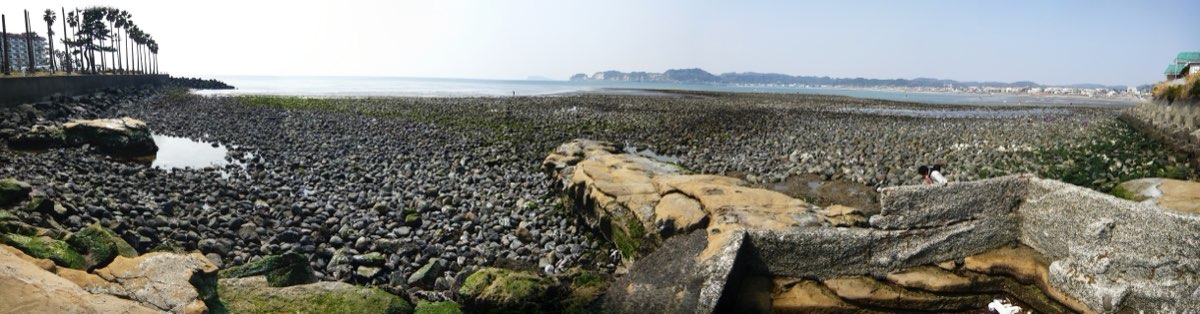
In 1232 the fund-raising monk Ōamidabutsu built a harbour at the eastern end of Yuigahama. According to the Agency for Cultural Affairs, its remains, Wakaejima, form a pier of piled cobblestones jutting into the sea, and are the oldest surviving harbour facility in Japan.
According to Kamakura City, by around 1230, when the building of the city was almost complete, the shogunate was at its height. Kamakura became the centre of Japan in politics, military affairs, diplomacy and culture.
Even after Yoritomo's line ended in its third generation, the city remained the de facto capital, surpassing Kyoto, under the Hōjō, the family of Yoritomo's wife Masako. At its peak it is said to have had as many as 30,000 people.
Zen in the warrior capital
Kamakura City writes that among the new Buddhist schools born in the Kamakura period, Zen was the one most readily accepted by warriors. Eminent monks from Song China and Japanese monks who had studied there spread its teachings, together with Zen architecture, arts and crafts, and literature. The city adds that trade with Song and Yuan China through Wakaejima brought Zen, Zen-style architecture, Buddhist sculpture and carved lacquer to Kamakura.
One Zen temple stands on a site linked to the Minamoto. According to the Agency for Cultural Affairs, Jufukuji was built by Hōjō Masako, who invited Eisai as its founding abbot, on the land where Yoritomo's father Yoshitomo had his residence.
Kenchōji tells its own founding story. In 1253 the regent Hōjō Tokiyori founded the temple, with the Chinese monk Rankei Dōryū (Lanxi Daolong), who had come to Japan in 1246, as its founding abbot.
Its temple bell, cast in 1255 and now a National Treasure, calls it "Kenchō Zen-ji." According to the temple, it was the first in Japan to call itself a "Zen temple," a training hall devoted only to Song-style Rinzai Zen.
Kenchōji explains that its halls were laid out almost in a straight line, modelled on Jingshan Wanshou Temple in Hangzhou, China. Its present layout does not preserve the original arrangement exactly. At its height, the temple says, it had about 1,000 monks, more than 400 branch temples and 49 sub-temples.
Engakuji was founded in 1282 by Tokiyori's son, the regent Hōjō Tokimune, who invited the Zen master Mugaku Sogen (Wuxue Zuyuan) from Song China. According to the temple, Tokimune wished to protect the nation, to spread Zen, and to mourn equally, friend and foe alike, those who died in the Mongol invasions.
Zen also brought a new way of building. The Agency for Cultural Affairs calls the Shariden (relic hall) at Engakuji, a National Treasure, the purest surviving example of the Zen style based on the central style of Southern Song China. The present hall, dated by its style to the early Muromachi period, was moved there after a great fire at the temple in 1563.
The famous "Five Mountains" (Gozan) of Kamakura belong to a later stage. Kamakura City explains that the Gozan system promoted officially appointed abbots step by step to higher-ranking temples, and that the present list of the Kamakura Gozan was fixed in the Muromachi period.
After the shogunate
According to Kamakura City, the shogunate was destroyed by Nitta Yoshisada in 1333. Kamakura then became the seat of the Kamakura-fu, which governed ten eastern provinces. After its leader Ashikaga Shigeuji was defeated and fled to Koga in 1455, Kamakura was no longer a political centre.
The temples felt the loss. Kenchōji writes that the fall of the Hōjō, its chief patrons, in 1333 was a heavy blow. Engakuji suffered several fires between the Muromachi and Edo periods and declined at times; according to the temple, Daiyū Kokushi rebuilt its halls in the late Edo period, laying the foundation of today's Engakuji.
Kamakura City notes that the temples and shrines were restored in the Edo period, when Kamakura became a temple town of farmers and fishers visited by worshippers. In the late seventeenth century Tokugawa Mitsukuni compiled the gazetteer Shinpen Kamakura-shi, and more townspeople from Edo came to tour the historic sites.
Visiting Kamakura today
Kenchōji and Engakuji are both in the Yamanouchi district of Kita-Kamakura, and both welcome visitors. Engakuji stands about a minute's walk from Kita-Kamakura Station on the JR Yokosuka Line. As of 2026, both temples hold zazen sessions for the public; check each temple's official website for visiting hours, fees and session dates.
Engakuji says its quiet halls preserve the traditional seven-hall layout handed down since its founding. Kenchōji reports that it rebuilt its main kitchen-hall, the Tokugetsurō and its monks' training hall in the Heisei era.
According to Tsurugaoka Hachimangu, yabusame (mounted archery) is still performed at its annual grand festival in September (as of 2026). The rite began in the Kamakura period when Yoritomo prayed for peace in the realm.
These are living places of worship. Kamakura City reminds visitors that the Gozan temples are privately owned rather than managed by the city, and asks that visitors be considerate of local residents.
Sources
- 鎌倉の歴史Kamakura City
- 鎌倉五山と禅文化Kamakura City
- 史跡朝夷奈切通Kamakura City Board of Education (Cultural Properties Division)
- 朝夷奈切通(国指定文化財等データベース)Agency for Cultural Affairs
- 和賀江嶋(国指定文化財等データベース)Agency for Cultural Affairs
- 寿福寺境内(国指定文化財等データベース)Agency for Cultural Affairs
- 円覚寺舎利殿(文化遺産オンライン)Agency for Cultural Affairs
- 神奈川県の歴史Kanagawa Prefecture
- 社会(歴史)歴史年表③ ~鎌倉・室町時代~(家庭学習用プリント)Chiba Prefectural Board of Education
- 「鎌倉幕府」はどこに?:1192か1180か、揺れる開幕年(1)Nippon.com (Nippon Communications Foundation)
- 知る(鶴岡八幡宮の由緒・伝統文化)Tsurugaoka Hachimangu
- 建長寺について(建長寺の歴史・建長寺開山大覚禅師・建長寺開基北条時頼公)Kenchoji (Rinzai school, Kenchoji branch head temple)
- 拝観案内・アクセス/坐禅会Kenchoji (Rinzai school, Kenchoji branch head temple)
- 円覚寺についてEngakuji (Rinzai school, Engakuji branch head temple)
- 拝観案内・アクセス/法話会・坐禅会・写経会Engakuji (Rinzai school, Engakuji branch head temple)