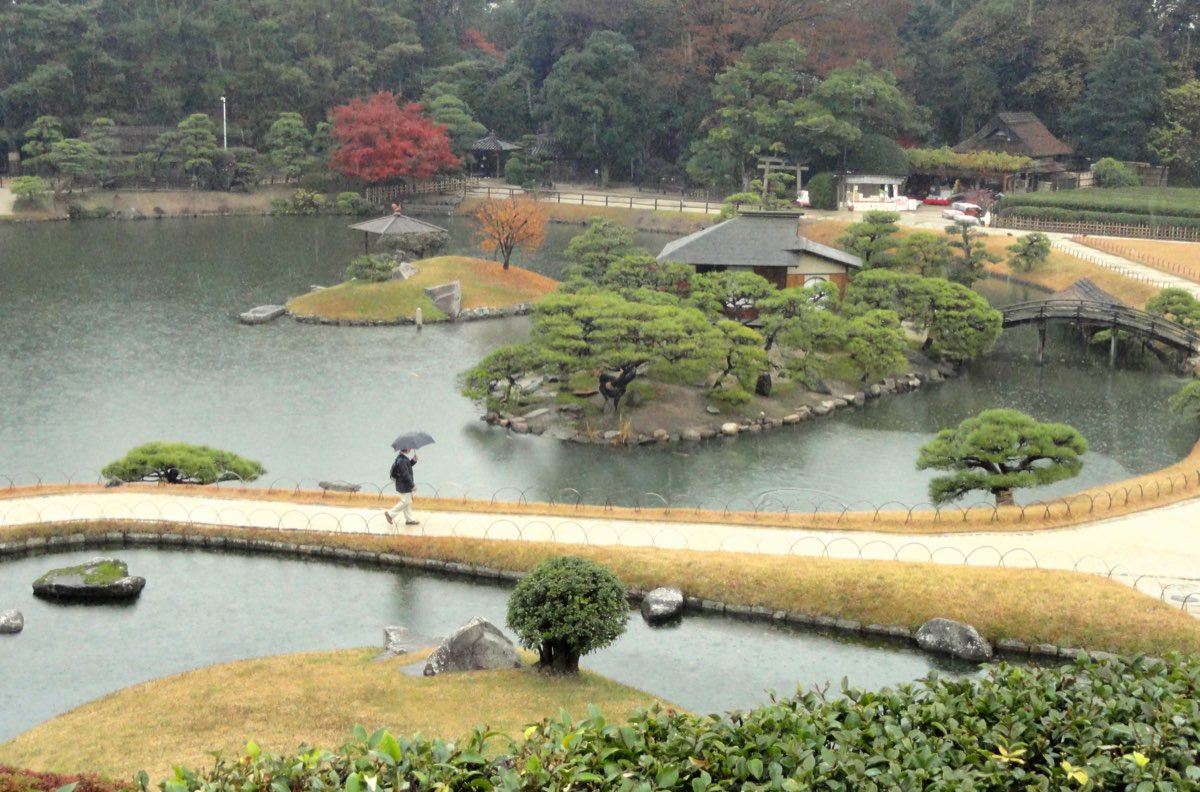
Kōrakuen in Okayama City is a daimyo garden, made for the lords of the Okayama domain. Ikeda Tsunamasa, the second lord, ordered his retainer Tsuda Nagatada to build it.
Work began in 1687, and the garden reached a first completion in 1700. Later lords changed it to suit their own tastes, but according to the garden's official site it has come down to the present without great changes to its Edo-period appearance.
The official site, run by Okayama Prefecture, describes Kōrakuen as one of "Japan's three great gardens," together with Kairakuen in Mito and Kenrokuen in Kanazawa. The Agency for Cultural Affairs also counts it among the three. It is a national Special Place of Scenic Beauty.
This article follows the garden from its making in the 1680s, through the changes of later lords and its opening to the public, to its restoration after heavy damage in the twentieth century.
A garden made possible by flood control
The garden's official history links its creation to large engineering works. Before the garden was made, the domain had been reclaiming the shallow sea that lay between the Asahi River, just east of the castle town, and the Yoshii River, about 13 kilometers further east. To reclaim Kojima Bay on a large scale, a big floodway, the Hyakken River, was needed, and work on its banks went ahead in earnest from 1685 to 1686.
As a result, the wide riverbed behind the castle, which had been prone to flood damage, became land that could be used with relative safety. Tsunamasa then paused the reclamation work and ordered the garden to be built in 1687. For about four years the work concentrated on the garden, and reclamation resumed in 1692.
The official site states that Okishinden, the new farmland that resulted, was the largest reclaimed land in Japan in the Edo period, at 1,800 chōbu. The whole series of works, including the garden, was directed by Tsuda Nagatada, a senior official of the domain. In this way, a place of rest for the lord was made behind the castle, where it was easy to reach.
Built step by step
According to the garden, drawings kept in the Ikeda family collection suggest that there was no single plan for the garden. Instead, its area and scenery were improved gradually while it was in use. At first it was a simple garden on about 17,000 tsubo of land, with a building for the lord, a garden to the south, and fields spreading to the east.
When Tsunamasa returned to Okayama in 1689, he visited the garden at once. The next spring, before leaving for Edo on alternate attendance, he told Tsuda Nagatada to add about 5,200 tsubo of land to the north.
In 1691 he was delighted with the garden, gave Tsuda a reward, and invited more than 800 retainers to receive celebratory rice cakes. Some regard this year as the garden's first completion.
More land was added later. In 1700 an extra plot of about 860 tsubo gave the garden its outer shape, which is almost the same as the outline of today's designated scenic area, and another view counts this as completion. In 1707 a Noh stage was finished, and some think the garden only gained all the functions Tsunamasa wanted at that point.
A garden plan from Tsunamasa's time, the Ochaya on-ezu, still survives. It has paper patches pasted over the parts that were changed, which, the garden explains, shows how Tsunamasa altered the garden to his liking while enjoying it.
The garden of those days looked different from today. About three quarters of it was fields, the land was flat, and the central mound did not yet exist.
It was mainly a garden for viewing from the rooms of the Enyōtei, the lord's living quarters, and of other buildings, with the fields to the east and Mount Misao outside the garden used as borrowed scenery. According to the inventory of the garden plan, there seem to have been nearly 1,200 cherry trees.
How later lords changed the garden
Tsunamasa's son Tsugumasa built the Yuishinzan, a mound about 6 meters high, in the middle of the garden. He ran waterways around its foot, dug a gourd-shaped pond, and rebuilt the buildings around the Noh stage. These changes gave the garden a high point and made it enjoyable to walk around.
Tsugumasa's grandson Harumasa, to save money, stopped the farm work in 1771 and turned the fields into lawn. With that, the irrigation channel became the Kyokusui, a stream winding gently through the grass. Most of the eastern side soon went back to fields, and the field called the Seiden is a remnant of that time.
Today Kōrakuen is a strolling garden, in which lawns, ponds, artificial hills and tea houses are linked by paths and waterways so that the view changes as visitors walk. The Kyokusui, about 640 meters long, runs through the grounds and forms ponds and waterfalls along its course.
A garden shared with the domain
Records of the garden's management kept in the Ikeda family collection show that it was one of the places where the lord spent his daily life. The official history calls it a living space, not an ornament.
It was also opened to others. In the Edo period, domain people could enter with permission.
Tsunamasa, who loved Noh, sometimes let them watch him dance, and later lords showed the garden on fixed days while they were away in Edo. In the late Edo period, when the Inari faith was popular, people were invited to the Hatsuuma festival of the Inari shrine in the garden while the lord was in Okayama, and in some years 30,000 to 60,000 came to worship.
Retainers showed the results of their training at the riding ground and the archery range, while the lord watched from a pavilion. As a reward, they were allowed to view the garden before going home.
In 1871 the Ikeda family renamed the garden, until then called the Go-kōen, as Kōrakuen and allowed people to see it on fixed days. In 1884 the family handed it over to Okayama Prefecture to preserve it. At first it was opened as land attached to the prefectural office rather than as a park, with rules such as closing the gates at sunset.
The garden was designated a Place of Scenic Beauty in 1922 and a Special Place of Scenic Beauty under the Law for the Protection of Cultural Properties in 1952.
Damage and restoration
In the twentieth century the garden suffered twice. It was badly damaged by the Muroto typhoon of 1934, and after the flooding a branch of the Asahi River was cut east of the garden, leaving it on an island in the river.
In 1945 the garden was damaged again, in the war. On 29 June 1945 American B-29 bombers attacked Okayama; according to Okayama City, 63 percent of the urban area of the time was burned and at least 1,737 people died, while another view puts the deaths at over 2,000. In this air raid most of the buildings in the garden burned.
Both times the garden was restored on the basis of Edo-period drawings. Some parts changed, such as simpler paths, and the present layout directly continues these repairs.
The buildings were rebuilt one by one: the Moshōan tea house in 1952, the Noh stage and archery pavilion in 1958, the Enyōtei in 1960, and the Eishō-no-ma rooms in 1967. The Enyōtei was rebuilt from the Ochaya on-ezu plan of Tsunamasa's time.
Places to visit
Kōrakuen stands in Kita Ward, Okayama City, and is open to the public. Its historic buildings, including the Enyōtei and the Noh stage, are usually closed, but the official site says they are opened at special times, such as the twice-yearly opening of the Enyōtei and performances on the Noh stage. Check the official site for opening hours and events.
Inside the garden, visitors can see the Renchiken, which Tsunamasa is said to have liked best; the Ryūten, a building with a waterway running through it; the Seiden field; the Kankitei, facing the 180-meter riding ground; and the Shima-jaya tea house, on an island in the Sawa-no-ike, the largest pond.
Sources
- 歴史・概要(後楽園)Okayama Korakuen (official site, Okayama Prefecture)
- 1.築庭の過程と一応の完成(後楽園)Okayama Korakuen (official site)
- 2.築庭当時の風景(岡山後楽園「後楽園の歴史あれこれ」)Okayama Prefecture (Okayama Korakuen Office, official site)
- 3.ともに楽しむ庭(岡山後楽園「後楽園の歴史あれこれ」)Okayama Prefecture (Okayama Korakuen Office, official site)
- 4.後楽園の変化(岡山後楽園「後楽園の歴史あれこれ」)Okayama Prefecture (Okayama Korakuen Office, official site)
- 5.岡山県に譲渡(岡山後楽園「後楽園の歴史あれこれ」)Okayama Prefecture (Okayama Korakuen Office, official site)
- 6.災害と復旧(岡山後楽園「後楽園の歴史あれこれ」)Okayama Prefecture (Okayama Korakuen Office, official site)
- 後楽園内にある建造物のご紹介(岡山後楽園「建物探訪」)Okayama Prefecture (Okayama Korakuen Office, official site)
- 企画展「第47回岡山戦災の記録と写真展 戦時下の学校と子どもたち」Okayama City (Okayama City Museum, Okayama Air Raid Exhibition Room)
- 常磐公園(偕楽園)(日本遺産ポータルサイト 構成文化財)Agency for Cultural Affairs (Japan Heritage portal)