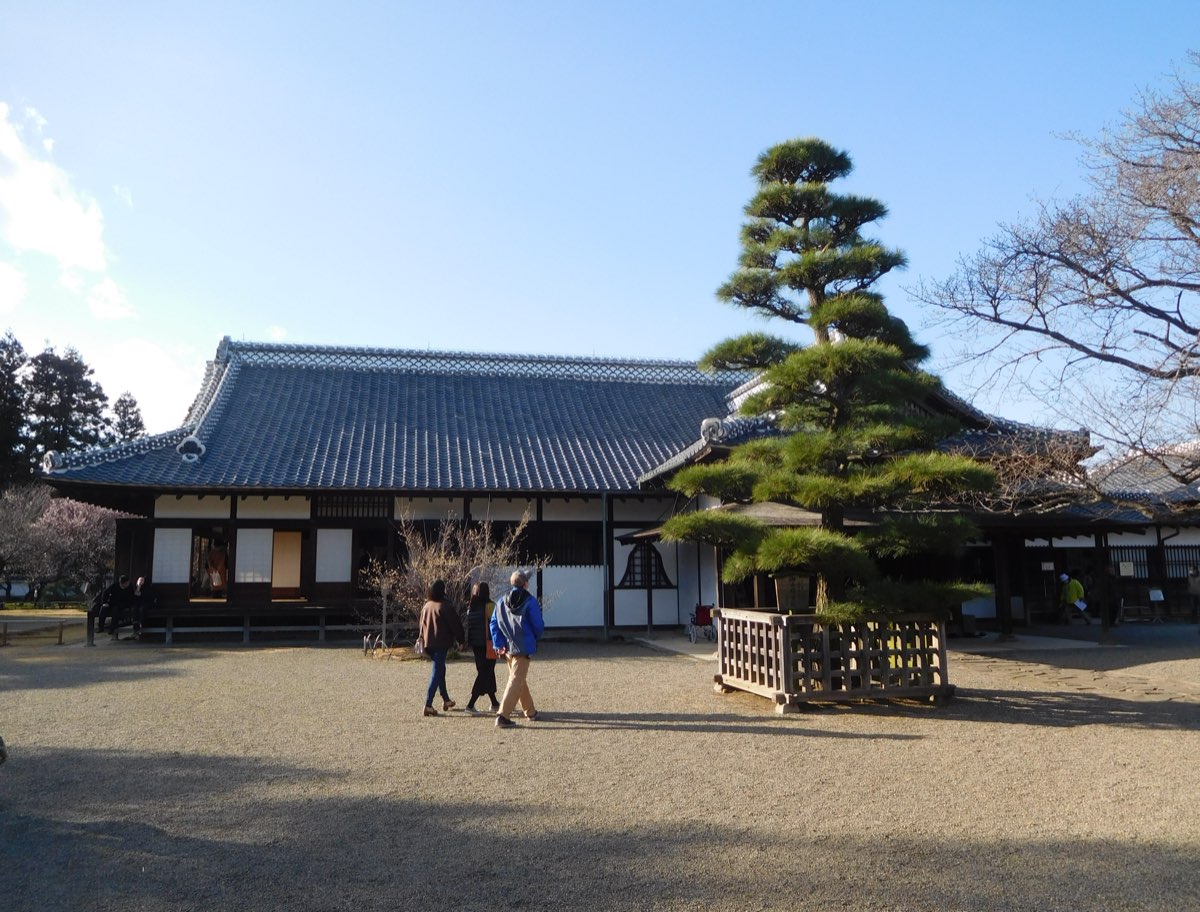
In the old castle town of Mito, in Ibaraki Prefecture, stands the Kōdōkan, the school of the Mito domain. Tokugawa Nariaki, the ninth lord of Mito, founded it in 1841 inside the castle grounds.
According to its own office and Mito City, its grounds of about 10.5 hectares made it the largest domain school in Japan. This article follows how Mito became a center of learning, what was taught at the Kōdōkan, and what can still be seen there.
A Tokugawa domain and a history project
Mito passed to sons of Tokugawa Ieyasu early in the seventeenth century. In 1609 (Keichō 14) Tokugawa Ieyasu installed his eleventh son, Yorifusa, previously lord of Shimotsuma, as lord of Mito Castle.
The domain was later raised to 350,000 koku and ranked among the Gosanke, the three senior branch houses of the Tokugawa. According to Mito City, the castle town was then enlarged into the leading castle town of the Kantō region after Edo.
The second lord, Tokugawa Mitsukuni, began compiling the Dai Nihonshi, a history of Japan modeled on Chinese histories. He set up an office for the project, the Shōkōkan, in the domain's Edo residence; in Genroku 11 (1698) it was moved to the second enclosure of Mito Castle.
The compilers searched widely for sources and studied related books and classics. According to Mito City, the work grew so large that it continued throughout the Edo period and was completed only in the Meiji era.
The Agency for Cultural Affairs notes that Mito had the Shōkōkan and that learning and education had flourished there since earlier times.
Nariaki's reforms
Tokugawa Nariaki (1800–1860) became lord of Mito in 1829 (Bunsei 12). According to Ibaraki Prefecture, with the backing of reformers such as Fujita Tōko and Aizawa Seishisai he pushed through domain reforms: frugality, reform of shrines and temples, and the rebuilding of the domain's finances.
Mito City describes these reforms as Nariaki's response to repeated economic and political crises in the late Edo period. It says that Aizawa and Fujita built on Confucian thought but held a worldview of their own, and that their writings and teaching had a great influence on the thought of the time.
Fujita Tōko (1806–1855) wrote the draft of the Kōdōkan-ki, the statement of the school's founding spirit, and a commentary on it. Ibaraki Prefecture states that his thought greatly influenced the activists of the late Edo period.
The reforms also caused friction. The prefecture records that conflict between the reform faction and the established faction came into the open, and in 1844 (Kōka 1) the shogunate ordered Nariaki to resign and placed him under confinement.
After Perry's arrival in 1853 he was appointed to advise the shogunate on coastal defense. He later clashed with the great elder Ii Naosuke over the treaty with the United States and died while still confined in Mito.
A school "like a university"
According to Mito City, Nariaki founded the Kōdōkan in Tenpō 12 (1841) as part of his reforms, to train capable people. It was a school for the domain's samurai and their sons; the Agency for Cultural Affairs adds that he meant education to steady people's minds and strengthen the country.
Its principles were published in Nariaki's name as the Kōdōkan-ki. They called for the unity of letters and arms, of Shinto and Confucianism, and of learning and practical affairs, with the aim of study and martial training that would be useful in government and society.
Students could study not only Confucian learning and the martial arts but also Western medicine, pharmacy, and astronomy. Mito City says the school served much like a comprehensive university does today.
Smallpox vaccination was carried out at its medical hall. Nariaki had two of his own children vaccinated, seeking to spread the practice in the domain.
The grounds held a main hall, halls for letters, martial arts, and medicine, a Kashima shrine, a Confucius shrine, an octagonal hall, a riding ground, and a drill ground. According to the Kōdōkan Office, they were arranged to reflect the founding spirit.
The Agency for Cultural Affairs states that the Kōdōkan's educational policy, facilities, and management greatly influenced other domain schools, such as the Bunbu Gakkō of Matsushiro and the Chidōkan of Shōnai.
A garden for rest
In 1842 (Tenpō 13), the year after the school's founding, Nariaki opened the garden Kairakuen on the shore of Lake Senba as its pair. He designed it himself, on grounds of about 18 hectares.
A stone set up in 1839 records his ideas for the garden with the phrase "one tension, one relaxation": the Kōdōkan was the place of study and Kairakuen the place of rest. The name means "enjoying together with the people," and the garden was opened to domain residents on set days.
Nariaki had many ume (Japanese apricot) trees planted at both the school and the garden. The Agency for Cultural Affairs explains that the fruit could serve as emergency food and that the tree's other name, kōbun, means "loving learning."
Turbulent years
Nariaki's seventh son, Yoshinobu, studied at the Kōdōkan before he was adopted into the Hitotsubashi family. According to Mito City, Mito's learning became the core of his political stance.
Yoshinobu became the fifteenth shogun and in 1867 returned governing power to the imperial court. The Kōdōkan Office says that afterward he stayed in confinement in a room of the Shizendō, a building at the school.
In Mito itself, Mito City records that after Nariaki's death the domain split and its factions fought repeatedly, which weakened the domain. The halls for letters, martial arts, and medicine were lost in fighting at the school in 1868 (Meiji 1), according to the Kōdōkan Office.
Visiting today
Today about 3.4 hectares of the school grounds are designated a Special Historic Site, the "Former Kōdōkan." The main gate, the main hall (seichō), and the Shizendō are Important Cultural Properties.
The Kōdōkan Office describes the main hall, also called the "school palace," as the center of the Kōdōkan, where examinations and ceremonies were held in the lord's presence. The gate was opened only for the lord's visits and formal events.
The grounds also include the Kashima shrine, which enshrines a deity received from Kashima Jingū, and reconstructed buildings such as the Confucius shrine and the octagonal hall that houses the stone of the Kōdōkan-ki. Mito City's Japan Heritage entry notes that classes on the Analects of Confucius are still held in the building.
The Kōdōkan is part of the Japan Heritage story "Education Heritage of Early Modern Japan," together with sites in Ashikaga, Bizen, and Hita. Kairakuen is counted among Japan's "three famous gardens" with Kenrokuen and Okayama Kōrakuen.
The Kōdōkan Office's walking route links the school with the remains of Mito Castle, including the reconstructed Ōtemon gate and corner turret. Please check the official website for opening times and admission before visiting.
Sources
- 水戸市歴史的風致維持向上計画(第1期) 第1章 歴史的風致形成の背景Mito City
- 近世日本の教育遺産群 ─学ぶ心・礼節の本源─(日本遺産ストーリー)Agency for Cultural Affairs (Japan Heritage portal)
- 旧弘道館(日本遺産ポータルサイト 構成文化財)Agency for Cultural Affairs (Japan Heritage portal); text by Mito City Historical and Cultural Properties Division
- 常磐公園(偕楽園)(日本遺産ポータルサイト 構成文化財)Agency for Cultural Affairs (Japan Heritage portal)
- 弘道館(散策ルート・施設案内リーフレット)Kodokan Office, Ibaraki Prefecture (hosted by the Ibaraki Prefectural Tourism and Local Products Association)
- 茨城の先人たち 徳川斉昭Ibaraki Prefecture (Culture Division, Ibaraki Bunka Joho Net)
- 茨城の先人たち 藤田東湖Ibaraki Prefecture (Culture Division, Ibaraki Bunka Joho Net)