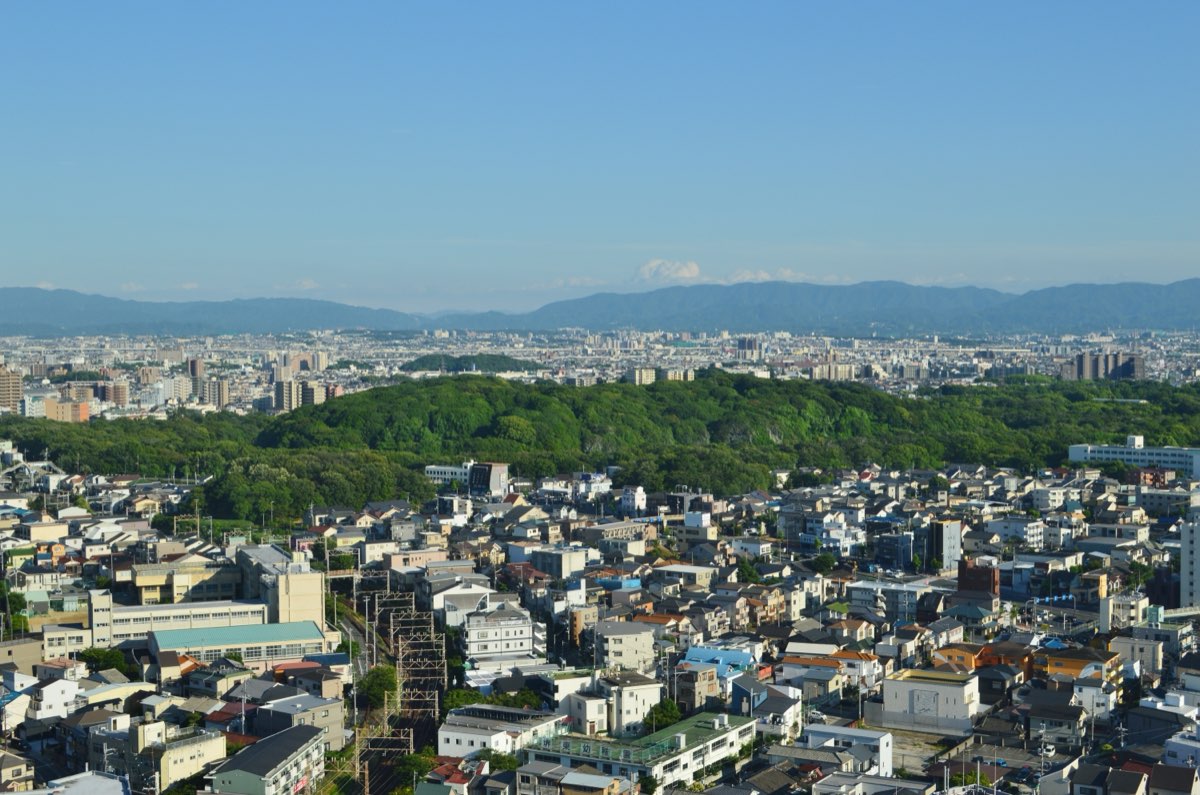
From the late 4th to the late 5th century, people on the plain beside Osaka Bay built some of the largest tombs ever made in Japan. Today 49 of these burial mounds, or kofun, in 45 component parts, form the World Heritage property "Mozu-Furuichi Kofun Group: Mounded Tombs of Ancient Japan."
The Mozu area in Sakai holds 23 of them, and the Furuichi area in Habikino and Fujiidera holds 26. This article looks at what the tombs are, what has been found in them, what can and cannot be said about who lies inside, and how they came to be protected.
A landscape of mounds
The Agency for Cultural Affairs describes the setting. The kofun were built at the height of the Kofun period on the plain facing Osaka Bay, which was then one of the political and cultural centres of the islands and the starting point of the sea route to the Asian continent.
Habikino City explains that the two groups lie side by side, east and west, about 8 km apart on terraces in the southern Osaka Plain. From the late 4th century through the 5th century, some of the largest kofun in Japan were built by turns in one group and then the other. Between them, the two groups include 5 of the 10 longest keyhole-shaped tombs in Japan.
According to the Agency's translation of the World Heritage statement, the Kofun period ran from the 3rd to the 6th century, before Japan became a centralised state under the influence of the Chinese ritsuryō legal system.
About 160,000 kofun are known across Japan. The Mozu and Furuichi tombs were chosen to represent the Middle Kofun period, from the late 4th to the late 5th century, which is regarded as the peak of the Kofun period.
Shapes, sizes and haniwa
The kofun vary greatly in size. The largest are keyhole-shaped tombs nearly 500 m long; the smallest are in the 20 m range. The Agency describes the mounds as stages for funeral rites, geometrically designed and decorated with haniwa, clay figures and cylinders.
Around each giant keyhole tomb stand smaller satellite tombs. Habikino City notes that keyhole, scallop-shaped, square and round tombs of many sizes were built, and that together they show the social hierarchy of the time.
The World Heritage statement says the kofun are thought to be tombs of the royal family. They contain grave goods such as weapons, armour and ornaments, and haniwa in the form of cylinders, objects, houses, animals and people. Some of the tombs are called ryōbo, imperial mausolea, and are managed by the Imperial Household Agency.
The largest tomb in Japan
At the centre of the Mozu area stands Nintoku-tennō-ryō Kofun, which the Agency for Cultural Affairs and Sakai City describe as the largest kofun in Japan. Its mound is 486 m long, and 840 m including its moats. It is built in three tiers and is the only giant keyhole tomb surrounded by three moats.
The Agency for Cultural Affairs notes that its site and its orientation, with the front facing south, were chosen with the view from Osaka Bay in mind.
In 1872 a pit-style stone chamber and a long, box-shaped stone coffin were exposed on the slope of the front mound. Drawings were made, and the grave goods, which included gilt bronze armour and glass vessels thought to have come from West Asia, were put back and reburied.
More than 29,000 cylindrical haniwa are estimated to have stood on the tomb. Haniwa in the shape of a woman's head, waterfowl, horses, deer and houses have also been found.
How much work did such a tomb take? The Agency cites one estimate: with up to 2,000 people working each day, it would have taken 15 years and 8 months, a total of 6.8 million person-days of work.
Interpretations differ
Who is buried here is a separate question. Sakai City explains that the tomb, with Hanzei-tennō-ryō Kofun to the north and Richū-tennō-ryō Kofun to the south, is known as one of the Mozu Mimihara Three Mausolea, and that it is now managed by the Imperial Household Agency as the tomb of Emperor Nintoku. Yet the city also says the tomb is known to have been built after Richū-tennō-ryō Kofun, which reverses the order of the reigns of Nintoku and Richū given in the Nihon shoki and other early texts.
Tombs of the Furuichi area
In the Furuichi area, Ōjin-tennō-ryō Kofun is the second-longest keyhole tomb in Japan, at 425 m. The Agency for Cultural Affairs says it is the largest of all in mound volume. It is surrounded by a double moat, and more than 20,000 cylindrical haniwa are estimated to have stood on it.
Many waterfowl haniwa were found there, along with clay models of fish, whales and octopus, which show part of the rituals held at the tomb. A collapse on the front mound is now widely thought to have been caused by an earthquake.
Next to it, at the round Konda Maruyama Kofun, gilt bronze horse trappings are said to have been found in 1848. These fittings, now a National Treasure held by the neighbouring Konda Hachimangū shrine, are thought to have come from northeast China or the Korean Peninsula. The Agency says they are among the oldest of their kind in Japan.
Tsudō-Shiroyama Kofun, at 210 m, is the northernmost keyhole tomb of the Furuichi area and dates from the early part of the Middle Kofun period. It was altered when it was used as a castle in the Muromachi period.
In 1912 a burial chamber was found on its rear mound. It held what the Agency calls one of the largest long, box-shaped stone coffins in Japan, with bronze mirrors, iron armour and weapons, and ornaments. In its moat, three realistic waterfowl haniwa stood on a square platform.
Kings of Wa and the wider world
Sakai City notes that the Chinese history Song shu records five powerful kings of Wa, as Japan was then called, named San, Chin, Sei, Kō and Bu. They appeared around the 5th century and sent tribute to China.
The city explains that the king of Wa is thought to have led an alliance of regional chiefs across Japan. The Mozu and Furuichi groups are thought to be heritage connected with these five kings.
The grave goods point to contact across the sea. According to Sakai City, haniwa, gilt bronze ornaments, horse trappings and iron weapons from the Mozu group show influence from the Korean Peninsula, China and as far away as Persia. Habikino City likewise notes grave goods that reflect links with the Korean Peninsula and China.
Saved, protected and inscribed
Around 1955 Itasuke Kofun, a 146 m keyhole tomb in Sakai, faced destruction by a housing development plan. A preservation movement led mainly by local citizens stopped the plan.
The tomb was then designated a National Historic Site and bought into public ownership. A helmet-shaped haniwa collected during the movement is now used as the symbol of cultural property protection in Sakai City.
Today the imperial mausolea are protected under the Imperial House Act and the National Property Act, and the historic sites under the Law for the Protection of Cultural Properties. The property is managed through a World Heritage council of the Imperial Household Agency and the local governments, with the Agency for Cultural Affairs as an observer.
On 6 July 2019 the World Heritage Committee, meeting in Baku, Azerbaijan, inscribed the Mozu-Furuichi Kofun Group on the World Heritage List under criteria (iii) and (iv).
The Agency for Cultural Affairs summarises the committee's discussion in three points: the tombs are rare evidence of the social and political structure of ancient Japan, shown in their range of sizes and shapes; they have been protected for 1,600 years and are still conserved under strong legal protection in an urban area; and they are rooted in the local community, including a tomb saved by a residents' movement against development.
Places to visit
In Sakai, the city recommends the World Heritage stone marker and the worship place (haisho) of Nintoku-tennō-ryō Kofun, about 500 m from JR Mozu Station, where volunteer guides are stationed. A 2.8 km path runs around the tomb.
Nearby are the free Mozu Kofun Group Visitor Center and Sakai City Museum in Daisen Park, which has exhibits and finds on the kofun group. For a view from above, the city lists a balloon ride from Daisen Park and the observation lobby of Sakai City Hall.
The World Heritage statement notes museums and interpretation facilities in Osaka, Sakai, Habikino and Fujiidera. The ceiling stones of the Tsudō-Shiroyama Kofun burial chamber are displayed at a guidance facility, and the horse trappings from Konda Maruyama Kofun are held by Konda Hachimangū. Opening days and hours change, so please check the official websites of Sakai, Habikino and Fujiidera before you visit.
Sources
- 「百舌鳥・古市古墳群」の世界遺産一覧表への記載決定についてAgency for Cultural Affairs
- 百舌鳥・古市古墳群―古代日本の墳墓群―(詳細解説、顕著な普遍的価値の言明の日本語訳)Agency for Cultural Affairs (Cultural Heritage Online)
- 仁徳天皇陵古墳、茶山古墳、大安寺山古墳(世界遺産「百舌鳥・古市古墳群」構成資産解説)Agency for Cultural Affairs (Cultural Heritage Online)
- 応神天皇陵古墳、誉田丸山古墳、二ツ塚古墳(世界遺産「百舌鳥・古市古墳群」構成資産解説)Agency for Cultural Affairs (Cultural Heritage Online)
- 津堂城山古墳(世界遺産「百舌鳥・古市古墳群」構成資産解説)Agency for Cultural Affairs (Cultural Heritage Online)
- いたすけ古墳(世界遺産「百舌鳥・古市古墳群」構成資産解説)Agency for Cultural Affairs (Cultural Heritage Online)
- 百舌鳥古墳群の特徴Sakai City (World Heritage Division)
- 仁徳天皇陵古墳(大仙古墳)Sakai City
- おすすめスポット(百舌鳥・古市古墳群を「訪れる」)Sakai City
- 百舌鳥・古市古墳群の世界文化遺産登録/古市古墳群の緩衝地帯の保全についてHabikino City
- 百舌鳥・古市古墳群の世界遺産登録が決定しましたSakai City