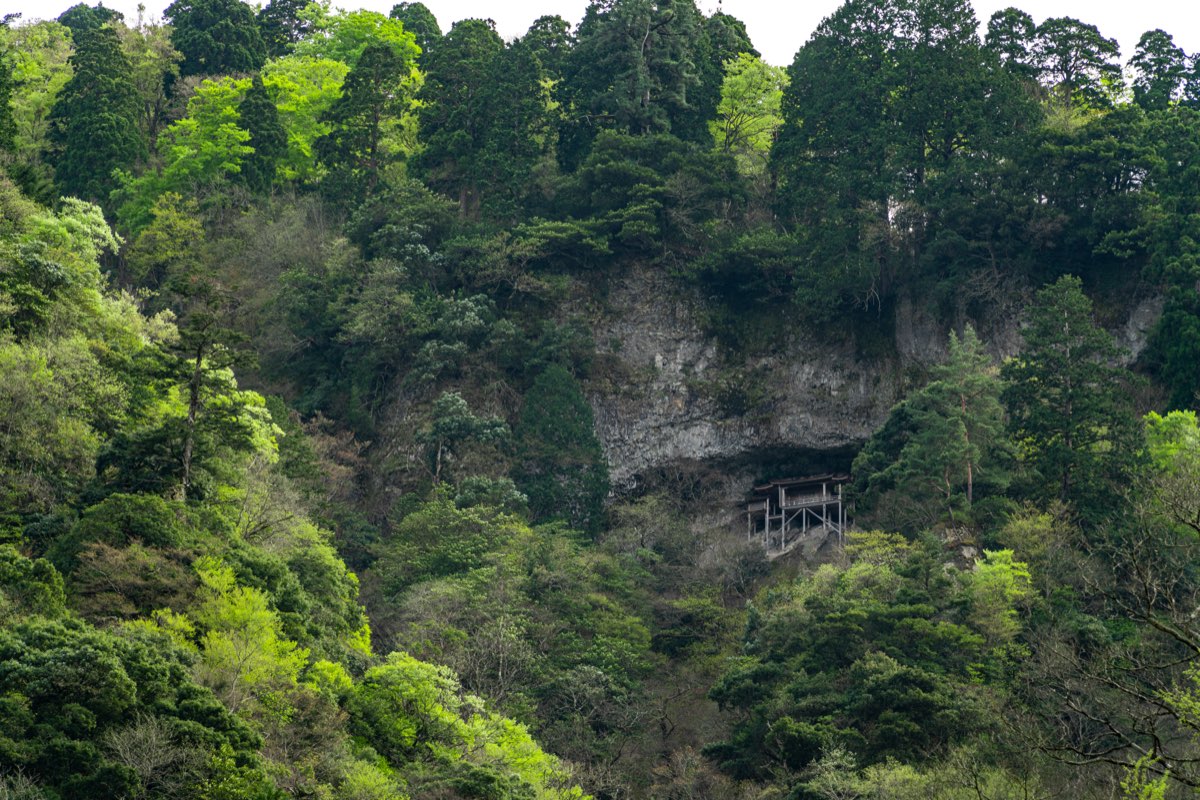
High on the north face of Mount Mitoku, in central Tottori Prefecture, a small wooden hall sits inside a hollow in a rock wall, its floor held up by long, slender pillars. This is the Nageiredō, the inner hall of the temple Sanbutsuji. It has been a National Treasure since 1952.
The name means "the hall that was thrown in." Temple tradition says that the ascetic En no Gyōja shrank the hall until it fitted in the palm of his hand and threw it into the cave.
Scientific dating tells another part of the story. This article looks at both the legend and the evidence, and at what visitors can see today.
A mountain for ascetic practice
Sanbutsuji is an old temple of the Tendai school on Mount Mitoku, in the town of Misasa. Three sub-temples stand at the foot of the mountain. Behind the main hall, across the Shikuiri Bridge, a series of buildings uses the steep northern slope: the Monjudō, the Jizōdō, the Nōkyōdō and the Nageiredō, along with a bell tower and other small halls.
How the temple began is not clearly known. According to temple tradition, in 706 En no Ozunu, better known as En no Gyōja and honored as the founder of Shugendō, scattered three lotus petals. They came down on Mount Yoshino in Yamato, Mount Ishizuchi in Iyo, and Mount Mitoku in Hōki, and he built halls on Mount Mitoku as a place for ascetic practice.
The temple describes En no Gyōja as a figure who seems to have been active around Nara in the seventh and eighth centuries. It says that he seems certainly to have existed, but that the details of his life, including when he was born and died, are unknown. Many legends about him have been handed down, in which he races through the sky and over the hills and commands demons and gods at will.
Interpretations differ
A second tradition says that in 849 the monk Ennin built the temple's halls and enshrined three Buddhas, Amida, Shaka and Dainichi, which gave Sanbutsuji, "Temple of the Three Buddhas," its name. Tottori Prefecture adds that there is no clear record that Ennin ever came to the mountain. It suggests that Tendai esoteric Buddhism was reaching the San'in region around this time.
The mountain was a place of training. Tottori Prefecture notes a tradition that Mount Mitoku had four practice areas. One lay among the steep rocks above the Nageiredō, and another ran from the Shikuiri Bridge up to the hall itself.
A hall set into the rock
The Agency for Cultural Affairs describes the Nageiredō as a small building set inside a cave in the mountainside and hanging over the cliff. Extremely long pillars support the floor from below, a form of construction called kake-zukuri. The hall measures one bay by two bays, and its roof is covered with cypress bark.
The rock shapes the building. A Tottori reference text, reproduced by both the prefecture and the temple, explains that the hall stands at about 500 meters on the north face.
It uses a natural hollow where a layer of volcanic tuff breccia meets andesite lava. The tuff cliff serves as its footing, while the lava above, marked by columnar joints, juts out over the hall.
According to the Agency, the Nageiredō was originally called the Zaō-den and served as the guardian hall of Sanbutsuji. A tiny hall attached to its side, the Aizendō, is thought to have been built at the same time. Apart from a repair known to have taken place in 1375, the hall's later history is unclear.
The Agency calls the Nageiredō the oldest building in the San'in region. It also describes it as a rare surviving structure that combines fine Heian-period design with an unusual composition.
When was it built?
The Agency for Cultural Affairs dates the hall by its style. It says that the date of construction is not known but that the building shows the features of the Heian period.
Its timbers are slender, its pillars, beams and rafters are broadly chamfered, and its rafters have a gentle slope. The roof, in the nagare-zukuri style, has extra eaves on both sides.
Tree-ring dating has given firmer evidence. According to Tottori Prefecture, a dendrochronological study by the Nara National Research Institute for Cultural Properties showed that the hall was built in the late Heian period, between the late eleventh and early twelfth centuries. The reference text reproduced by the prefecture and the temple gives the year of the study as 2001 and the range as 1086 to 1184, and the Agency's database also lists 1086–1184.
Tree rings can show when the hall was built, but not how. The reference text reproduced by the prefecture and the temple says that the method used to build it on the cliff remains a mystery to this day.
The statues of Zaō Gongen
Seven standing statues of Zaō Gongen were once enshrined in the Nageiredō. According to Tottori Prefecture, all seven are Important Cultural Properties and are now shown in the temple's treasure hall.
The principal image is the newest, from the early Kamakura period. It is the only one built up from several blocks of hinoki cypress; the other six are each carved from a single block.
Tottori Prefecture describes Zaō Gongen as an esoteric deity greatly revered in the Heian period as a subduer of evil. It says that one wooden standing statue of Zaō Gongen at the temple, 1.15 meters tall, is close to the oldest among Zaō Gongen images in Japan.
Interpretations differ
There is also a newer idea about the principal image. Based on a reading of documents found inside the statue, a theory has been put forward that it is the work of the sculptor Kōkei, father of the famous Unkei. The prefecture presents this as one theory, not a settled conclusion.
Recognition
The Agency's database gives 18 February 1904 as the date of the Nageiredō's designation as an Important Cultural Property, and it became a National Treasure on 29 March 1952. Mount Mitoku itself is a national Place of Scenic Beauty and Historic Site.
In September 2008 the Agency for Cultural Affairs announced the results of its review of new candidates for Japan's World Heritage tentative list. A proposal titled "Mount Mitoku: Mountain of Faith and Cultural Landscape" was not added to the list, but it was positioned as a candidate cultural property for it.
In April 2015 the Agency recognized Mount Mitoku and Misasa Onsen, both in the town of Misasa, as Japan Heritage. The story links the two: the pilgrimage on the mountain purifies the "six roots" of perception, and bathing in the hot spring heals the six senses. A legend says that the spring was found after a pilgrim to Mount Mitoku spared a white wolf, and the hot spring was a place to cleanse body and mind before the pilgrimage.
Places to visit
Sanbutsuji and the trail to the Nageiredō (Misasa, Tottori).* A steep trail with chains in places leads from the temple up to the Nageiredō, and many visitors climb it. The temple treats the climb as a pilgrimage on a mountain of ascetic practice. Climbers wear a wagesa, a ring-shaped stole lent at the reception, and the route ends just before the Nageiredō.
The temple sets firm conditions. To prevent accidents, it checks clothing and shoes before allowing anyone onto the trail, and sneakers may not be accepted. Climbers must go in pairs or larger groups and keep both hands free, and small children cannot climb.
Poles and walking sticks are not allowed. The trail closes when rain or snow makes it dangerous, and it is usually closed in winter, from about December to March.
The whole precinct is a national Historic Site and Place of Scenic Beauty. Collecting plants or animals, smoking and using fire are forbidden, visitors are asked not to eat on the mountain, and flying drones in and around the precinct is banned. Reception hours, fees and the day's trail conditions change, so check the temple's official website before visiting.
The treasure hall at Sanbutsuji.* The seven statues of Zaō Gongen from the Nageiredō are displayed in the temple's treasure hall. According to the temple, the entry offering for the mountain includes admission to it.
Misasa Onsen.* The hot spring town, recognized with Mount Mitoku as Japan Heritage, is closely linked with the pilgrimage to the mountain.
Sources
- 三仏寺奥院(投入堂)Agency for Cultural Affairs (Cultural Heritage Online)
- 1.開山・建立(三徳山)Tottori Prefecture (Chubu General Office)
- 1 建造物(三徳山)『鳥取県文化観光事典』 (2002), excerpt reproduced on a Tottori Prefecture (Chubu General Office) page
- 三徳山三佛寺(三徳山 公式ホームページ)Mitokusan Sanbutsuji (the temple's own official site)
- 2 仏像等(三徳山)Tottori Prefecture (Chubu General Office)
- 5 修験の世界(三徳山)Tottori Prefecture (Chubu General Office)
- 三徳山の世界遺産登録Tottori Prefecture (Cultural Properties Division)
- 文化遺産のツボ 第17回「祝!「三徳山・三朝温泉」日本遺産初認定」Tottori Prefecture (Cultural Properties Division)