For about 450 years, Okinawa was a kingdom of its own, ruled from the royal castle of Shuri. The Agency for Cultural Affairs explains that the kingdom based its economy on wide trade with China, Korea, Japan and Southeast Asia, and developed an international culture distinct from that of Japan at the time.
This article follows the kingdom from its unification in 1429 through the Satsuma invasion of 1609 to its end in 1879, and closes with its World Heritage sites and the rebuilding of Shuri Castle.
The age of the gusuku
According to a history of Okinawa published by the Okinawa Convention & Visitors Bureau, the period from about the twelfth to the fifteenth century is called the Gusuku period. People turned to farming, and leaders called aji appeared across the islands. From the thirteenth century, powerful aji built gusuku as strongholds and ruled their areas by force.
Interpretations differ
The same history notes that hilltop places of worship and groves where the dead were buried are also called gusuku. Some are thought to have grown from settlements with sacred places into strongholds, while some large ones may have been built as palaces from the start; their origins are still not fully understood.
At Urasoe Castle, according to the Agency for Cultural Affairs, excavations found remains from four or five phases, beginning in the late thirteenth or early fourteenth century. Which royal line built the castle has not been confirmed.
From three kingdoms to one
By the middle of the fourteenth century, three kingdoms stood side by side on Okinawa Island. The Cabinet Office names them Hokuzan, Chūzan and Nanzan, and the visitors bureau's history places them in the north, centre and south of the island.
According to an article in the Agency for Cultural Affairs' magazine, Ryūkyū's relations with China are said to have begun in 1372, when Satto, king of Chūzan, answered an invitation from the Hongwu Emperor and entered a tributary relationship. Chinese emperors confirmed the kings of Ryūkyū in office, a practice called investiture, more than twenty times between 1404 and 1866. The visitors bureau's history adds that investiture brought permission to trade with Ming China.
In the early fifteenth century, according to the Agency for Cultural Affairs, Shō Hashi captured a castle in the Shimajiri area of southern Okinawa and made it his base for unifying the three kingdoms.
The Cabinet Office states that in 1429 Shō Hashi united Hokuzan, Chūzan and Nanzan for the first time and became the first king of the Ryūkyū Kingdom, and that he is said to have made Shuri Castle his base. The castle had been built around the middle of the fourteenth century. It served as the royal castle of the First and Second Shō dynasties for about 450 years, and its buildings show the influence of Chinese and Japanese architecture.
A kingdom of the sea
Okinawa Prefecture's history page for children says the kingdom sent ships to China, Japan and other Asian countries, and that Naha's port is said to have been crowded with goods and people from overseas, in what is called the "Age of Great Trade." Ryūkyū also appears in Portuguese records under the name "Lequio."
According to the visitors bureau's history, Ryūkyū bought spices, ivory and other southern goods in places such as Luzon, Siam, Java and Malacca and sold them to Japan, Korea and China, while reselling Japanese swords and lacquerware, Korean cotton cloth, and Chinese raw silk and ceramics, for large profits.
Welcoming the Chinese investiture envoys was a great undertaking of state. The Agency's magazine explains that the royal government held months of ceremonies and lavish banquets for them, with songs, dances and kumi odori drama known as okansen odori, after the "crown ships" that brought the king's crown.
The Satsuma invasion and life between two powers
In 1609, the kingdom was invaded by the Satsuma domain in southern Kyushu. The visitors bureau's history explains that after Tokugawa Ieyasu founded the Edo shogunate in 1603, he ordered Satsuma to make Ryūkyū submit to the shogunate.
When Ryūkyū did not comply, Satsuma sent about 3,000 soldiers on 100 warships. They took Amami Ōshima, Tokunoshima and Okinoerabu, landed on Okinawa at Unten harbour, and defeated the kingdom's forces.
The Agency for Cultural Affairs records that Urasoe Castle was damaged in the fighting of 1609. As a result of the campaign, the Ministry of Land, Infrastructure, Transport and Tourism notes, the Amami Islands were separated from Ryūkyū and placed directly under Satsuma.
According to the Agency's magazine, Ryūkyū from then on was under Satsuma's real control while formally still receiving investiture from the Chinese emperor, and was built into Japan's system of shogunate and domains in this irregular form. The visitors bureau's history adds that Satsuma surveyed Ryūkyū's land by 1611 and imposed taxes and rules, and that it hid its control from China because it valued the profits of Ryūkyū's tribute trade.
Ryūkyū also sent missions to Edo: one to give thanks whenever a new king took the throne, and one to offer congratulations whenever a new shogun came to power. These journeys, called Edo nobori, took place eighteen times between 1634 and 1850. Records say young dancers in the missions performed before the shogun and at the Satsuma residence.
Twenty-one letters from the king of Chūzan received by the shogunate are an Important Cultural Property. The Agency's database explains that after the shogunate, through Satsuma, objected to certain honorific words in the Shōtoku era, the letters changed from Chinese-style writing to Japanese epistolary style.
The end of the kingdom
In 1872, the Meiji government turned the Kingdom of Ryūkyū into the Ryūkyū domain. The visitors bureau's history says that in 1875 the government demanded, among other things, an end to the investiture ties with Qing China.
On March 27, 1879, according to Okinawa Prefectural Archives, a senior official of the Home Ministry went to Shuri Castle with 160 police officers and an armed force of 400 soldiers. He read an order abolishing the domain and creating Okinawa Prefecture, and ordered King Shō Tai to live in Tokyo and the castle to be handed over. The archives explain that the series of measures from 1872 is called the "Ryūkyū Disposition," after the government's own documents, and that the kingdom, a unified state since the early fifteenth century, had lasted more than 450 years.
Shuri Castle: lost and rebuilt
Shuri Castle has burned and been rebuilt several times. The Cabinet Office states that it was completely burned in 1945 by US attacks during the Battle of Okinawa. After a government decision in 1986, the main hall and other buildings were restored and the park partly opened on November 3, 1992; it fully opened in February 2019.
On October 31, 2019, fire destroyed the main hall and other principal buildings again. The Agency for Cultural Affairs reported that nine buildings, including the main hall, burned completely.
Two spots of the original remains, which carry the site's World Heritage value, were damaged where they had been exposed for display and research, about 0.05 percent of the site; the rest were thought to be protected under fill, and the Agency considered the effect on that value minor.
Under the government's policy, the main hall is in principle being restored to the form rebuilt in 1712 and designated a National Treasure in 1925, with stronger fire protection. A groundbreaking ceremony for the main hall was held in November 2022. In June 2026 the Chief Cabinet Secretary announced a completion ceremony at the park for November 22, 2026, and the park says public viewing of the main hall begins at noon on November 23.
Places to visit
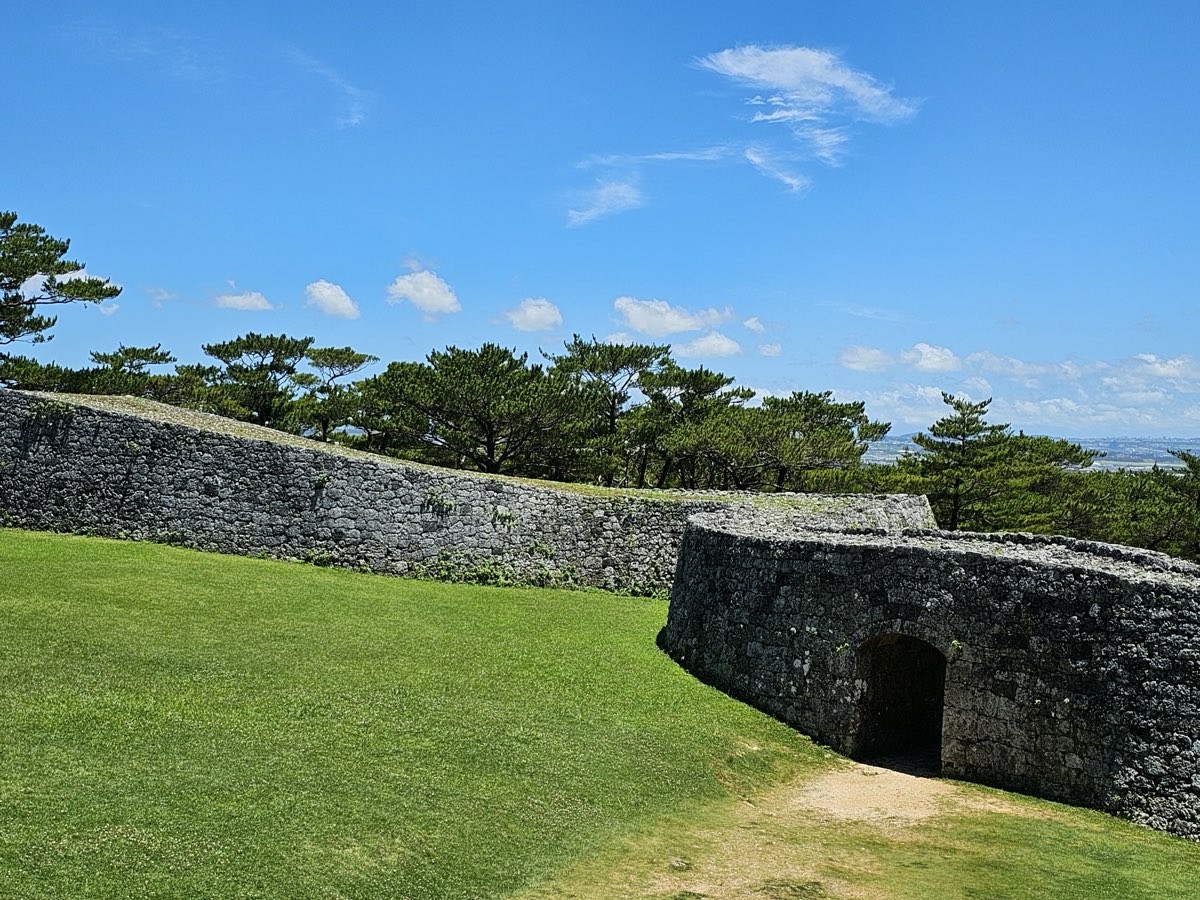
In December 2000, the Gusuku Sites and Related Properties of the Kingdom of Ryukyu were inscribed on the World Heritage List. The nine sites are the castle sites of Nakijin, Zakimi, Katsuren, Nakagusuku and Shuri, the Sonohyan-utaki stone gate, the royal tomb Tamaudun, the royal villa Shikinaen, and Sēfa-utaki. The castle walls are mostly coral limestone and use many curves, a feature particular to Ryūkyū.
Zakimi Castle, said to have been built by the lord of Yomitanzan and his residence around 1420, keeps two arched gates and fine stone walls. It was used as a Japanese artillery position in the Second World War and as a US communications base after it.
The visitors bureau's history notes that the king is said to have always passed through the Sonohyan-utaki stone gate when he left Shuri Castle, and that Shō Tai, the last king, lies in Tamaudun. Viewing the inside of the rebuilt main hall at Shuri Castle requires a ticket reserved for a date and time. Check the official sites for opening hours before visiting.
Sources
- 沖縄県の歴史(おきなわ修学旅行ナビ)Okinawa Convention & Visitors Bureau (Okinawa Prefecture)
- 浦添城跡Agency for Cultural Affairs (Cultural Heritage Online)
- 島添大里城跡Agency for Cultural Affairs (Cultural Heritage Online)
- 琉球王国のグスク及び関連遺産群Agency for Cultural Affairs (Cultural Heritage Online)
- 世界文化遺産プロモーション事業Okinawa Prefecture (Tourism Promotion Division)
- 首里城公園(国営沖縄記念公園 首里城地区)Cabinet Office
- 琉球王朝文化の華「琉球舞踊」(ぶんかる)Agency for Cultural Affairs
- 歴史概要(沖縄こどもランド)Okinawa Prefecture
- 奄美群島の概要Ministry of Land, Infrastructure, Transport and Tourism
- 琉球国中山王書翰並貢物目録Agency for Cultural Affairs (Cultural Heritage Online)
- あの日の沖縄 1879年3月27日「沖縄県」の設置Okinawa Prefectural Archives
- 資料1-3 世界文化遺産「琉球王国のグスク及び関連遺産群」首里城跡で発生した火災の被害状況報告の概要Agency for Cultural Affairs (paper for the 146th Japanese National Commission for UNESCO, MEXT)
- 令和8年6月2日(火)午前 内閣官房長官記者会見(首里城正殿の復元完成式について)Cabinet Secretariat (Prime Minister's Office of Japan)
- 首里城公園(トップページ・お知らせ)Shurijo Castle Park (Okinawa Churashima Foundation)
- 座喜味城跡Agency for Cultural Affairs (Cultural Heritage Online)