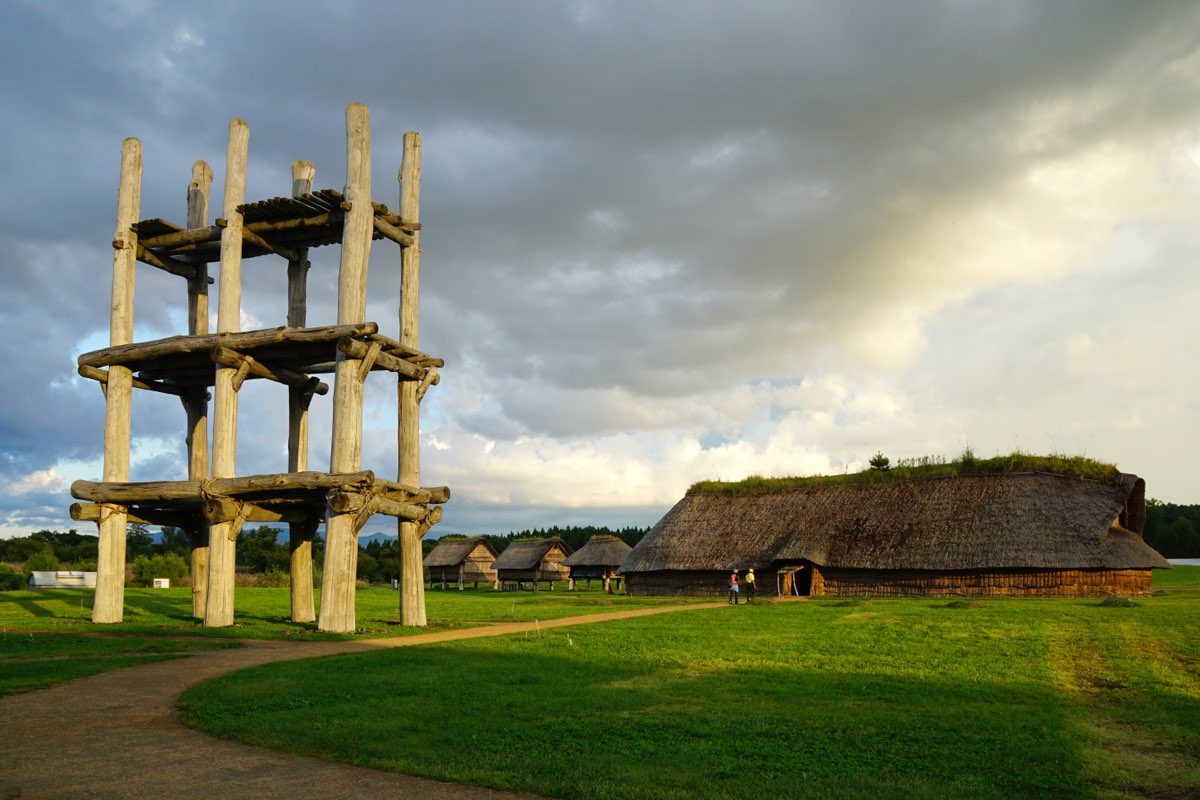
At the tip of a range of low hills in Aomori City, excavations that began in 1992 uncovered the remains of a large Jōmon settlement. People lived there in the Early and Middle Jōmon periods, from about 3,900 to 2,200 BCE, roughly 5,900 to 4,200 years ago.
The excavations revealed many buildings, artificial mounds, and graves of adults and children, along with huge amounts of pottery and stone tools, and valuable wooden objects.
According to the Sannai-Maruyama Site Center, the site covers about 42 hectares in total. The official World Heritage website presents it as a large hub settlement, with land carefully divided by use.
A settlement between forest and bay
The settlement stood at the tip of gentle hills that extend from the Hakkoda Mountains, on a coastal terrace about 20 meters above sea level beside the Okidate River. Mutsu Bay, close by, is a calm inner bay, and the Site Center describes it as rich in fish. Behind the settlement spread deciduous broadleaf forest, with chestnuts, walnuts, and wild plants.
The climate was somewhat warmer than today, by an estimated 2 to 3 degrees Celsius on average. The sea reached farther inland, and the shoreline is thought to have been at about 5 meters above present sea level.
According to the Site Center, before the settlement was built the area was a rich forest of beech and acorn-bearing trees. When people made their village, they cut down most of these trees but left the chestnuts and walnuts, and the surroundings became largely a chestnut forest that people managed.
Food remains show what this meant in daily life. Most of the diet came from plants. Chestnuts seem to have been especially important, and beans and bottle gourds were also cultivated.
Among animal bones, small animals such as flying squirrels and hares are common, rather than the deer and wild boar typical of many Jōmon sites. Fish include sea bream, yellowtail, mackerel, flounder, herring, and sharks.
A planned village
The official World Heritage website describes the settlement as a planned arrangement of pit dwellings, post-built structures, rows of pit graves, buried pots, artificial mounds, storage pits, roads, and large buildings. Graves were kept strictly apart from the houses where people lived every day.
Some buildings were very large: the largest pit building found here measures about 32 by 10 meters. Such buildings are usually found near the center of the settlement. Suggested uses include a meeting hall, a shared workshop, or a communal house.
One large post-built structure stood on six posts. Its post holes are about 2 meters across and 2 meters deep, set 4.2 meters apart, and held chestnut posts about 1 meter thick, preserved by groundwater and by charring. The structure is thought to have been a large rectangular raised building.
Food was stored, too. Storage pits were dug together outside the settlement, near the edge of the terrace.
Many have a narrow opening and a wide bottom, giving them a flask-shaped cross-section, and they are thought to have held chestnuts and other nuts. Some are almost 2 meters deep.
Roads and the dead
From the center of the settlement, a road about 12 meters wide ran toward the sea for about 420 meters. It was made by digging slightly into the ground, forming a shallow trench, and in places it was covered with packed earth, a kind of Jōmon "paving." More recent excavations have also found a road running north and south.
Adults were buried along the road on the east side of the settlement. Their round or oval pit graves, 1 to 2.5 meters long, were laid out in two rows, one on each side of the road, facing each other. Some graves contained jade pendants or groups of arrowheads.
On the west side, graves surrounded by circles of stones, about 4 meters across, stand in a line along a road on the slope. The Site Center suggests that they belonged to influential people in the community.
Children were treated differently. When a child died, the body was placed in a pot with a round hole made in it or with its rim or base broken off, and buried near the dwellings.
Judging from the size of the pots, the children were probably around one year old. More than 800 such child burials have been found, and many of the pots held a round stone about the size of a fist.
Ritual, craft, and goods from afar
Over many years, people dumped soil, ash, and broken pottery and stone tools in the same places until small hills formed. The level layers suggest that the mounds were deliberately leveled.
These mounds held more than everyday waste. More than 2,000 clay figurines have been found at the site, which the World Heritage website calls the largest number in Japan.
Most are flat and cross-shaped. According to that site, these and other ritual objects from the mounds show that rituals continued here over a long period. The Site Center also reports jade and miniature pottery from the mounds.
Interpretations differ
What these rituals meant is less certain. The Site Center notes the view that people did not see waste simply as rubbish, and that discarding things may have carried a prayer that they would return and bring abundance. This is an interpretation, not something the finds prove directly.
A waterlogged valley used as a dump preserved things that usually rot away, such as wooden objects, lacquerware, seeds, and even parasite eggs. Red-lacquered wooden plates and red pigment from the lowland date from about 5,500 years ago, and the Site Center concludes that lacquer goods were made here, which required specialist skill.
Another find is a small bag woven from the bark of a conifer of the cypress family, known as the "Jōmon pochette." According to the Site Center, it is the only complete example in Japan.
Goods also arrived from far away, carried by boat. Jade came from around Itoigawa in Niigata, about 600 kilometers away, and was found as raw stone, unfinished pieces, and finished beads. Obsidian came from several areas around the Sea of Japan, including Tokachi and Shirataki in Hokkaido, Oga in Akita, Gassan in Yamagata, Sado in Niigata, and Kirigamine in Nagano.
Amber was brought as raw material from around Kuji in northern Iwate and is thought to have been worked here and passed on to other settlements. Asphalt also arrived from distant areas. According to the Site Center, this exchange became even more active from about 5,000 years ago, as the settlement grew.
Later Jōmon Aomori and World Heritage
Sannai-Maruyama was not the end of the Jōmon story in Aomori. On the Tsugaru Peninsula, the Kamegaoka site in Tsugaru City dates from about 1,000 to 400 BCE. It stood on a hill 7 to 18 meters above sea level along the Iwaki River, facing an ancient inner bay known as Paleo-Lake Jūsanko.
On the plateau lies a burial area with many pit graves containing offerings and beads. In the surrounding wetlands, ritual dumping grounds yielded finely made lacquered pottery, lacquerware, clay figurines, plant-based objects, and jade beads.
A large clay figurine missing its left leg, found in 1887 and now an Important Cultural Property, gave its name to the "goggle-eyed" (shakōki) type of figurine because of the way its eyes are shown. According to Tsugaru City, the Kamegaoka site gave its name to the Kamegaoka culture of the Final Jōmon period, centered on northern Japan.
Both sites are now part of the Jomon Prehistoric Sites in Northern Japan, which became a World Heritage property on 27 July 2021. The property has 17 component parts in Hokkaido, Aomori, Iwate, and Akita, and eight of them are in Aomori Prefecture.
The property arranges its sites in stages of settled life. Sannai-Maruyama is presented as a large hub settlement mainly from the second half of the "development" stage, and Kamegaoka as a large cemetery from the second half of the "maturity" stage.
Protection began well before that. Aomori Prefecture decided in 1994 to preserve the site, which became a Special Historic Site in November 2000; in May 2003, 1,958 of its finds were designated Important Cultural Properties.
Visiting today
Sannai-Maruyama is open to visitors as part of the Sannai Maruyama Jomon Culture Center, which displays about 1,700 finds, including a large flat clay figurine and the "Jōmon pochette." The site itself can be seen only when the Center is open, and the Center's admission ticket is required.
Free volunteer guides lead tours in Japanese at set times, and tablet guides in English and other languages are available. At JR Aomori Station, the Aomori Jōmon Station "Jomojomo" introduces the eight World Heritage component parts in the prefecture.
At Kamegaoka, the site closes in winter, and the Tsugaru City Kizukuri Kamegaoka Archaeological Museum displays many finds from the site. The buildings standing at Sannai-Maruyama today are modern reconstructions, not original structures. Opening hours and closures change, so check the official websites before visiting.
Sources
- 三内丸山遺跡とはSannai-Maruyama Site Center, Aomori Prefecture
- 三内丸山遺跡Jomon Prehistoric Sites World Heritage Promotion Headquarters
- 縄文時代の扉を開くSannai-Maruyama Site Center, Aomori Prefecture
- 亀ヶ岡石器時代遺跡Jomon Prehistoric Sites World Heritage Promotion Headquarters
- つがる市の位置・地勢・沿革Tsugaru City
- 北海道・北東北の縄文遺跡群Jomon Prehistoric Sites World Heritage Promotion Headquarters
- Learning about the Jomon Prehistoric Sites in Northern JapanJomon Prehistoric Sites World Heritage Promotion Headquarters