From July 19 to October 31, 2010, a festival of contemporary art was held for the first time on seven islands of the Seto Inland Sea and around Takamatsu Port. The venues were Naoshima, Teshima, Megijima, Ogijima, Shōdoshima, Ōshima and Inujima. The theme was "the restoration of the sea."
The festival has been held every three years since, and the 2025 edition was the sixth. This article looks at how the first Setouchi Triennale came about, what happened during its 105 days, and how its islands can be visited today.
Before the festival: art on Naoshima
Contemporary art had come to the islands well before 2010. According to Benesse Art Site Naoshima, its activities began when two hopes met.
Fukutake Tetsuhiko, the founding president of the publisher Fukutake Shoten, wished to create a place on an island in the Inland Sea where children from around the world could gather. Miyake Chikatsugu, then mayor of Naoshima, dreamed of developing an educational and cultural area on the island.
Benesse House opened on Naoshima in 1992, and the Art House Project began in 1998. The Chichu Art Museum followed in 2004, and in 2008 the Inujima Seirensho Art Museum opened on Inujima.
The festival itself grew out of several proposals. The executive committee's final report for 2010 records that in fiscal 2004 a policy study by young Kagawa prefectural officials proposed holding an "Art Island Triennale." In March 2005 the Naoshima Fukutake Art Museum Foundation announced a plan for a cultural and artistic event on several islands every five years.
In fiscal 2006 the prefecture ran an experimental "Art Shuttle" boat linking Naoshima with Takamatsu, Shōdoshima, Marugame and Sakaide. The executive committee was founded in April 2008.
The first festival, 2010
The executive committee was chaired by the governor of Kagawa. Fukutake Sōichirō, chairman of the Naoshima Fukutake Art Museum Foundation, served as general producer, and Kitagawa Fram, a professor at Joshibi University of Art and Design, as general director.
According to the report, 75 artists and projects from 18 countries and regions took part, along with 16 events. Some works stayed on view after the festival ended.
New museums opened during the festival year. The Lee Ufan Museum on Naoshima opened in June 2010, and the Teshima Art Museum opened in October, before the festival closed.
The organizers had expected 300,000 visits. That figure was reached on September 5, the 49th day, and the final count was 938,246, more than three times the estimate.
The report explains that this number is not a count of individual people. Visitors were counted at reference facilities on each island, and the island totals were added together. A person who visited three islands during a two-night trip, for example, was counted three times.
By island, Naoshima, with many existing facilities and a well-known name, accounted for about 31 percent of visits and Teshima for about 19 percent. The report notes a marked share of women up to their thirties, and many visitors from cities such as Tokyo and Osaka. Visitors came from every prefecture: about 40 percent from the Kantō and Kansai regions, and another 40 percent from Kagawa and Okayama.
A volunteer support group called the Koebi-tai helped run the festival. By November 1, 2010, it had 2,606 registered members.
What the islanders said
After the festival closed, the committee held meetings with the residents' associations of every island. According to the report, most islanders spoke well of the festival, although some raised problems with sea transport and with how the island economies could benefit.
On Ogijima, the residents' association took turns selling octopus rice at the island's community hall. The report records them saying that keeping this up for 105 days was hard, but that it succeeded because everyone worked together, from those who caught the octopus to those who cooked and sold it.
Several islands also said the 105 days had been very long. In a survey of 513 residents of districts where works were installed, 88 percent said they were glad works had been placed in their area, and 82 percent said the festival had helped revitalize their community.
At the same time, 20 percent said visitors' manners had not been good, and 33 percent said the festival had caused some trouble in their daily lives. Overall, 94 percent judged the festival a success.
Islands with difficult histories
The festival's official statement of purpose describes the Inland Sea as a rich route of exchange. It also says that in the modern era the sea suffered decline from pollution caused by industrial development and from industrial waste, while island populations fell and aged. The festival aims to bring vitality back to the islands, and its organizers write that they want to see the smiles of the islands' older residents.
Two of the venues have particular histories. On Teshima, according to the Ministry of the Environment, a waste-disposal company brought in large amounts of industrial waste beyond its permit from the early 1980s to 1990, burning it in the open and dumping it illegally.
Residents applied for pollution mediation in 1993, and the mediation was concluded in 2000. According to the Environmental Dispute Coordination Commission, the removal of about 910,000 tonnes of waste and other material was completed in March 2017, and its treatment on neighboring Naoshima ended that June.
According to Kagawa Prefecture, new waste was found at the site in January and February 2018 during groundwater cleanup work. The waste found from January 2018 onward, 616 tonnes in all, had been removed and treated by July 2019.
Ōshima is the home of the National Sanatorium Ōshima Seishōen, one of Japan's thirteen national sanatoriums for Hansen's disease. It opened in 1909, set up jointly by eight prefectures of the Chūgoku and Shikoku regions, and came under the national government in 1941.
The sanatorium's Social Exchange Hall states that many patients were forced to live in isolation on the island under national policy. The Leprosy Prevention Law was abolished in 1996.
In a statement adopted by the Cabinet on May 25, 2001, after deciding not to appeal a Kumamoto District Court ruling in a state compensation lawsuit over Hansen's disease, the prime minister said the government took seriously that the policy of placing patients in institutions had greatly restricted many patients' human rights, and expressed the government's deep remorse and frank apology for the suffering that patients and former patients had been forced to endure. The sanatorium joined the festival's executive committee in March 2010.
When the committee met Ōshima's residents after the festival, the report records two comments. There are no children on Ōshima, and residents were moved that many families with children had come. It had also been good that so many people came to know about the Hansen's disease facility.
Places to visit
The festival's official website says that outside the festival periods, opening days are set for each island or area and works are shown regularly. It publishes an artwork opening schedule.
On Naoshima, the Chichu Art Museum, designed by Tadao Ando, holds permanently installed works by Claude Monet, James Turrell and Walter De Maria. Most of the building is underground so as not to spoil the scenery. Entry is by timed reservation.
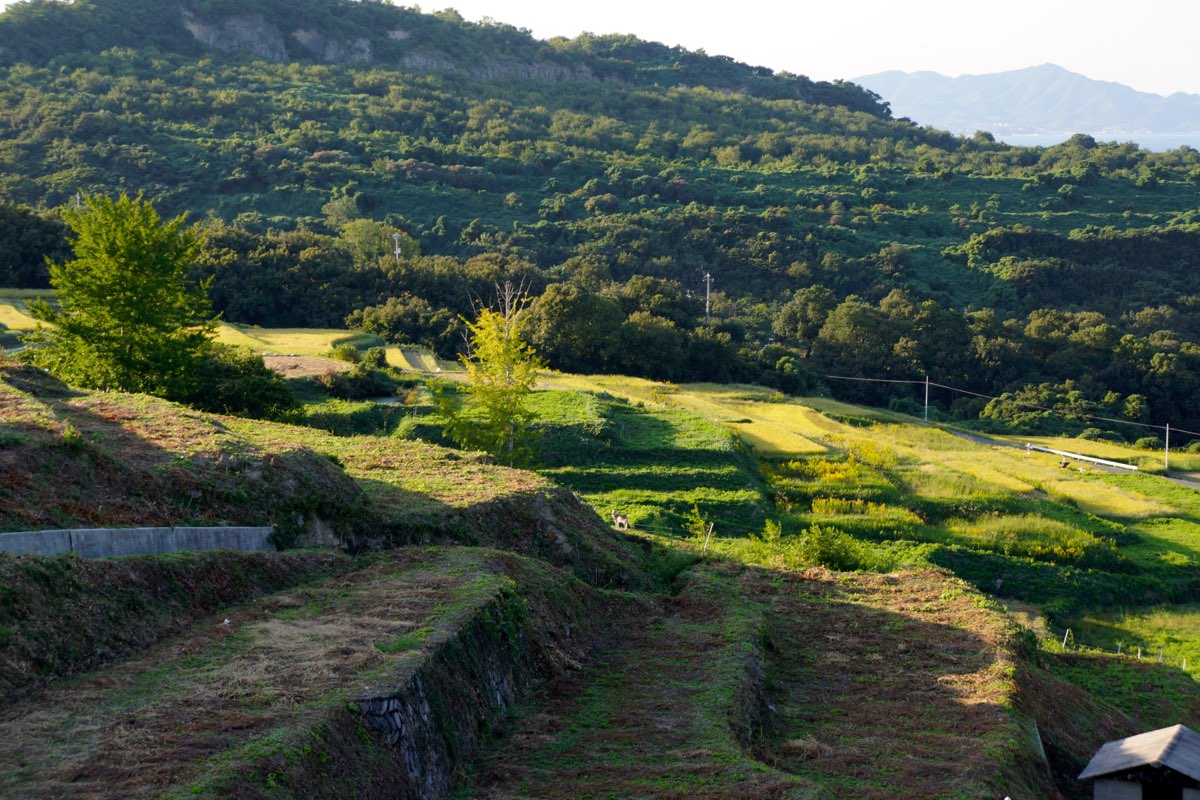
On Teshima, the Teshima Art Museum by the artist Rei Naito and the architect Ryue Nishizawa stands on a hill at Karato. Terraced rice fields that had been left unused were restored with local residents, and a building shaped like a drop of water was placed on the site.
Inside, a "spring" comes into being throughout the day. Entry is by timed reservation.
On Inujima, which belongs to Okayama City, the Inujima Seirensho Art Museum preserves and reuses the remains of a copper refinery. The refinery was built with local capital in 1909 and closed after only ten years when copper prices crashed. The museum is closed every day from December to February.
On Ōshima, the sanatorium's Social Exchange Hall, fully opened in April 2019, has three exhibition rooms and a library. The island can be reached only by the government boat from Takamatsu Port, and using the hall requires advance application.
Check each official website for opening days and reservations before visiting.
Sources
- 瀬戸内国際芸術祭2010 総括報告Setouchi Triennale Executive Committee (chaired by the Governor of Kagawa)
- 瀬戸内国際芸術祭とはSetouchi Triennale Executive Committee
- ベネッセアートサイト直島の歴史Benesse Art Site Naoshima (Fukutake Foundation / Benesse Holdings)
- 地中美術館Benesse Art Site Naoshima (Fukutake Foundation)
- 豊島美術館Benesse Art Site Naoshima (Fukutake Foundation)
- 犬島精錬所美術館Benesse Art Site Naoshima (Fukutake Foundation)
- 瀬戸内国際芸術祭 公式サイト(トップページ)Setouchi Triennale Executive Committee
- 公害紛争処理における調停機能の活用(豊島産業廃棄物水質汚濁被害等調停申請事件)Environmental Dispute Coordination Commission, Ministry of Internal Affairs and Communications
- 産廃特措法に基づき特定支障除去等事業を実施又は実施を予定している事案について(香川県豊島事案)Ministry of the Environment
- 園長挨拶(国立療養所大島青松園)National Sanatorium Ōshima Seishōen (Ministry of Health, Labour and Welfare)
- 概況(国立療養所大島青松園)National Sanatorium Ōshima Seishōen (Ministry of Health, Labour and Welfare)
- ハンセン病問題の早期かつ全面的解決に向けての内閣総理大臣談話(平成13年5月25日 閣議決定)Ministry of Health, Labour and Welfare
- 豊島廃棄物等処理事業報告書(第1編〜第3編)Kagawa Prefecture
- 大島青松園社会交流会館National Sanatorium Ōshima Seishōen Social Exchange Hall
- ご利用案内(大島青松園社会交流会館)National Sanatorium Ōshima Seishōen Social Exchange Hall