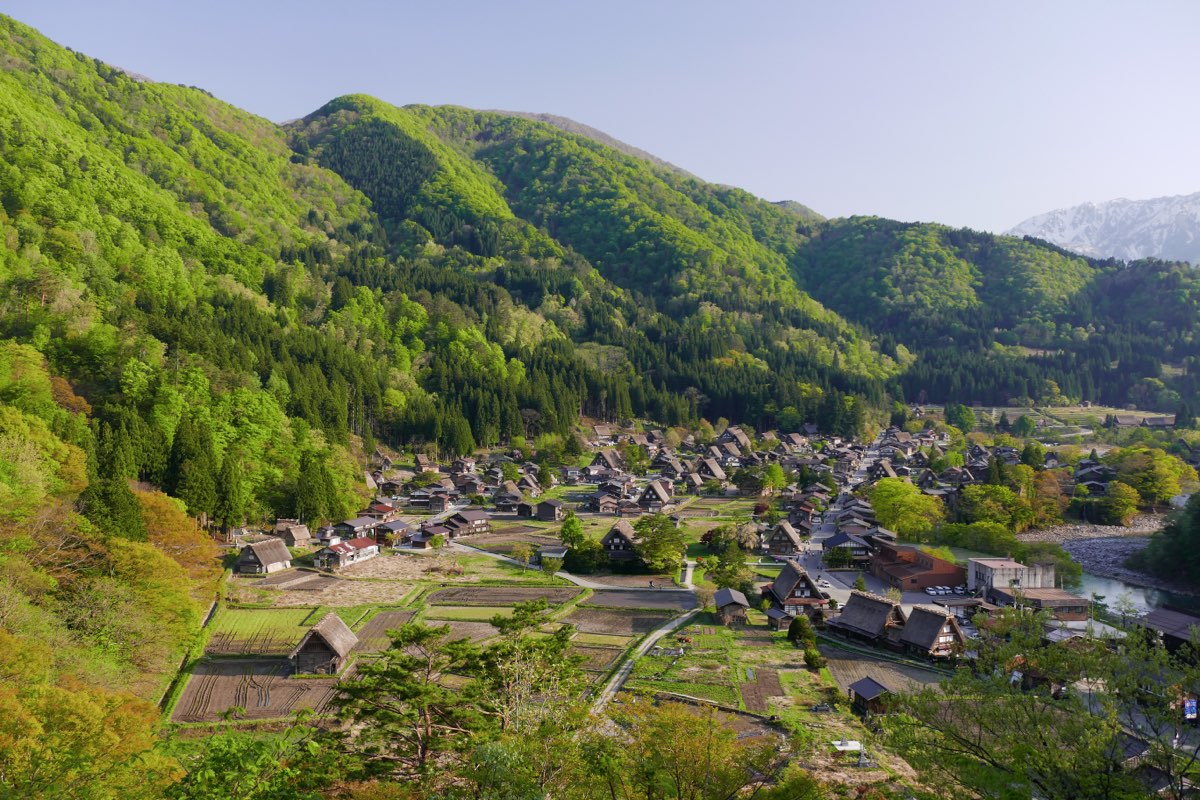
In the steep valleys of the Shō River, on the border of Gifu and Toyama prefectures, three villages keep large farmhouses with steep thatched roofs. Ogimachi lies in Shirakawa, Gifu; Ainokura and Suganuma lie in the Gokayama area of Nanto, Toyama. Together they were inscribed on the World Heritage List in December 1995 as the Historic Villages of Shirakawa-go and Gokayama.
People still live in all three villages. This article looks at how the houses grew out of a mountain way of life, how residents keep their roofs, and how the villages came to be protected.
A remote, snowy valley
The Agency for Cultural Affairs' statement of the property's value describes the area as long regarded as remote and hard to reach, in valleys surrounded by steep mountains. According to Shirakawa Village, 96 percent of its land is forest and only 0.4 percent is farmland.
Snow falls from December to March, usually piling up two to three meters, with a record of 4.5 meters. The village says Shirakawa-go has been described as an "isolated island," partly because snow could cut its links with neighboring areas.
The name Shirakawa-go, the village says, first appears clearly around 1176, in the diary of an aristocrat in Kyoto. According to the Agency for Cultural Affairs, Shirakawa-go was ruled directly by the Edo shogunate from the late seventeenth century. A site run by the local tourist association adds that Gokayama belonged to the Kaga domain throughout the Edo period.
Houses built for silk and saltpeter
According to the tourist association's site, there was little flat land and little rice farming. The Agency for Cultural Affairs notes that many residents also felled and carried timber and raised silkworms, and that silkworm work was done in the attics of the houses.
Shirakawa Village dates the first versions of the gasshō style to around 1700, when silk and gunpowder production flourished, and says the form seen today took shape around 1800. In its sheet for the national preservation district, the village writes that the growth of silk farming from the mid-Edo period, and the making of saltpeter (enshō), are said to have encouraged the development of these houses.
Saltpeter was a raw material of black powder. According to the tourist association's site, it was made in pits dug under the floors of the houses, a process that needed wide floor space.
The same site says this is said to have been a main reason for building such large houses. Production stopped in the Meiji era when cheap nitrate began to be imported from Chile.
The Wada House in Ogimachi shows how this trade could bring wealth. According to the village, the Wada family were hereditary village heads and the largest landowners in Ogimachi. They made their fortune in saltpeter and, from the latter half of the 1800s, in silk.
Inside a gasshō-style house
The name gasshō refers to hands pressed together in prayer, which the steep triangular roof is said to resemble. According to the Agency for Cultural Affairs, the roof covers three to five levels. The ground floor is a wide living space, while the upper levels served as attic bedrooms or work spaces.
A large family of dozens of people commonly lived in one house. The village says the attics were divided into two to four layers and used to raise silkworms. Sericulture remained a major industry in Shirakawa-go until the first decades of the twentieth century.
The roof frame is built without nails. Shirakawa Village explains that the timbers are tied with straw rope and with bindings called neso, made from young witch hazel, which tighten as they dry. Diagonal beams brace the roof against wind and earthquakes.
Most houses in Shirakawa-go are built with their gable ends facing north and south, partly to resist the strong winds that blow along the valley. The steep slope stops heavy snow from building up and damaging the house.
Smoke and heat from the sunken hearth, the irori, rise into the attic. The village says the soot makes the wood more resistant to moisture and pests, and the heat helps keep the thatch dry.
Thatching together: yui
A thatched roof wears out and must be replaced, usually every 20 to 30 years. In Shirakawa-go, according to the village, re-thatching has traditionally been a shared task that can bring together up to 200 villagers. This spirit of cooperation, based on strict reciprocity, is called yui.
The owner first calls on neighbors from the same residents' group, or kumi. Each person's contribution, from work and grass to bottles of sake for the closing meal, was written down in a yui-chō. The oldest surviving record dates from 1792.
As of 2023, the village says, re-roofing is usually done by professionals. Villagers still gather at least once a year, usually in spring or autumn, to thatch a roof in the spirit of yui so that the skills are passed on. The village's 2026 sheet notes that local children also take part in yui thatching.
The statement of value adds that traditional mutual aid among residents has kept the thatched roofs in good condition.
From decline to protection
The statement of value notes that the number of gasshō-style houses in each village has decreased. According to Nanto City, the area including Shirakawa-go once had at least 1,850 gasshō-style buildings, and fewer than 200 remain.
According to the village, as Japan's growing economy needed more and more electricity, several dams were built along the Shō River. They brought prosperity to Shirakawa-go but were also seen as a threat to the landscape and to established ways of life. By 1971, the number of gasshō-style houses in Ogimachi had fallen by half.
That year, the residents founded the Shirakawa-mura Ogimachi Natural Environment Preservation Society. It adopted the principles of not selling, renting, or demolishing gasshō-style houses. All residents of Ogimachi are members, and the society meets monthly to consider applications to change houses or their surroundings.
Ogimachi was selected as a national preservation district for groups of traditional buildings on 4 September 1976. The village's 2026 sheet counts 263 conservation repairs in the 48 years after selection.
In Gokayama, Ainokura and Suganuma were designated national historic sites in 1970, and residents formed their own preservation societies in 1967 and 1985. Both villages became preservation districts in 1994. According to Nanto City, Gokayama once had more than 1,500 gasshō-style houses, and only Ainokura and Suganuma still keep a landscape centered on them.
The Agency for Cultural Affairs' statement links the inscription to two criteria. The villages are an outstanding example of traditional settlements adapted to their environment and social and economic circumstances. They also physically reflect their social structure, which survived the rapid economic change in Japan after 1950.
Fire is the main danger. According to the statement, firefighting equipment covers each village and residents have formed fire brigades. Ogimachi's disaster-prevention system centers on 60 water cannons, and Suganuma and Ainokura completed their own systems in 2000 and 2002.
Visiting the villages
The three villages welcome visitors, and they are also home to residents. According to Shirakawa Village, Ogimachi is home to more than 100 families, many living in gasshō-style houses. Nanto City says people still live in traditional houses in Ainokura and Suganuma.
In Ogimachi, the village's official site asks visitors to respect residents' privacy. It asks them not to enter private property or fields, open doors, or look in through windows. Visitors should take their trash home, smoke only in designated places, and never use fireworks or light bonfires.
The village also introduces the Wada House, an Important Cultural Property where most rooms and the attic are open to the public, and the Gasshōzukuri Minkaen, an open-air museum of 25 structures moved to the site.
In Gokayama, the official tourism site asks visitors to keep out of private property, including fields and the space under the eaves. It also asks them to make way for residents' cars and to avoid visiting early in the morning or after dark. Nanto City has built car parks, an observation plaza, and public toilets for visitors.
Check opening times and current rules on the official sites of Shirakawa Village and Gokayama before you go.
Sources
- 白川郷・五箇山の合掌造り集落(文化遺産オンライン 世界遺産)Agency for Cultural Affairs (文化庁, 文化遺産オンライン)
- 白川郷・五箇山の合掌造り集落 顕著な普遍的価値(OUV)の言明Agency for Cultural Affairs (文化庁)
- 白川村荻町(岐阜県)重要伝統的建造物群保存地区 紹介資料Shirakawa Village (published by the Agency for Cultural Affairs)
- 南砺市相倉・南砺市菅沼(富山県)重要伝統的建造物群保存地区 紹介資料Nanto City (published by the Agency for Cultural Affairs)
- Gokayama – UNESCO World Heritage Sites(世界遺産 五箇山)Japan Tourism Agency (観光庁, 地域観光資源の多言語解説文データベース; text by Nanto City)
- What Kind of Place Is Shirakawa-go?Shirakawa Village
- Thatching Roofs and "Yui"Shirakawa Village (text from the Japan Tourism Agency multilingual commentary project)
- Ogimachi Historic DistrictShirakawa Village (text from the Japan Tourism Agency multilingual commentary project)
- Gassho-style HousesShirakawa Village (text from the Japan Tourism Agency multilingual commentary project)
- The Architecture of Gassho-style HousesShirakawa Village (text from the Japan Tourism Agency multilingual commentary project)
- For Those Visiting for the First TimeShirakawa Village
- Gasshozukuri Minkaen Outdoor MuseumShirakawa Village
- Wada HouseShirakawa Village
- 歴史・産業(白川郷・五箇山の合掌造り集落世界遺産センター)Shirakawa-go Tourist Association (白川郷観光協会; site footer "Copyright shirakawa-go.gr")
- Gokayama & World HeritageGokayama Tourist Information Center (五箇山総合案内所)