Sunpu is the old name of what is now Shizuoka City. Early in the Edo period, Tokugawa Ieyasu retired there after handing the title of shogun to his son.
According to Shizuoka Prefecture, his leading retainers, scholars, and wealthy merchants came with him, and this had a great influence on the culture of the region. This article follows Ieyasu's ties to Sunpu, the castle and town he rebuilt, and what can be seen there today.
A town Ieyasu knew from childhood
Shizuoka City records that in the Muromachi period Imagawa Noriku was appointed shugo (military governor) of Suruga Province, and the Imagawa family's residence is thought to have stood around the site of the later castle from that time.
Ieyasu, then called Matsudaira Takechiyo, came to Sunpu as a boy. From 1549 (Tenbun 18) he lived there for twelve years, until the age of nineteen, as a hostage of the Imagawa family.
During those years he received teaching from Taigen Sessai, head priest of the temple Rinzai-ji, among others. Shizuoka City calls this a very important period in the shaping of Ieyasu's character, and notes that he spent his youth, his middle years, and the end of his life in Sunpu.
The first Sunpu Castle
After Suruga became one of his provinces, Ieyasu began building Sunpu Castle as his residence in 1585 (Tenshō 13). Kunōzan Tōshōgū's chronology records that he moved from Hamamatsu to Sunpu in the twelfth month of 1586 (Tenshō 14).
The castle was completed in 1589 (Tenshō 17), covering the area inside what is now the Ninomaru (second enclosure). The next year Ieyasu was moved to the Kantō region by order of Toyotomi Hideyoshi, and Nakamura Kazuuji, a retainer of the Toyotomi, became lord of the castle.
In 1603 (Keichō 8) Ieyasu was appointed seii taishōgun and opened the Edo shogunate.
The retired shogun returns
In 1605 (Keichō 10) Ieyasu passed the title of shogun to his son Hidetada. According to Shizuoka City, the following year he chose Sunpu as the base for his rule as ōgosho, or retired shogun, and came back.
The city's chronology records that he moved into Sunpu Castle in the seventh month of 1607 (Keichō 12). He extended the old castle, adding a third enclosure (the Sannomaru), laid out the streets of the town, and carried out flood-control work on the Abe River. Shizuoka City says this created the prototype of the center of today's Shizuoka.
Shizuoka City explains that in 1607 Ieyasu ordered daimyo across the country to build it, with three moats ringed by stone walls and, at the northwest of the main enclosure (the Honmaru), a keep said to have had five (or six) roofs and seven floors.
The Honmaru was completed in 1607 but burned in a fire in the twelfth month of that year. Rebuilding began at once: the Honmaru palace was completed in 1608 and the keep in 1610.
A Japan Tourism Agency commentary explains that many daimyo sent workers to dig the moats and build the walls. The workers carved the crests of their domains and other marks on some of the stones, and the commentary says many of these marks can still be seen.
Ruling from Sunpu
As ōgosho, Ieyasu kept real power over the country in his last years. Shizuoka City says that Sunpu became a center of politics, economy, and culture that surpassed Edo, and describes this as Sunpu's golden age.
In another explanation, the city describes government in this period as conducted in effect from two centers, Sunpu and Edo, and says that Sunpu flourished as a political and economic center.
To make the shogunate secure, Ieyasu enacted laws such as the Buke shohatto (Laws for the Military Houses) and the Kinchū narabini kuge shohatto (Laws for the Imperial Court and Nobility). According to Shizuoka City, he also conducted diplomacy at Sunpu Castle, trading with Asian countries and with the Netherlands, Spain, and England.
Kunōzan Tōshōgū's chronology gives examples. In 1609 Ieyasu received an envoy of the Dutch king at Sunpu Castle and permitted trade, and in 1613 he did the same for an envoy of the English king.
In the seventh month of 1611 he received an envoy sent in return by King Philip III of Spain at Sunpu Castle and was presented with gifts that included a Western clock. The shrine records that this clock is now part of a group of materials related to Ieyasu designated as Important Cultural Properties.
Death and Kunōzan
According to Kunōzan Tōshōgū, Ieyasu fell ill at Tanaka on the twenty-first day of the first month of 1616 (Genna 2) and returned to Sunpu Castle for treatment. He died there on the seventeenth day of the fourth month, at the age of seventy-five.
The shrine cites a diary, the Honkō Kokushi nikki, for his instructions about what should happen after his death. His body was to be buried at Kunōzan in Suruga, his funeral held at Zōjōji in Edo, his memorial tablet placed at Daijuji in Mikawa, and, after the first anniversary, a small hall built on Mount Nikkō in Shimotsuke to enshrine him.
Following these instructions his remains were buried at Kunōzan, and a shrine was founded there on the orders of the second shogun, Hidetada. The shrine calls itself the origin of all the Tōshōgū shrines dedicated to Ieyasu.
The shrine's chronology records that its buildings were completed in the twelfth month of 1617 (Genna 3). The shrine buildings, in the gongen-zukuri style, fully lacquered and richly colored, were built nineteen years before those of Nikkō Tōshōgū and are designated a National Treasure.
After Ieyasu's death, Hidetada's son Tadanaga became lord in 1624 but was ordered into confinement in 1631, and from then until the end of the Edo period the castle was run by appointed wardens.
A fire in 1635 (Kan'ei 12) destroyed the keep and most of the other buildings. The palace, turrets, and gates were rebuilt by 1638, but the keep was never rebuilt.
In 1869 (Meiji 2) the name "Suruga Fuchū" was changed to "Shizuoka." In 1896 the castle site was given to the Army; the upper part of the remaining keep base was demolished and its soil used to fill the moat around the Honmaru.
Visiting today
Shizuoka City acquired the castle site in 1949, and the Honmaru and Ninomaru became a park. Named Sunpu Park in 1951, it was renamed Sunpu Castle Park in 2012.
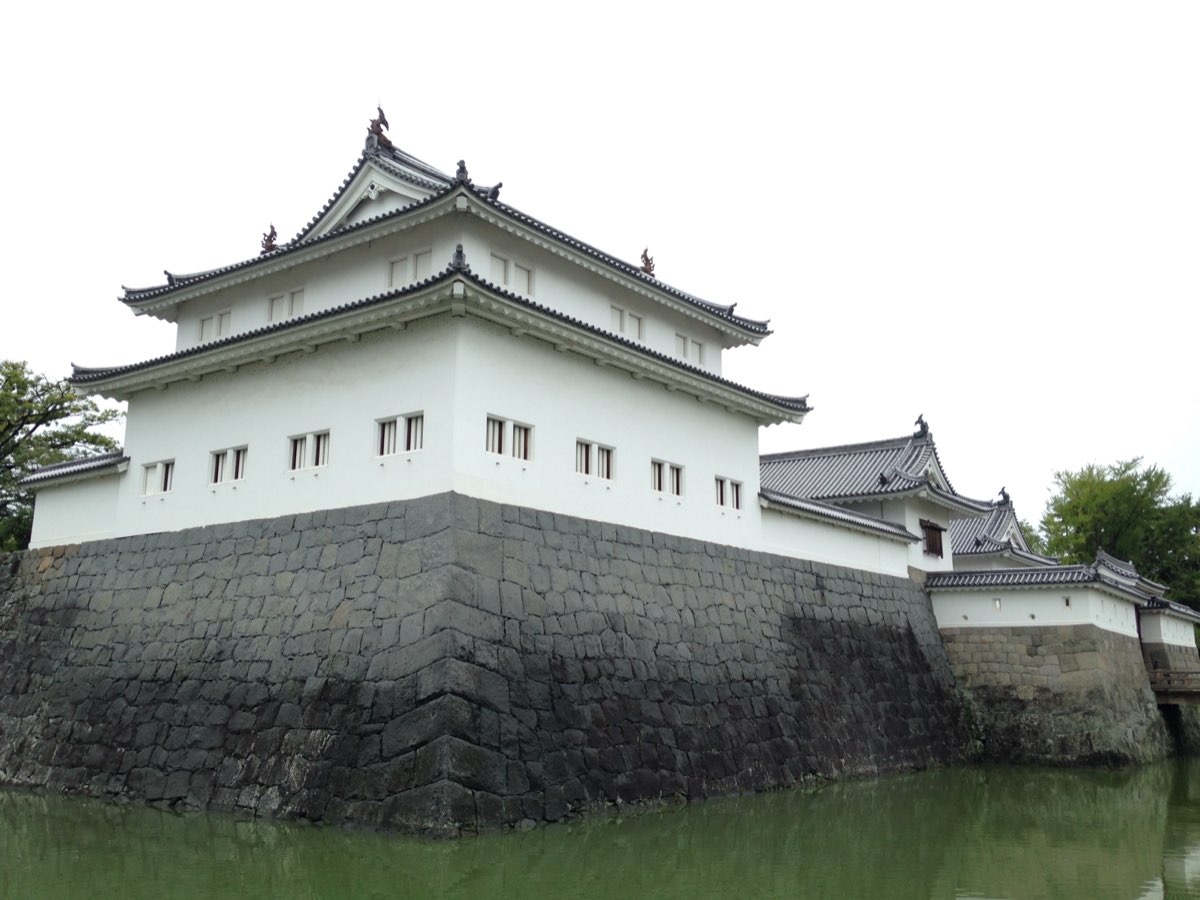
Several castle buildings have been reconstructed: the Tatsumi-yagura turret in 1989, the Higashi-gomon gate in 1996, and the Hitsujisaru-yagura turret in 2014. The city notes that the Tatsumi-yagura has an L-shaped plan, which it says is rare among castle turrets in Japan.
Inside the Higashi-gomon and Tatsumi-yagura are finds excavated in the park and a reconstruction of the room at Rinzai-ji where the young Ieyasu is said to have studied with Taigen Sessai. The park also has a bronze statue of Ieyasu as the retired shogun, and part of the Honmaru moat has been excavated and reproduced.
The city excavated the keep base from 2016 to 2020 and found the foundations of both the earlier keep and Ieyasu's larger one. The Japan Tourism Agency commentary describes the base as the largest keep foundation ever built in Japan. The viewing area and information hall at the excavation site closed on December 26, 2025, for the construction of a new facility.
Kunōzan Tōshōgū stands on Kunōzan, which the shrine gives as 216 meters high, overlooking Suruga Bay. Its museum holds more than 2,000 cultural properties related to Ieyasu and the Tokugawa shoguns. The shrine can be reached by the Nihondaira Ropeway or on foot from the base of the mountain.
Please check the official websites of Sunpu Castle Park and Kunōzan Tōshōgū for opening times and admission before visiting.
Sources
- 県の歴史と昔話Shizuoka Prefecture
- 徳川家康と駿府(駿府城公園公式サイト)Shizuoka City (Sunpu Castle Park official website)
- 駿府城公園の歴史(駿府城公園公式サイト)Shizuoka City (Sunpu Castle Park official website)
- Sumpu Castle Park (English page)Shizuoka City (Sunpu Castle Park official website)
- 東御門・巽櫓(駿府城公園公式サイト)Shizuoka City (Sunpu Castle Park official website)
- 駿府城跡・駿府城跡天守台発掘調査Shizuoka City
- Foundation of Sumpu Castle's Main Tower(駿府城天守台跡の石垣)Japan Tourism Agency (multilingual commentary, published on the Shizuoka City website)
- 久能山東照宮(公式サイト トップページ)Kunozan Toshogu
- 久能山の歴史(久能山東照宮)Kunozan Toshogu
- 徳川家康公について(久能山東照宮)Kunozan Toshogu