Rising above the Toyama Plain, Tateyama has been a focus of religious devotion since ancient times. Its highest point reaches 3,015 meters. Strictly speaking, there is no single peak called Tateyama: today the name usually refers to three summits, Oyama, Ōnanjiyama and Fuji-no-Oritate.
From the late medieval period, according to Toyama Prefecture's Board of Education, the faith centred on this mountain flourished and drew pilgrims from all over Japan. The board ranks it alongside the faiths of Mount Fuji and Hakusan. This article follows that story through the ritual objects, paintings and villages that served them.
A mountain of the dead, a mountain of hell
Toyama Prefecture's plan for the Tateyama Museum says the mountain was long thought of as a place where the souls of the dead go. It is said to have been a sacred site for mountain ascetics by the Heian period at the latest. The plan states that in the Heian period people believed there was a "hell" on Tateyama, and the mountain appears as a mountain of hell in the Konjaku Monogatarishū, a collection of tales from that period.
The plan links that belief to the mountain's strange, barren landscape. Places there were given names such as Jigokudani, "Hell Valley," and Gaki no Tanbo, the "rice paddies of hungry ghosts," the name for the ponds dotting the Midagahara plateau.
The plan describes Tateyama faith as a mountain religion formed by combining nature worship, Shinto and Buddhism. Its main elements include the founding of the mountain, symbolic death and rebirth, and ideas of hell linked to the landscape. Tateyama was said to be a mountain where hell and the Pure Land exist side by side.
Climbing the mountain was believed to let pilgrims experience death and rebirth. The plan calls this climb, known as zenjō tohai, the central ritual of Tateyama faith, through which people were saved from falling into hell.
A founding legend
How the mountain was "opened" is told in a legend. According to a Tateyama Town text in the Japan Tourism Agency's database, Saeki Ariyori, son of the local governor, was led into the mountains by a white hawk.
He shot an arrow into a black bear, then found the bear in a cave near the summit, where it turned into the Amida Buddha and urged him to take up ascetic practice. Tradition dates this to the year 701.
This is a religious tradition, not an event that can be dated by independent evidence. Physical finds, however, suggest early activity on the peaks.
In 1907, a party led by Shibasaki Yoshitarō, a surveyor of the army's Land Survey Department, reached the summit of Mount Tsurugi, believed to be unclimbed, and found a bronze staff finial and an iron sword. Both are estimated to date from the Heian period, although much about the sword remains unclear.
The prefecture's plan considers the finial a sign that ascetics were already climbing Mount Tsurugi in ancient times. The Tateyama Town text adds that bronze finds around the summit suggest Tateyama may have been a training ground as early as the eighth century.
Lodging villages and painted mandalas
According to the Tateyama Town text, the pilgrimage began to attract many more people in the 1600s. Dozens of pilgrim lodges, called shukubō, were set up in the villages of Ashikuraji and Iwakuraji at the foot of the mountain. In the 1800s, up to 6,000 pilgrims are thought to have climbed in a single season.
Ashikuraji stands on a river terrace about 400 meters above sea level. The prefecture's plan describes it as a village that once had a large group of halls and 33 lodges. The 33 lodge households and five shrine households formed a self-governing body called the Issan.
The lodge masters of Ashikuraji spread the faith with Tateyama mandalas, paintings that showed its world in detail. Each lodge had its own territory of supporters in distant regions. The master travelled around it, using the mandala to explain the faith and inviting people to climb Tateyama or to join a ritual for women at Ashikuraji.
Most surviving mandalas show five themes: the founding legend, hell, the Pure Land, the pilgrimage routes with their legends, and that women's ritual. According to the plan, 53 have been identified; the Tateyama Museum owns 13 and holds 15 more on loan or deposit. The Tateyama Town text notes that Edo-period mandalas have been found throughout Japan.
Women and the Nunobashi rite
Tateyama was closed to women. A 2026 flyer from the Tateyama Museum explains that in the Edo period women were taught that, burdened by "five obstacles and three subordinations," they were bound to fall into hell and could hardly reach paradise, and they were not allowed to enter the mountain.
According to the prefecture's Board of Education, under this ban women's religious groups were permitted to worship as far as the hall at Ashikuraji. Their clothing is among the ritual objects preserved today.
In place of the climb, a ritual for women's salvation called the Nunobashi Kanjō-e developed at Ashikuraji. The prefecture's plan says it was established there in the later Edo period.
Women in white clothing, blindfolded, first confessed at the Enma Hall. They then crossed the Nunobashi bridge over white cloth laid in three rows, donated by the Kaga domain and by believers.
At the Uba Hall on the far side, they received a kechimyaku certificate that was believed to promise rebirth in the Pure Land. The bridge was regarded as linking this world and the next. The museum's flyer says the rite is said to have been held every year on the middle day of the autumn equinox week.
The Uba Hall honoured the Uba-son, described in the plan as an earth-mother deity and a deity of women's salvation. Faith in the Uba-son was centred on saving women from hell.
Change and revival
After the Meiji Restoration of 1868, according to the Tateyama Town text, the ban on women entering Tateyama was abolished. Many beliefs combining Shinto and Buddhism were set aside, and the places of worship on the mountain became Shinto shrines.
The prefecture's plan says the Nunobashi Kanjō-e stopped in the early Meiji period under the influence of the movement against Buddhism. The Uba Hall itself was torn down during that movement.
In 1996, the museum worked with the people of Ashikuraji and Tateyama Town to re-enact the rite for the National Cultural Festival, the first time in about 130 years. From 2011 it has been held every three years with participants from across Japan. It was postponed in 2020 because of COVID-19 and held in September 2022 without spectators.
Other customs continue. Each year on March 13, the robes of the Uba-son statues are sewn and changed, a custom continued since the Edo period. The prefecture has designated it an Intangible Folk Cultural Property, and according to the plan it is now led by officers of the village women's association.
The ritual objects of the faith have also been protected. In 1970, 1,083 objects from Ashikuraji, including pilgrims' and ascetics' clothing, items used to host pilgrims, and the garments of women's groups, were designated as Important Folk Materials (today Important Tangible Folk Cultural Property). In 2020, 160 more were added, bringing the total to 1,243.
Visiting today
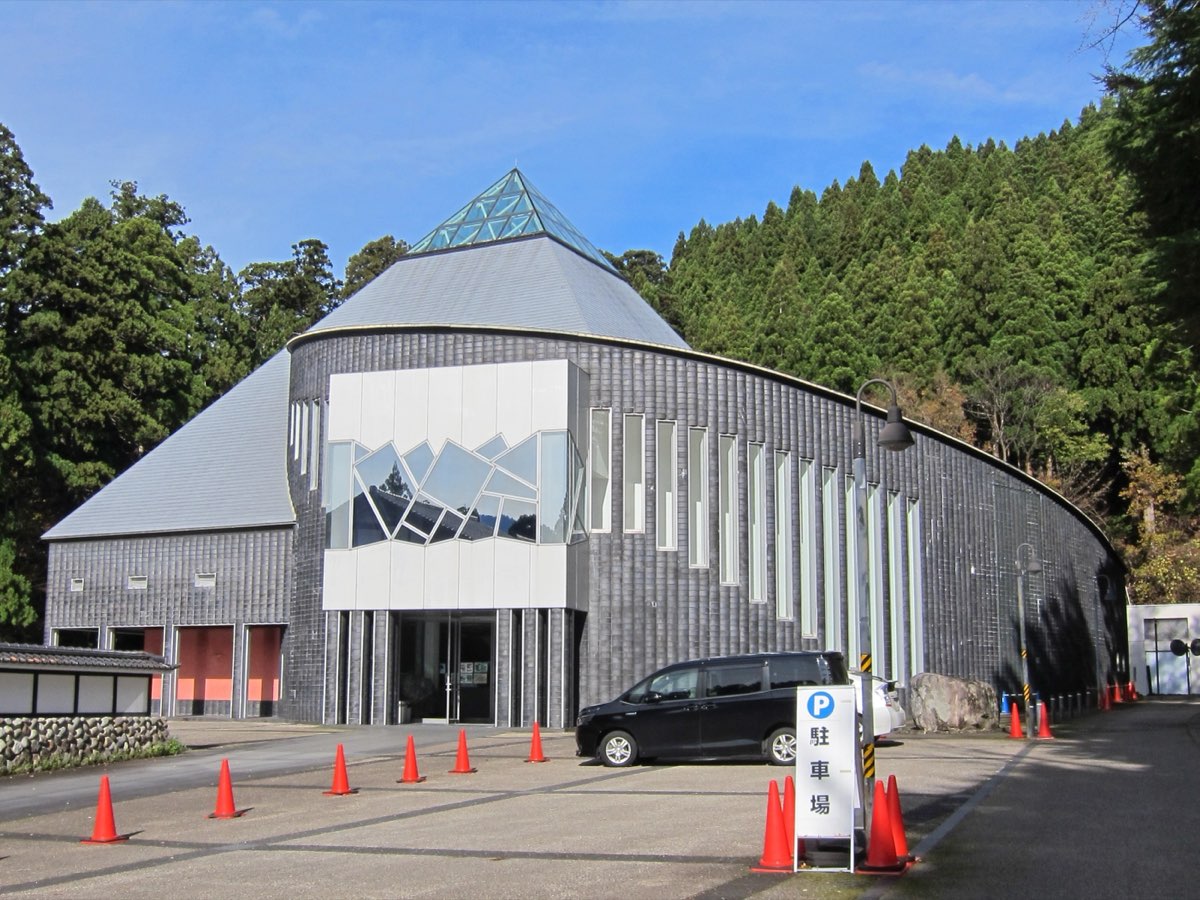
The Toyama Prefectural Tateyama Museum stands in Ashikuraji, which the plan describes as once one of the base villages of the faith. It opened in November 1991 and studies the relationship between people and nature at Tateyama. Its grounds, about 13 hectares, include an exhibition hall, the outdoor Mandala Yūen and Kyōsanbō, a late-Edo lodge building.
Around the museum, the plan says, the village still has the Ashikura Chūgū Kiganden prayer hall of Oyama Shrine, the Enma Hall, the reconstructed Nunobashi bridge and Uba Hall platform, many stone Buddhas, and two former lodge buildings.
According to the museum's flyer, a commemorative exhibition was scheduled from June 30 to September 27, 2026, timed with a Nunobashi Kanjō-e planned for that September. Exhibitions, opening days and the dates of the rite change, so check the museum's official information before you go.
Sources
- 立山博物館を中核とした文化観光拠点計画 ~昨日と違うわたしに出会う、霊山立山 "こころ"の旅~Toyama Prefecture (plan published by the Agency for Cultural Affairs)
- 立山信仰用具富山県教育委員会・とやま学遊ネット
- 令和8年度 布橋灌頂会開催記念展(チラシ)富山県[立山博物館](Tateyama Museum of Toyama, Toyama Prefecture)
- The Tateyama Faith (Japan Tourism Agency multilingual commentary database)立山町多言語解説協議会 (tateyamamachi tagengo kaisetsu kyogikai), published in the Japan Tourism Agency multilingual commentary database
- Tateyama Mandalas (Japan Tourism Agency multilingual commentary database)立山町多言語解説協議会 (tateyamamachi tagengo kaisetsu kyogikai), published in the Japan Tourism Agency multilingual commentary database