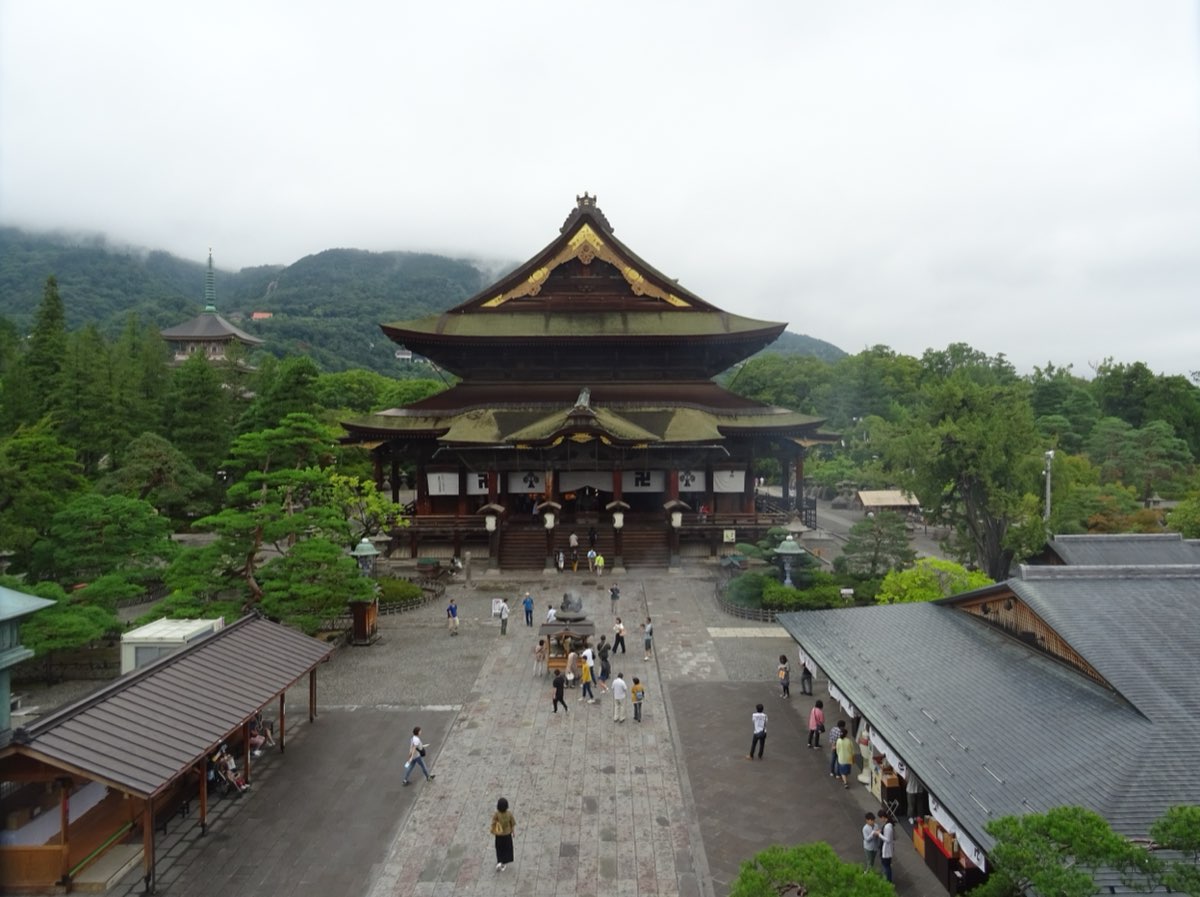
Zenkōji is a Buddhist temple in the Motoyoshi-chō district of Nagano City. Its principal image is a triad of Amida Buddha with two attendant bodhisattvas sharing a single halo. The temple describes itself as belonging to no single Buddhist school and as known across Japan for accepting all people.
Nagano City says that Zenkōji and its gate town have long been a centre of faith, loved by people from all over the country. This article follows how that happened, keeping apart what the temple's founding legend tells and what documents and excavations show.
A founding legend and early evidence
The temple's founding story comes from the Zenkōji engi, its traditional account of origins. According to that account, the image travelled from India to the Korean kingdom of Paekche and reached Japan in 552, when Buddhism was introduced. During the dispute over whether to accept the new religion, the Mononobe clan, who opposed Buddhism, threw it into the Horie canal in Naniwa.
In the same account, Honda Yoshimitsu, who had gone to the capital as an attendant of the governor of Shinano, brought the image to Shinano. It was first enshrined in what is now Iida City and moved to the present site in 642.
In 644 temple buildings were raised at the emperor's wish and named Zenkōji after Yoshimitsu. These are the temple's traditions, not dated history.
The temple itself says that no records of its earliest period survive. Roof tiles found in the precinct in 1924 and 1952 are in the Hakuhō-period style of Kawara-dera, and according to the temple they show that a temple of considerable size stood here by about the late 7th century.
The temple adds that the Iroha jiruishō, a dictionary compiled in the late 12th century, contains material showing that by the mid-8th century the image was known in the capital as the oldest sacred image in Japan. The principal image has been kept as an absolute hidden image since 654, according to the temple, and no one may see it.
Faith spreads in the medieval period
The temple says that Pure Land belief flourished among the court nobility in the late 10th century. With its rise, according to the temple, wandering monks called Zenkōji hijiri carried copies of the image on their backs. They recited the founding story and spread Zenkōji faith among ordinary people as they travelled.
According to Nagano City, the temple had burned in 1179 and was rebuilt under the protection of the Kamakura shogunate. Copies of the Zenkōji image became popular, and by the late Kamakura period "new Zenkōji" temples had been founded in many parts of Japan, spreading the faith nationwide.
According to the city, roads to the temple developed as pilgrims increased. Two illustrated scrolls about the monk Ippen and his followers, the Ippen hijiri-e (1299) and the Yugyō shōnin eden (made by 1307), show the temple rebuilt in the Bun'ei era and the bustle in front of its gate.
The city says that the people who lived by the gate included carpenters, Buddhist sculptors, painters, yūjo (women entertainers), lute-playing monks (biwa hōshi) and monks who explained religious pictures. In the Muromachi period, Zenkōji faith was combined with the cults of Togakushi and Iizuna and drew many pilgrims. The temple adds that Shinran and Ippen, founders of Buddhist schools, also visited.
The temple also says that Minamoto no Yoritomo and the Hōjō family were devoted to Zenkōji and donated buildings and land. The present maedachi honzon, the "stand-in" image that represents the hidden one, is said to have been made in the Kamakura period.
The image leaves Shinano
The temple calls the Sengoku (Warring States) period an age when its image "wandered". The plain around today's Nagano City was where Takeda Shingen and Uesugi Kenshin fought the battles of Kawanakajima. In 1555, by the temple's account, Takeda moved the image, the temple treasures and the monks to Kōfu.
After the Takeda fell, the temple says, the image passed to the Oda and Tokugawa, and finally Toyotomi Hideyoshi enshrined it at Hōkōji in Kyoto. The temple tells that shortly before Hideyoshi's death the Buddha appeared at his bedside and asked to return to Shinano. In 1598 the image came back to Zenkōji after more than forty years away.
The temple says that the temple and the whole gate town fell into decline during these wars. After the Edo shogunate was founded, Tokugawa Ieyasu granted temple lands of 1,000 koku, and Zenkōji gradually recovered.
Fires, travelling showings and the 1707 main hall
Nagano City writes that Zenkōji burned many times through lightning and fire. A temporary main hall was put up in 1666, and a full rebuilding plan began in 1692. To pay for it, the temple held showings of its sacred image in Edo, Kyoto and Osaka, all of them very crowded.
In 1700 a fire spreading from the town destroyed the hall under construction and the timber gathered for it. The city says the shogunate then stepped in. From 1701 to 1706 (six years) a kaikoku kaichō, a showing that toured the whole country, raised the money, and the new main hall was completed in 1707.
The temple describes the same tour as five years of showings across Japan that collected more than 20,000 ryō in donations. Its special Gokaichō website adds that the tour lasted five years and six months and went from present-day Aomori in the north to Kagoshima in the south.
The 1707 hall was designated a National Treasure in 1953. According to the temple, it is about 27 metres high, about 24 metres wide and about 54 metres deep, which the temple calls among the largest wooden National Treasure buildings in eastern Japan.
Pilgrims, women and the lodging temples
Nagano City says that Zenkōji faith reached ordinary people everywhere through the Genroku and Hōei touring showings, where crowds gathered with great enthusiasm. After that, the number of men and women making the pilgrimage grew, and the city calls the large share of women a notable feature of the Zenkōji pilgrimage.
According to the city, every road into Shinano became a "Zenkōji road", with signposts pointing to the temple. The temple says it was known for teaching that anyone who prays with the nenbutsu will be led to the Pure Land, whatever their sex or status. That is why, it explains, so many pilgrims were women.
A story the temple tells, "Led by a cow to Zenkōji pilgrimage", makes the same point. In it, an old woman with a mean heart chases a cow that has caught her cloth on its horns all the way to Zenkōji.
There she awakens to faith; the cow, she later realises, was the bodhisattva Kannon. The temple explains that its text is a modern rendering of words on a late Edo-period print.
The city adds that showings at the temple itself were held 15 times in the Edo period, each more crowded than the last. The sub-temples lodged pilgrims, guided them through the halls and organised Zenkōji-kō pilgrim associations across the country. By about the Meiwa era (1764–1772), the home districts of these supporters were assigned to the sub-temples by county.
In modern times, the temple says, visitors increased as transport developed, and today about six million people come each year (temple website, as of October 2026). Its special Gokaichō website adds that the Gokaichō has been held once every seven years since 1882, and that the 2015 Gokaichō welcomed 7.07 million visitors.
Visiting Zenkōji today
The temple describes the okaidan-meguri inside the 1707 main hall: a walk through a pitch-dark corridor beneath the altar to touch the "key to paradise". The temple says the climb to the upper floor of the Sanmon gate (1750) has been open again since 2008. The sutra hall (1759), an Important Cultural Property, holds a revolving sutra case.
According to the temple, there are 39 lodging temples (shukubō) around Zenkōji, and visitors who come to worship can stay in them by reservation. Nagano City counts 25 of them under Daikanjin, the Tendai head temple, and 14 under Daihongan, the Jōdo head temple. The city says most of their buildings burned in a large fire in 1891 and were rebuilt afterwards.
The maedachi honzon can be seen in the main hall only at the Gokaichō, held once every seven years. The temple's special Gokaichō website says that the next one is planned for 2027 (Reiwa 9) and will last 77 days, with the opening ceremony on 4 April and the closing ceremony on 19 June (as of October 2026). The permanent exhibition of the Nagano City Museum includes a corner on Zenkōji and its faith.
Hours, fees and event dates can change, so check the official websites of Zenkōji and the Nagano City Museum before you visit.
Sources
- 第2章 長野市の歴史的風致形成の背景Nagano City
- 常設展示・善光寺信仰Nagano City Museum
- 善光寺について(善光寺の紹介・歴史)Zenkōji (善光寺)
- 本堂Zenkōji (善光寺)
- 内々陣Zenkōji (善光寺)
- 主要施設(山門・経蔵ほか)Zenkōji (善光寺)
- 逸話(牛に引かれて善光寺詣り)Zenkōji (善光寺)
- 宿坊のご案内Zenkōji (善光寺)
- 令和9年善光寺前立本尊御開帳特設サイト(トップページ)Zenkōji (善光寺)
- 御開帳について(令和9年善光寺前立本尊御開帳特設サイト)Zenkōji (善光寺)
- 御開帳行事(令和9年善光寺前立本尊御開帳特設サイト)Zenkōji (善光寺)